

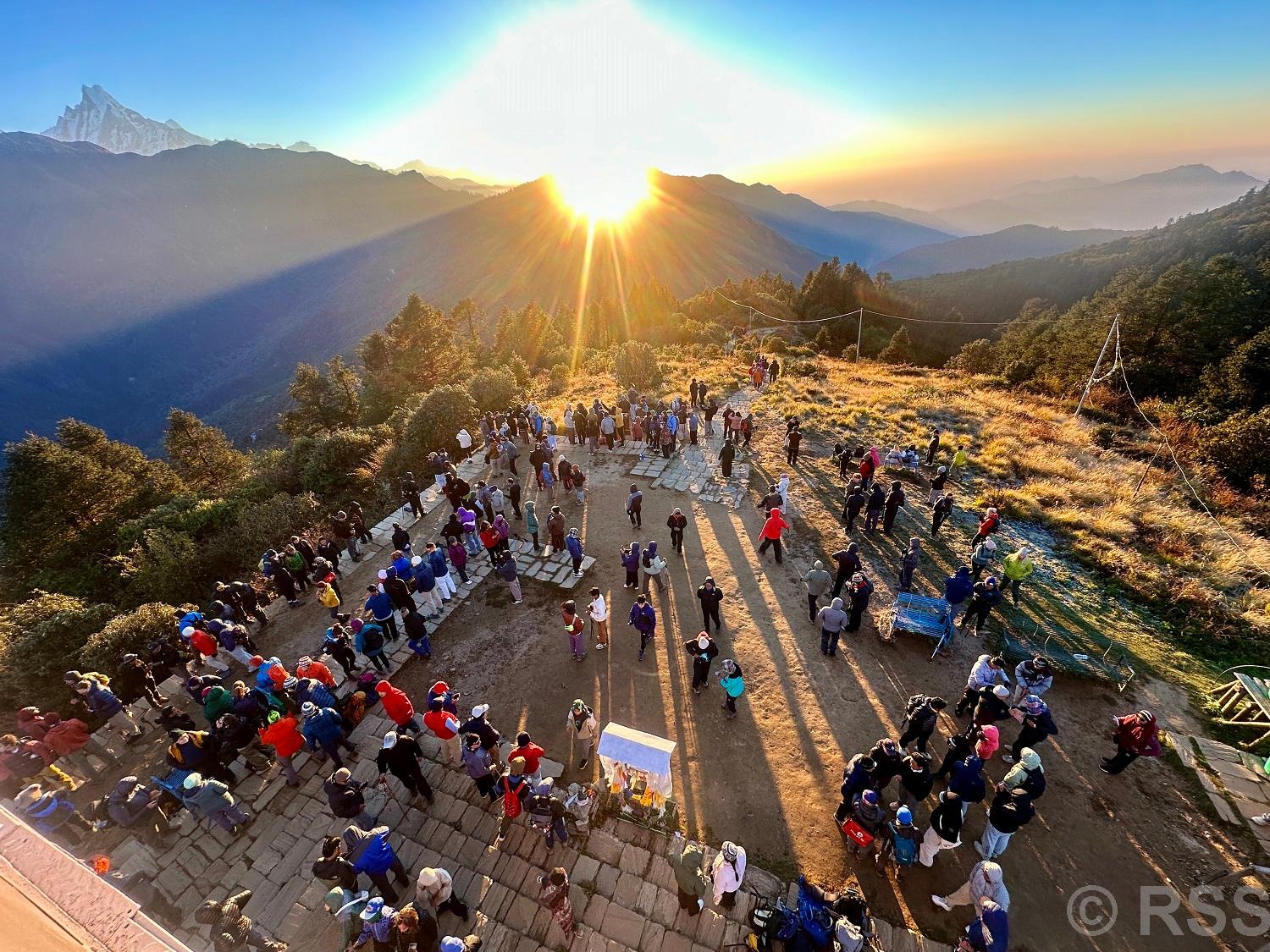
Myagdi. As Lali climbs to the eastern horizon, Punhil’s Takura starts filling up with tourists. Some are carrying cameras, some are busy capturing the scene on their mobile phones. The mountains gradually open up with the chirping of birds. When the first rays of the sun fall on the snow peaks, the white snow ranges shine in golden color. This unique view of nature makes tourists mesmerized.
After the end of the monsoon, with the clear blue sky, undulating mountains and cold weather, the activity of tourists has increased in Ghodepani-Punhill located in Annapurna Rural Municipality-6 of Myagdi. This destination has started to be chosen by domestic and foreign tourists who want to celebrate Dasaantihar holidays and enjoy nature.
Dam Bahadur Pun, the former chairman of Annapurna Rural Municipality, who is also a hotelier of Ghodepani, said that Ghodepani Punhill, which became deserted before Dasain, has seen an increase in the number of guests in recent days.
“Because of the disaster, it was deserted in the month of October”, he said.
Santosh Baral, who came to visit from Pokhara, said that he was fascinated by the natural beauty of Ghodepani-Punhill. He said that he was able to spend some time away from the busy daily life of the city and enjoy the mountains, forests and peaceful environment. There has been an increase in the trend of using festival holidays for travel and new experiences.
Punhill, at a height of 3,210 meters above sea level, is the main attraction of Ghodepani. From here one can see more than 15 Himalayan peaks including Dhaulagiri, Annapurna, Nilgiri, Gurja, Manapathi, Machhapuchhre, Manaslu and Barah peak. Suresh Pun, a local businessman, said that when the weather clears, the snow chains spread far and wide appear as if standing before the eyes.
Along with the sunrise, tourists also come here for sunset and mountain views. After watching the sunrise at Punhil in the morning, tourists return to Ghodepani and observe the surrounding forests, villages and natural resources. Rosi Shrestha from Pokhara said that the calm environment and greenery helps to forget the tiredness of travel.
“The sun rising on the mountains in the morning, the snow ranges visible throughout the day and the peaceful atmosphere of nature enticed”, he said, “For nature lovers, Ghodepani-Punhill is suitable for festival vacationers and short trek tourists.”
According to Ghodepani hotelier Teksar Budhuja Pun, hoteliers have become busy with the increase in the number of tourists. Ghodepani has 25 comfortable hotels that can accommodate 1000 people daily. Hotelier Pun said that due to the festive holidays and favorable weather, tourists are expected to increase further in the coming days.
Ghodepani-Punhil on the world famous Annapurna cycle path for trekking tourism is also popular for short treks. You can reach here by trekking from Pokhara to Ulleri via Nayapul of Kaski. Ghodepani can also be reached by road through Pokhrebgar, Ghar and Sikh in Myagdi. Punhil is reached after about half an hour’s walk from Ghodepani.
According to the tourist guide Sundar Banjara, the main attraction here is the mountain view and the sunrise. Tourists are often attracted to Ghodepani-Punhil because many mountains can be seen from one place in favorable weather.
The tourism history of Ghodepani and Punhil is also interesting. Lungtung Hill, which was once a grazing area for local farmers, is now known as Punhill in the world tourism market. Local businessmen say that late Major Tek Bahadur Pun, who retired from the Indian Army, laid the foundation for tourism development by naming this hill. A view point has also been built in Punhil in his memory.
After the Annapurna conservation area was included in the project, the promotion of this area has expanded to the international level. Natural beauty, mountain scenery, biological diversity and local culture are the additional attractions here.
The recent floods and landslides in various areas have affected Nepal’s tourism sector, but the Ghodepani-Punhil, Ghandruk and Annapurna base camp areas have not been directly affected, tourism professionals have said. They say that the real situation of safe destinations should be publicized so as not to spread the message that Nepal’s tourism as a whole is unsafe due to disaster-affected areas.