

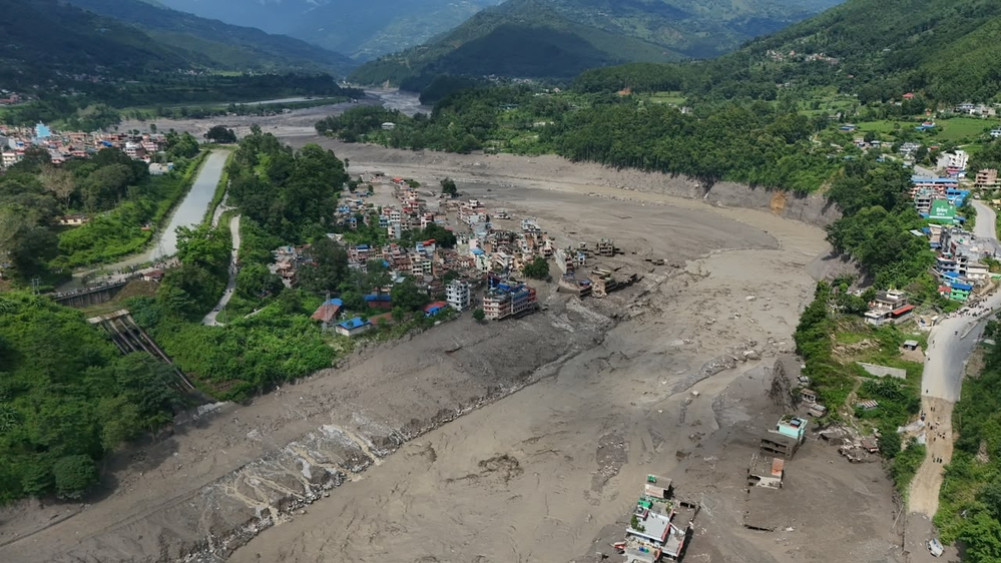
Kathmandu. The disastrous floods that occurred in the Bhotekoshi and Trishuli rivers on August 10th caused huge human and material damage in Rasuwa, Nuwakot, Dhading and other areas. In the history of natural disasters not only in Nepal but also in the world, this disaster can be considered as a special type of unimaginable and unexpected event. In this flood, which came at a rate of 188 km per hour, there was an additional flow of 20 million cubic meters or 20 billion liters of water.
The flood that came with water, stones, gegran, rocks caused huge damage to human resources and infrastructure. After the flood, the river level has risen by about eight meters. Due to the flood at a height of about 90 to 150 meters, the surrounding settlements, hydropower projects, roads and arable land have been damaged. This incident has taught us a lot about our future development projects, settlement development and infrastructure construction.
After getting the news of flood in Bhotekoshi, I myself reached the spot and was active in the rescue work. When I heard the news of the flood, I thought that it was a natural disaster, but after reaching the scene, I realized that the situation is very serious. The flow of the river was very fast. Roads, bridges and various structures were damaged. In some places, it was difficult to identify the previous geographical situation. Even more serious was the situation where people were trapped in the tunnels and power houses of various hydroelectric projects.
The family members were eager to know about the condition of their man. In such a situation, it was my responsibility to be there as a representative of the people. People’s representatives should be present in the suffering of the people. It is one of our responsibilities to sit in Parliament to make policies, but when people are in crisis, it is equally important to reach out to them. Wherever you can help with your knowledge, ability or access, it is necessary to be active. But the people’s representatives will not take away the work of the rescue workers. They should perform their role in coordination with the relevant security agencies, technicians and experts.
Especially, when the news came that people were trapped in the tunnels of the hydroelectric project, I could not take it as a matter of general relief. Being an engineer myself, I had some experience in tunnel construction and its structure. Therefore, I thought that if my knowledge and experience can be used in rescue, why should I retreat? After reaching the scene, it was understood that the situation was much more difficult than imagined. The flood had damaged some structures to the extent that they could not be seen. After that, by studying the available map, the condition of the structure, the flow of water and the possible access route, we should think about the rescue options. Everyone involved in the rescue had one goal – to get the trapped people out safely. The contribution made by security personnel, technicians and local common people is unforgettable.
The incident of people getting trapped inside the tunnel was a very sensitive situation. Even if a structure looks damaged from the outside, people’s lives are connected inside it. We had to think one by one about how many people are inside the tunnel, where they can be, what is the condition of water, what is the condition of oxygen.
We have to think about the condition of the tunnel, the water level, possible obstructions, where people might be and possible routes to get there. Remembering the situation of the employees working there and their family members, it felt more pressure. The person involved in the rescue should make a decision based on facts and technology, not on emotions. But with that, every minute was equally important. Emotionally we all wanted to rescue, but proceeding without identifying a technically safe route would have created another risk.
The first challenge in the rescue operation was to make safe access to the scene. Roads, bridges, electricity and communication structures were also affected after the flood. Another challenge was to find out the actual condition of the tunnel. It is not easy to guess from outside where the tunnel is blocked, how much water is there, what is the condition of air and oxygen inside.
Therefore, we had to work by combining the available maps, technical equipment and the experience of the rescue team. A lot of effort had to be made to identify the mouth of the Trishuli-3 ‘A’ tunnel. For that, an attempt was made to get information about the condition of the tunnel by drilling and other works. Later, when it was reported that human voices were heard from inside the tunnel, it became a very promising sign for the rescue team.
My engineering experience helped me understand the technical aspects related to tunnels, structures and geography. A tunnel is not an ordinary structure. Its design, geographical conditions, ventilation system, water drainage, emergency access etc. should be understood. When discussing the map of the tunnel, the condition of the structure and the possible access, it was possible to have a technical point of view.
As I have experience in tunnel construction in the past, I was able to suggest possible options by looking at the available maps and structures, but rescue is not something that anyone can do alone. The coordination of the Nepali Army, Armed Police, local technicians, project staff and other related agencies was very important. My role was to assist wherever technical knowledge was needed and to find solutions wherever possible. Rescue is not possible by the efforts of one person. Nepali army, armed police, local rescue teams, project technicians and staff all need coordination.
Especially hydropower projects are directly affected by natural disasters such as floods and landslides as they are built on the banks of rivers. Having said this, Nepal should not retreat from hydropower development, but now the style of development should be changed. The risk should be included in the design of the project. Infrastructure should be built keeping in mind the behavior of rivers, geography, effects of climate change and possible extreme floods. The incident of Bhotekoshi has given us a lesson that we should not stop development, but develop in a more secure and modern manner.
Hydropower is our great potential, but we cannot proceed without ignoring the risks associated with it. All the hydropower projects affected by this disaster will come back into operation. Dams of some projects have been damaged, some have tunnels, some have problems with power plants. Power plants in Langtang and Chilime have been damaged. The main challenge seems to be how to keep the dam strong.
Risks cannot be ignored while constructing hydropower projects. In my experience, now the tunnel construction standards should be made and implemented. As much as possible, the structures of hydropower projects should be built underground. A safe place can be made by making a separate bunker in the upper part of the power house. It seems that food and communication systems should be built in emergency situations. This incident made us realize that emergency machine tools should be kept ready for rescue.
Such tools can be done collectively by various projects. The main thing is that when building dams or other structures of hydropower projects, attention should be paid to protect them from disasters such as earthquakes, floods and landslides. Now, from project design to construction, possible extreme floods, geography, climate change and environmental risks should be seriously covered. Stopping development is not the solution. The solution is to develop with a focus on safe, sustainable and risk reduction.
Bhotekoshi flood is not only a natural disaster, it is also a serious test for Nepal’s disaster management system. The biggest lesson is to prepare before disaster strikes. Rescue planning should not be done only after the disaster, risk forecasting, early warning system, emergency access route, communication system and rescue equipment should be prepared in advance. Especially in the case of abnormal water flow or flooding in the upper part of the river, a system should be developed to provide immediate information to the lower part.
It can greatly reduce human casualties. After the flood, I have also emphasized the need for early warning system in the direction of making human losses as zero as possible. Amidst the roar of the river and the darkness inside the tunnel, the efforts of the rescue workers make one thing clear – the combination of technology, skilled manpower and human sensitivity is essential during disasters. We are still in a disaster recovery mode. Now this system should be changed. Risk identification, early warning, safe place, rescue equipment, communication system and skilled manpower should be prepared before the disaster. Early warning system is very important especially in the field of river and hydropower projects. If abnormal water flow is observed in the upper area, there should be an arrangement to immediately inform the settlements and projects below.
This disaster has caused great pain to many families. The pain of losing or missing a family member cannot be expressed in words. We must understand how painful every day is for the families of missing persons. Now along with relief and rescue, rehabilitation and reconstruction should also be prioritized. When building a damaged structure, it is not the same as before, but it should be made safer by taking into account future risks.
Bhotekoshi has taught us a harsh lesson – although disasters cannot be prevented, their damage can be greatly reduced through preparedness, technology and effective coordination. Now our attention should be in that direction. Even after the rescue, the government and related agencies cannot be held accountable. Relief, rehabilitation and reconstruction should also be prioritized. Rather than rebuilding the damaged structure, it should be rebuilt in such a way that there is less damage in case of a similar disaster in the future. Besides keeping this incident as a high priority, the government has drawn the attention of the international community. Prime Minister Balen Shah’s speech at the United Nations General Assembly has motivated many countries of the world to help Nepal. As a result, the United Nations Climate Change Disaster Relief Fund has decided to provide 20 million US dollars (about 3 billion rupees) to Nepal for the relief, rehabilitation and reconstruction of flood victims in the Bhotekoshi-Trishuli region.
(The presented idea is based on a conversation between Krishna Adhikari, Head of Articles of RSS, with Sriram Neupane, MP, National Independent Party)