

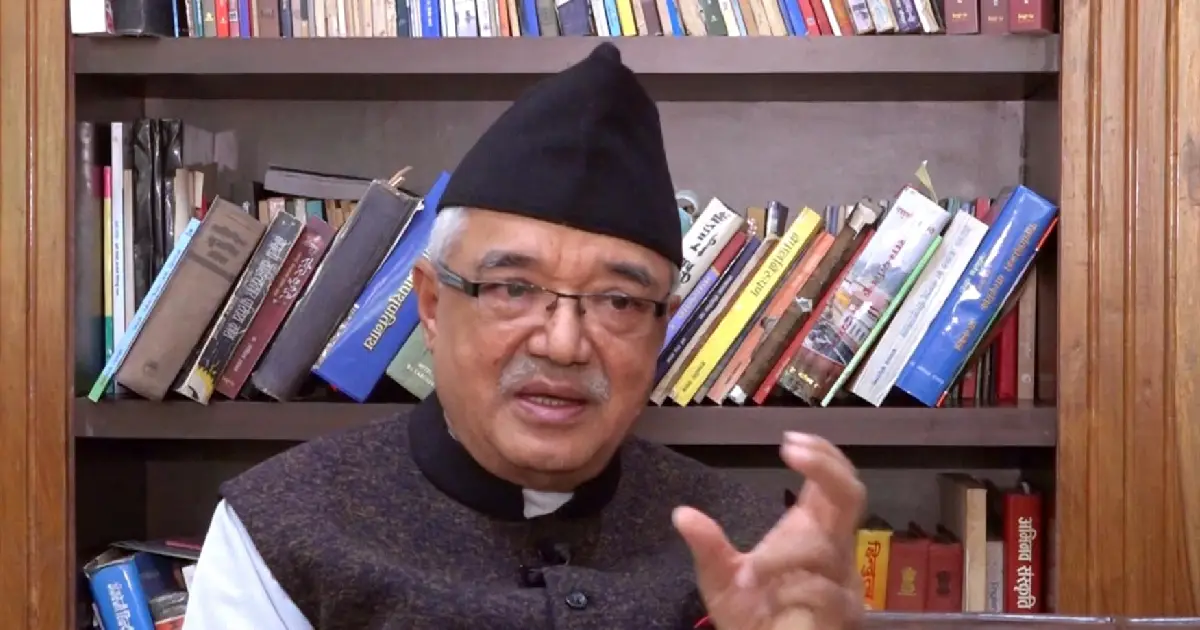
Kathmandu. Dagobind Tandon is an established name in the cultural field of Nepal. Tandon, who has done scholarly research in the cultural studies of the Pashupati region, has headed the Pashupati region development fund twice. Culture expert Tandon, who has also led the Guthi Sansthan Academic Council, is now also the chairman of the Guthi Sansthan Board of Directors. A part of the interview with culture expert Tandon on the cultural side of Dasai is presented here.
How can one understand the religious, cultural and social significance of Dasai? There are various festivals in Nepal throughout the year. Among them, Vijayadashami i.e. Badadashami has great importance. One has become an integral part of this culture. Navratri falls within this. During Navratri, this sadhana festival also took place. Now since it is a festival of sadhana, it is also a great cultural integral part of an opportunity to get to know oneself. It is very important. Along with saying Dasai, it is a major festival that any Nepalese, wherever they go, remembers as home. After Dasain, Tihar, Chhath, Losar and other festivals are also celebrated according to their customs.
In recent years, there are many Nepalis in the Diaspora. No matter where they are, no matter where they live, there is a discussion among them whether to go home on Dasain or not. Dasain is also a festival that remembers us Nepalese wherever we are and comes home. This festival is so broad that even if someone says, “No, I don’t accept it, I don’t do it”, it can cover everyone, so Dasain is a national festival day after day.
A national festival because we don’t give as long a holiday as Dasai to any other festival. However, holidays are decreasing compared to before, in school, in the office. The grandeur it had in yesterday’s festival is diminishing. But despite this, Vijayadashami is a big festival of Nepali people. Now it has been established as a festival for all Nepalis, not only for Hindu religion and Hindu followers. This festival has united all Nepalis with a sense of unity in diversity. Before the unification of Nepal, there were various Bhure and Thakur states here. At that time there were more than 52 states. The way Prithvi Narayan Shah did the integration. After that, it would have been possible to leave Vijayadashami in Gorkha, but without doing so, the matter of bringing Jamra from the Dasain house to Kathmandu and recognizing Dasain as a national festival is very important in itself.
This shows that which of the festivals of Nepal we can celebrate as a national festival since that time ie since 1825, Prithvi Narayan Shah had sown it. Because of this, it is still customary to bring jamara from Gorkha on the day of Saptami, and then bring it to Kathmandu Hanumandhoka in a grand manner with official programs. It also has great cultural significance. In this way, the kind of dignity and importance that Dasain has got, is not found in other festivals.
Dasain has also worked to connect Nepalis. Be it hills, plains or mountains, Dasain is celebrated everywhere in its own way. There is no custom of putting tika or jamra towards the mountains. There it is celebrated as a festival of brotherhood, exchange of greetings and entertainment. There are Muslims and Christians in Nepal, they have also started celebrating it in their own way. They accept Vijayadashami. In this festival, there is a way to exchange greetings, meet and have fun with each other, this also reflects the importance of Dasai. Now Dasain is not limited only in Nepal but has expanded worldwide. Wherever the Nepalese have reached, there is now a tradition of celebrating Vijayadashami grandly.
In recent times, the aspect of sadhana in it has faded away. It seems that the aspect of spirituality is about to fade or disappear. As soon as Dasai is called, the custom of enjoying food has increased. The challenge of bringing together the religious and cultural significance of Dasain has been added.
Dasai has become a matter of importance and curiosity for foreign tourists as well. It is believed that tourism can be promoted through this. Nowadays, in Pokhara, Kathmandu, and other places, foreigners also gather together to celebrate the festival as a festival. It seems that this trend has increased elsewhere as well. It has become a tradition not only for the natives but also for the foreigners to apply tika, tap the Jamra and then feel a sense of pride.
There is a tradition of taking blessings from one’s elders or those who are older than oneself, giving blessings to those younger than oneself, exchanging good wishes and wishing for good health, peace and happiness in the blessing, such a custom is rarely found in the world. There is nothing wrong with following any religion, sect or religion. Perhaps, explaining and defining some of the things in it in their own way should be taken naturally.
Even in Nepal, some people wear red tika, that’s fine, some white tika, Akshata is only kneaded in curd, that’s fine too. Some wear jamara, some don’t, that is also going on. That’s why Vijayadashami has been celebrated in this diversity as well. It is working to unify everyone. This is possible because of the greatness in it, the various meaningful things, the good things in it.
Dasain – What are the sadhana and spiritual aspects that are about to disappear from culture? Navratri was the festival of sadhana in the past. Worshiping Navadurga Devi Bhavani for nine days, after that worship is now seen in the context of Nepal as Sattvik, Rajsi and Tamasi Puja. Now all the three types used to perform sadhana according to their beliefs.
Now it is felt that the sadhana aspect is going to disappear a little bit. The sadhana that is done every day, that sadhana is to know oneself, to eliminate the animality within oneself. Whatever vices there are in me like work, anger, greed, infatuation, drunkenness, greed, may those vices disappear from me and may Durga Bhagwati bless me in such a way that I do sadhana so that these things do not exist in me and after doing that sadhana, I accept the tika prasad on Dasain day and bless others with it.
The inner element of it, the aspect of sadhana and the aspect that must be understood, the aspect of philosophy, a useful aspect of life, has been forgotten and is being lost.
In the recent years, some problems have been seen due to lack of culture and moral education. We did not try to teach culture right from school. Moral education has disappeared. So what is our culture? What connects us? Why are we proud of our culture and love it? Should our cultures be adopted? The distortions in it should be removed and thrown away.
The good aspects of it should be accepted. In order to increase it, some things are not happening according to that. Now is the time to think about it.
During Dasain, the house used to be decorated. From 15-20 days ago, the people of the village used to gather together to clean the village-to-village neighborhood, clean wells, ponds, wells, schools, monasteries, viharas, monasteries, spread and hoist flags. Now today it has started to disappear. Even at home, it was a custom to do lippot by someone bringing red clay, someone else bringing kamero.
Now they were suitable for the house according to the architectural style of yesterday. Now we have gone to a new type of modern architecture. Now Kamero, lime or red clay will not be used. Other colors started coming in as an option. Some things have changed. Now that change has to be accepted that it will change according to time. It will not work if you put it in today’s modern house saying that it will bring a waist. Therefore, some things are changing.
Within the culture of Dasain, there is a tradition that some people give sacrifices and others don’t. Now, this culture of sacrifice has been going on since before or did it start later? There are different types of people in the society. People have their own level of intelligence. There is a level of knowledge, there is a level of philosophy. Earlier, I could say that there are Sattvik, Rajsi and Tamasi worship systems. Those who follow sattvikta do not sacrifice animals. Sacrifice is a gift. Rather than what they give a gift, they pray to the goddess Durga Bhavani or whomever they worship, be it Lord Shiva, Vishnu, Rama, Krishna, Buddha, whoever they consider to be worshipful, they pray, do sadhana, worship to God to remove that ignorance, darkness and vices.
Another is Rajsi and Tamasi Puja method. Tantra is also predominant in Rajasi and Tamas. Animal sacrifice has entered into it due to Tantra Pradhanism. If we look at the history of Nepal, an authentic history of our history starts from Lichchavikal. In the legend, in the genealogy, before that, Kirant, Mahishpal, Gopalvanshi etc. are also found.
Since there is no evidence, we have to understand some of the things of that time now based on legends and folklore. The practice of animal sacrifice was introduced during the Malla period. It started when Harisinha, who was from Karnataka, came to Bhaktapur.
After Hari Singh came to Bhaktapur as a king, Tulja entered. After the entry of Tulja, if we look at the field of sculpture of Nepali history, if we see the statues of goddesses, matriarchs, and Durgabhavanis, most of them belong to the Malla period. It is also found to have been built since the 13th and 14th centuries after Harisingh came here.
Whether we are talking about Bhagwati or Ashtamatrika, whether we are talking about Palanchoka Bhagwati, all the deities, in the Malla period, Maithili influence seems to be there. After the influence of Pala and Maithil in Nepali art, goddesses became dominant. Due to the predominance of the goddesses, Pashupabli gained entry. Before that, there was no practice of sacrifice in Nepal. Even if we study sculpture, we can see the same thing. After that, it was widely propagated in the Newar community. Especially due to the entry of the Pals, the concept and philosophy of mother power that was going on in Bengal, it entered here as well. Pandits came, scriptures came, rituals came. Similarly, the Maithils entered here from Karnataka. In this way, it was added to the Newari culture from two sides. It became unique, it became Nepali.
The influence that is before that, the influence of Pal and Maithila is visible. Animal sacrifice started and Tantra became dominant. Animal sacrifice is our religion, there is no other religion. Now that people have come to awareness, discussions and discussions about how animal sacrifice can be a religion have started to take place.
For the past few years, if you go to the Devi’s monastery, you will find that there has been a significant decrease in animal sacrifices. Those who say they should sacrifice coconuts instead of animals, sacrifice kubindo or sacrifice gherula also seem to be the same.
Earlier, there was a widespread custom of animal sacrifice on Ishta Devi, Kuldevi, and Kuldevi. Now that too is slowly being removed, the process of not offering animal sacrifices, instead of offering other sacrifices, sattvic sacrifices is also going on. As a result, there is a sign that changes are coming in the society.
If we look at the history, there was once sati practice in Nepal. We once said that sati practice is an integral part of this religion. Gradually, reformist leaders came, reformist elders came, reformist teachers, reformist gurus, and personalities who could explain it to the people who were in power at that time, it became a thing of the past in the period of history.
Some of the things that we now call culture, that culture is also slowly changing, changing and changing. If the amendment is not amended, then again it will be like water in a pond. If it doesn’t go anywhere, it starts to stink. Culture should be like a waterfall. The water of the waterfall flows like a gurgling sound and goes into the river.
The distortions within it gradually fade away and disappear over time. And a consciousness and awakening also increases in people. After that awareness and awakening is increasing, some things change over time.
Culture is that which brings happiness to oneself, brings joy to the family, also brings joy to the nation, and if it gives happiness to mankind, then that is culture. If something hurts someone, makes someone pale, or brings tears to someone, it does not belong in the culture. It should be gradually explained to those who do not understand, and at the same time, if it is followed practically, the distortions within some cultures will disappear automatically.
Dasain, Tihar, Chhath, etc., while exposing and protecting our important religion and culture, our festivals will be proved to further enhance the pride of Nepal and Nepali people by embracing the contemporary and practical aspects.