

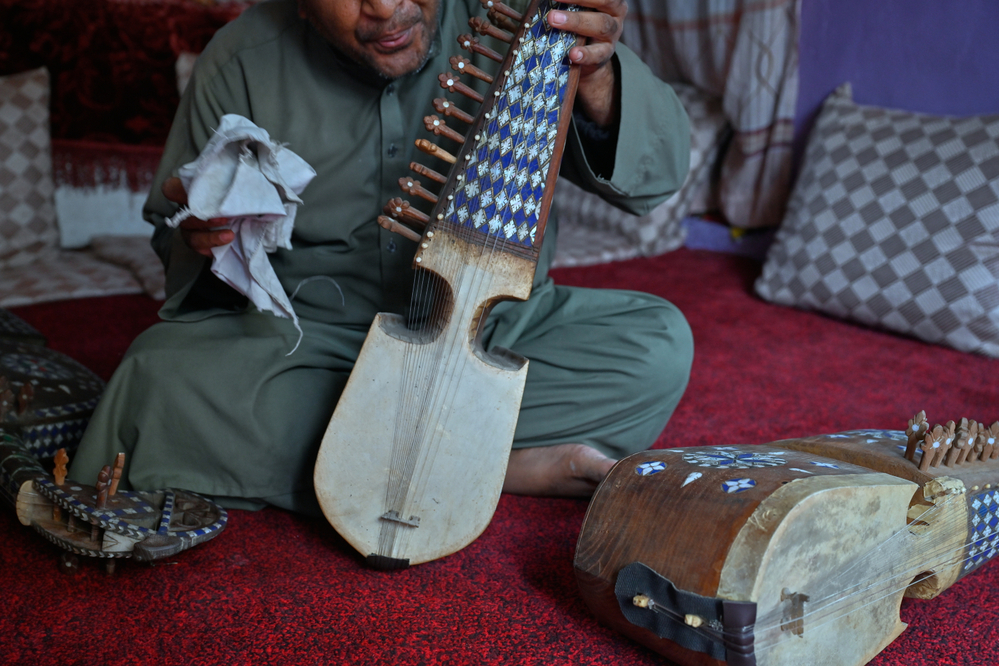
Kabul. Once upon a time, music was resounding in the streets and alleys of Kabul. Those melodious tunes from tea shops or restaurants made Kabul, the capital of Afghanistan, famous as a city of music.
However, those days have now become history. Since 2022, playing or listening to music has been officially banned across Afghanistan. The Taliban government, which seized power in 2021, has banned all forms of music except religious bhajans (singing without instruments). This ban has been implemented through the confusing and harsh rules of the Taliban’s Ministry of Virtue Promotion and Prevention of Corruption.
As long as I live, I will continue to play the rubab. It should be played in secret, but this is our culture, the Afghan tradition, which I will continue to fight to revive. Saif-ul-Islam Khyber, spokesperson of the ministry, says, “Music is forbidden in Islam. It gives pleasure to Satan and leads to various other evils. No one is allowed to listen to music, record songs or create musical tunes.
After the Taliban seized power, most of the local musicians and artists were forced to flee the country. Even the singers, musicians or artists in the country sent their wares out through foreign friends or hid them inside their homes to save them from the Taliban’s vandalism and action.
Shops in Kucha-e-Kharabat, an area of Kabul’s old city where musicians predominate, now sell food, clothes and household goods instead of instruments.
All over Afghanistan, musicians lost their livelihood overnight. However, it is often said that it is impossible for them to completely abandon the music that has been in their blood for generations. Despite the fear of being caught and jailed, some musicians are secretly keeping their instruments safe behind closed doors.
A commitment to preserving tradition
The day I covered my instruments with tripal, I felt myself buried alive under that cloth, music gave me life, fame and identity. An artist without music is like a corpse without a soul. In a small house in a narrow lane, a musician took out three hand-carved wooden rubabs (Afghan traditional instruments). With the rubab in his arms, he began to play, and the small room reverberated with the melodious melody of the music. “As long as I live, I will continue to play the rubab,” said the musician, “perhaps in secret, but I will not let it be silenced.” This is our culture, the tradition of Afghanistan, which I will continue to fight to revive.
A singer in another corner of Kabul has the same determination. “Now the music cannot be performed openly, but no one can erase it from our hearts,” he said, “whether in secret or in dreams, we will continue to sing and play.”
Both requested to keep their names confidential for security reasons. Those singers who used to sing well in concerts and festivals before the arrival of the Taliban have now covered their rubab, harmonium, flute, tabla and keyboard with tripal. “The day I brought instruments and covered them with Tripal, I felt that I myself was buried alive under that cloth,” he said emotionally, “Music gave me life, fame and identity.” An artist without music is like a corpse without a soul. Sometimes he stands in front of those hidden instruments and cries and apologizes along with the instruments for not being able to play.
The cycle of poverty
The aforementioned rubab player used to teach at a music school and also had his own traditional instrument shop. His father and grandfather were also musicians. But when the Taliban came, he closed the shop and sent many of the weapons abroad, hiding some with him.
When the business closed, he was financially and emotionally devastated. Shortly after the store closed, his father died of a heart attack. He says that his father died of a heart attack because he could not bear the pain of closing the shop.
At one time, he used to earn up to 10,000 Afghanis (about 150 US dollars) a day by teaching music and running a grocery store. But now he barely earns 100 afghani (one and a half dollars) by working daily. He is struggling to support his wife and children. Similarly, the singer, who was unemployed for two years, has now started a small business with the help of friends.
Risky underground presentation
This is my father’s nose. And I want to continue this legacy, this process of transmission should not stop. In the early days of prohibition, there used to be some secret musical events. But now that too has been completely closed. Day by day the situation was getting tougher. The detectives became active in search of artists like us,’ said the singer, who has not participated in any secret program for four years, ‘The risk is high, I don’t want to go to jail because I am a small child.’
The police raided a secret program in which a rubab player was participating, based on the fact that someone took a photo and sent it. Although many people were arrested, he managed to escape. Since then he has not played in such gatherings.
An original culture at risk of extinction
The rubab player has decided to start teaching this art to his eldest son, which he learned from his father. This is my father’s nose. And, I want to continue this legacy,’ he says, ‘this process of transmission should not be stopped.’
The singer believes that music is so ingrained in Afghan society and culture that it can never be completely eradicated. He says, ‘No one can separate music from Afghan society. These two are interrelated like nails and flesh.” AP