

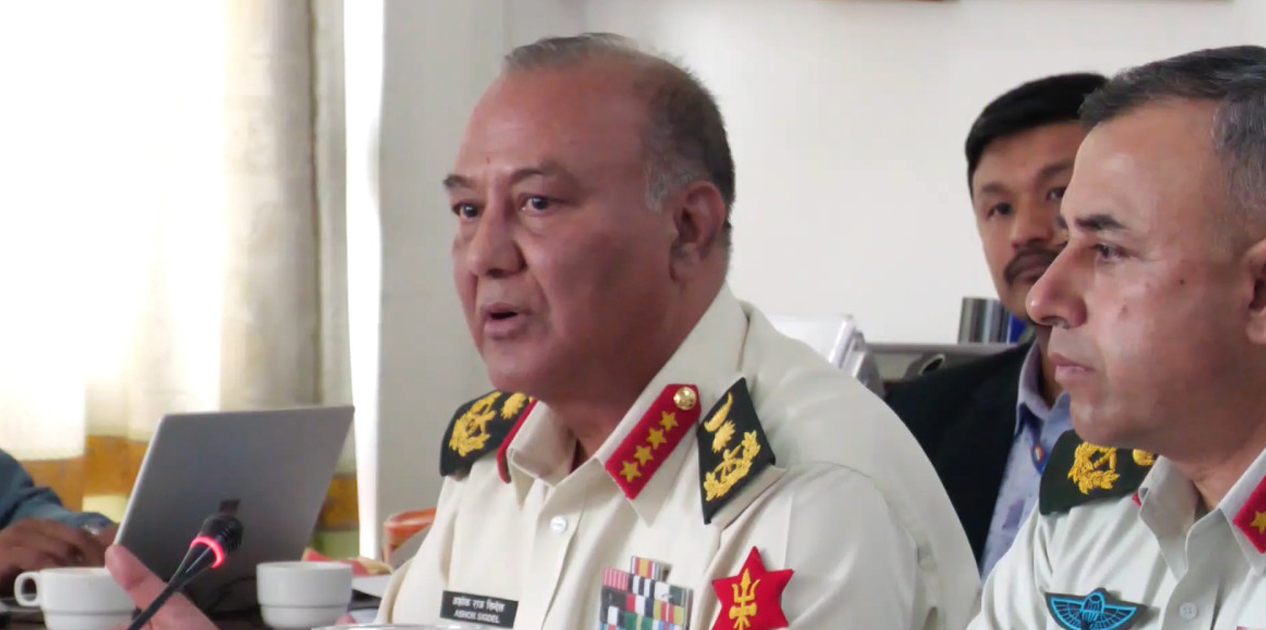
Kathmandu. Commander-in-Chief Ashokraj Sigdel has said that based on the experience of disaster response in Bhotekoshi and Budhigandaki corridors, a short ‘chain of command’ with clear responsibilities is necessary at that time.
In the Parliamentary Special Committee on Study and Monitoring of Bhotekoshi and Kaligand Corridor Disasters, he expressed the opinion that although there has been some improvement in coordination in disaster response this time compared to the past, it is necessary to make it more effective.
Commander-in-Chief Sigdel said that the ‘category’ should be separated and clarified according to the nature and responsibility of the disaster, and a long ‘chain of command’ would delay the response, so a dispersed command structure is necessary.
Although the Disaster Risk Reduction and Management Act, 2074 and the Regulations, 2076 gave coordinating roles to various agencies, he said that in the initial stage, there was operational ambiguity between the army, security and civilian agencies as to who would lead the response in the field when a clear ‘chain of command’ was not specified in the Emergency Operations Center Operation Procedures, 2082.
After the Bhotekoshi flood, when 21 helicopters were deployed in the 35 nautical mile area, there was difficulty in managing the airspace, Chief of Army Staff Sigdel said that the need for effective ‘airspace management’ was felt at that time as unnecessary drone flights created problems in rescue operations.
Stating that the existing air capacity of the army is the national capacity, it should be developed in an integrated manner and he suggested to strengthen the air base of the army and add ships and helicopters as needed. He suggested that the air capability of the army should be kept at the highest level as a national asset.
Mentioning that about 35 to 40 percent of the pilots working in private air companies and about 80 percent of the technical manpower are experienced personnel of the Nepali Army, Commander-in-Chief Sigdel said that upgrading the existing air capability of the army is necessary.
He said that every province should identify the location so that the minimum requirements are met and make arrangements to be able to conduct camps immediately if necessary during a disaster.
It was suggested by the army to carry out the development projects only after multi-risk assessment and mapping of the disaster and to relocate the already constructed projects as needed.
Stating that specialized teams, damage and needs assessment teams and necessary equipment should be kept ready for immediate rescue in tunnels and submerged structures during disasters, Commander-in-Chief Sigdel said that equipment such as high-capacity sludge pumps, solar systems, equipment used for breathing in confined spaces, tunnel communication systems and thermal/lidar drones are needed.
Before mobilizing the foreign rescue team, the army suggested that the need should be assessed and called only as needed. The army also suggests to control the tendency to enter the rescue site without coordination and arrange entry on the basis of priority.
According to the army, during the rescue and response operations, entering the field without helmets, flash jackets and necessary equipment, such activities should be stopped in the future.
Along with the disaster response, it was suggested that the district level should take the lead in rehabilitation, reconstruction and revival and the National Disaster Risk Management Authority should provide support. The Army’s suggestion is to continue post-disaster search and rescue in the recovery phase, remove debris, restore important structures, give priority to road connectivity, and expand health and education systems.