

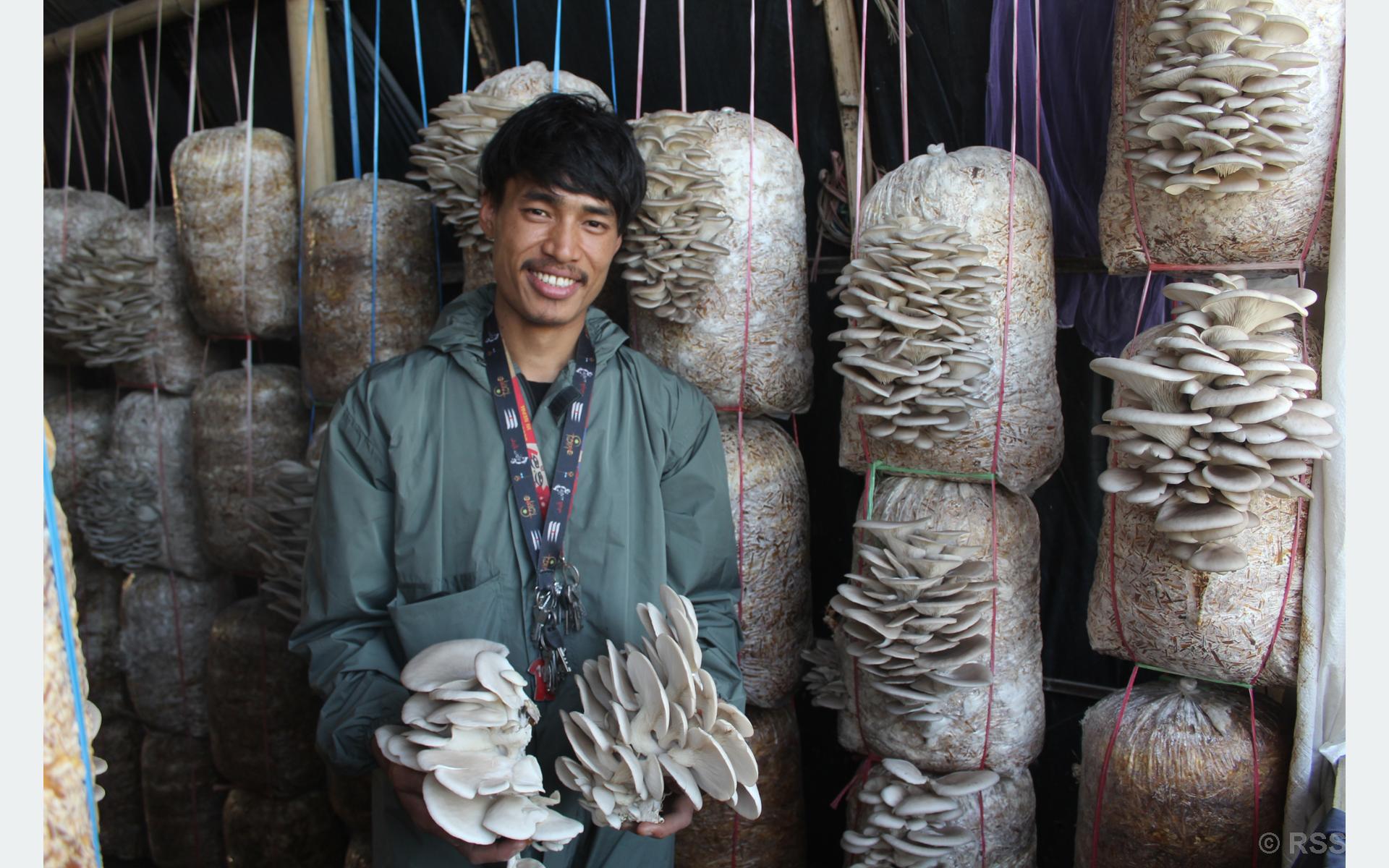
Banepa (Kavre). Until five o’clock in the morning, Panauti’s life seems peaceful. While most people are sleeping, Syangtan is busy picking mushrooms.
Amidst this peaceful environment, 29-year-old Devraj Syangtan is busy picking mushrooms at the Roshi Agricultural Farm in Panauti Municipality-9, near the electricity hydropower plant.
After picking the mushrooms till 3:30 in the morning, he has to transport the produced mushrooms to the vegetable market. This is the daily life of a professional tea farmer, which he embraces with the determination to do something in his own country while staying with his family.
Syangtan, who returned to his country after spending 10 years in foreign employment, is now seeing a future in his village through cheukheti.
The days he spent away from his family while abroad and the hardships he had to suffer made him want to stay with his family and start farming.
After working abroad for a long time, he decided to do something in his own country after the opportunity to stay with his family and share happiness was reduced. After that, instead of working for others abroad, he chose the path of becoming self-sufficient by sweating at home.
“I could not forget the days I spent abroad without a family. That’s why I started mushroom farming while being in the arms of my own family,” said Syangtan.
This business is not new for him, who has started farming with the thought of continuing the profession that his family has been doing. His father had been farming since 2065. The profession that the family was doing was old for him.
After returning from abroad, he planned to continue and expand the family business. His efforts to professionally advance the experience and skills gained from his family are now focused on Chiukheti.
Syangtan, who started tea cultivation by renting about three plants of land, initially built five tunnels with an investment of Rs 20,000, but now he has 27 tunnels.
He informed that 21 lakh 60 thousand rupees have been invested in the construction of the tunnel.
As the business is expanding, they have taken loans from cooperatives when their own capital is not enough. He has the experience of needing more capital along with constant hard work to bring the business that started with a small investment to its current state.
He says that time, labor and management are equally important to increase production in agricultural business.
He has the support and support of his family in business. Mother, brother and daughter-in-law work and take care of the tunnel together. Family members have been cooperating in picking mushrooms, taking care of tunnels and managing production.
Syangtan is active in expanding knowledge about farming. He is now taking classes online. He believes that by learning new technology and knowledge along with traditional experience, production can be organized.
It is not enough to produce in mushroom cultivation. In order to maintain the quality of the produced mushrooms, attention should be paid to regular care and market management.
Syangtan has paid special attention to protect the mushrooms from diseases and insects and to maintain the necessary environment inside the tunnel.
Mushrooms can be picked within about 21 days to four weeks after placing the mushroom seeds. About 440 packets are kept in one tunnel. From that, about 800 to 900 kg of mushrooms are produced per unit.
Mushrooms can be produced in two batches in one tunnel in a year. In order to increase the quantity of production and maintain the quality, one has to work hard from the management of the tunnel to the time of mushroom picking.
Straw required for tea cultivation is brought through dealers. Seeds are purchased from Kathmandu and Bhaktapur. From the management of the materials required for farming to the process of selling the produced mushrooms, we have to work together.
You should start picking mushrooms from around 1 pm. Must be able to tip between 3:30 AM and 4 AM. After that, as soon as the vegetable market opens, the produced mushrooms should be delivered to the market.
Along with production, time management and access to the market are equally important in tea cultivation.
Oyster mushrooms produced by Syangtan are currently being sold in bulk at Rs 150 per kg. Even though mushrooms are sold in the market, it is challenging to get the expected return from the business as they cannot get a reasonable price according to the cost of production and their labor.
According to him, the total income from the sale of mushrooms is up to 13 lakhs in a year.
The said amount is the income before deducting production cost, tunnel management, labor and other expenses. He said that the total income of two lots produced in one year from one tunnel would be around Rs 50,000.
He said that after receiving two lakh rupees as a grant from the local government last year, it helped in expanding the business.
He says that farmers like him would be more comfortable to proceed professionally if there is provision of government subsidies and subsidized loans along with necessary technical knowledge, skills, production management and market support in tea farming.
He believes that if technology and necessary support is obtained from the government agencies, the production can be increased as well as the business can be made more organized.
The journey of Syangtan, who is looking for a future in agricultural business by combining his foreign experience with the labor of his country, has shown the possibility of doing business in his own village.