

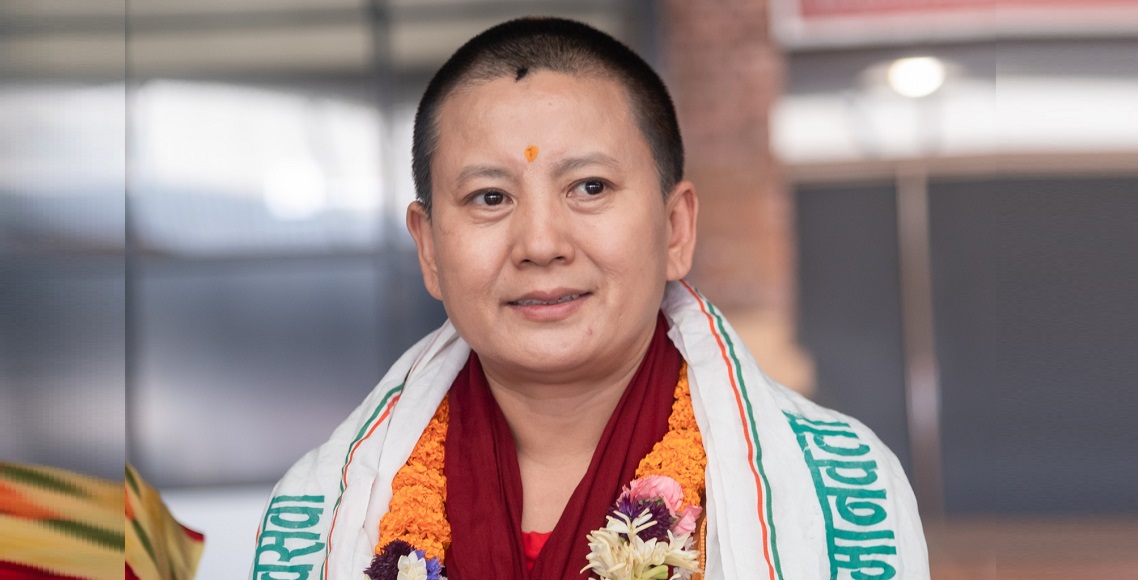
Kathmandu. Ani Choing Dolma, who won the hearts of Nepali people with the song “Flowers in the eyes of flowers, thorns in the eyes of thorns”, is now in the limelight again. But this time he is being discussed not because of music or social services, but because of his appointment as the vice president of Lumbini Development Fund and old controversies connected with him.
Ani, who has been active in the education of Buddhist nuns, support for kidney patients and various humanitarian campaigns, has been appointed by the government to lead the organization for the development and protection of Lumbini, the birthplace of Lord Gautama Buddha. Some have considered his appointment as an honor for his social contribution, while others have questioned the past controversies and the selection process.
After all, who is Ani Choing Dolma? What is the case of 18 million rupees connected with him? Why did the dispute about citizenship arise? And why did the government choose him when there were so many applicants?
Born in the Buddhist area of Kathmandu, Ani Choing entered the Nagi monastery in Shivpuri at the age of 13. She studied religious practice and music under the guidance of Buddhist guru Tulku Urgen Rinpoche and became an international identity by presenting Buddhist mantras and spiritual music in a modern style.
A collaboration with American musician Steve Tibbetts and the release of the album ‘Cho’ in 1996 played an important role in bringing his music to an international audience. In Nepal, the song ‘Phoolo Anjama Phoolai Sansar’ made him known in every household.
But her introduction was not limited to the singer. By establishing the Nuns Welfare Foundation of Nepal in 1998, she continued the work for the education of nuns. Arya Tara School has been run through this institution, where Buddhist philosophy and Tibetan language are also provided along with modern education.
Similarly, in the year 2010, she established the Arogya Foundation and launched a campaign to support the treatment of kidney patients. Due to her involvement in various humanitarian and social campaigns, she has built a distinct reputation in public life.
Amidst this reputation, after he became the vice-chairman of the Lumbini Development Fund, his past has come into debate again.
18 million rupees case from Hong Kong
The most famous controversy associated with Ani Choing is the large amount of money that came into her bank account in 2018. According to public news reports, 1,649,940 US dollars were deposited in his then Mega Bank account for three consecutive days. According to the exchange rate at that time, the amount was equal to about 180.31 million rupees. On 26th, 27th and 28th of Baisakh 2075, the details of large amount of money being deposited in the account on three consecutive days were published. It was said that on the first day 579 thousand 980 US dollars, 539 thousand 980 dollars on the second day and 529 thousand 980 dollars were collected on the third day.
After questions were raised about the source of the funds and the purpose of the transaction, the bank sent the details of the suspicious transaction to the Financial Information Unit of Nepal Rastra Bank. After that, the news that this matter has reached the Money Laundering Investigation Department was made public.
But one important thing should be understood here. The arrival of large sums of money from abroad is not in itself evidence of money laundering. Where the money came from, who sent it, for what purpose it was sent and whether the legal process was completed is the main basis of the investigation.
Ani has claimed that the money came through legal means and she has completed the necessary procedures. According to him, the money issue was settled towards the end of 2018. He has also alleged that he suffered unnecessary suffering from the then bureaucracy.
But the question of what is the final status of the investigation of this case has been raised again. If the investigation was formally concluded, what was the decision? If the amount was withheld, when and on what basis was it released? It is necessary to make public the official records of the relevant bodies on these matters.
Alleged pressure from the then Prime Minister’s Secretariat
When this case was made public, there was also an allegation that there was pressure from the then Prime Minister KP Sharma Oli’s secretariat to release the funds.
After the money was withheld, it was claimed that there was pressure on the officers of the investigation department. Along with this, questions were also raised about the speed of investigation and the role of government agencies. However, making allegations of duress public and confirming them are two different things. To draw a conclusion about this, official records, statements of relevant officials and evidence are required. Therefore, rather than convicting anyone in this case, it is more appropriate to demand that the final findings of the investigation be made public.
What was the dispute about citizenship?
The details of complaints about Ani Choing’s citizenship in the past were also made public. It was alleged that he took the citizenship of the descendant by showing Kancha Bahadur Lama as his father. It was said that Kancha Bahadur’s son Pramansingh Lama had filed a complaint at the district administration office in Kathmandu saying that Ani was not a member of his family.
In the complaint, it was claimed that Kancha Bahadur Lama died in 2039. On the other hand, Ani’s autobiography mentions the death of her father in the year 2061, and the difference between the two accounts was questioned.
According to public information, she took citizenship on 19th May 2046 under the name Choing Dolma Moktan Lama. Later, details about the copy of the citizenship were also made public.
Why was Ani chosen when 104 people applied?
With the appointment of Ani Choing, the selection process is being discussed the most. According to the public information, an open application was sought for the appointment of Lumbini Development Fund officials. Only 104 people applied for the post of vice president. But the cabinet meeting held on 30th October 2083 decided to appoint Ani as the vice president on the proposal of the Minister of Culture, Tourism and Civil Aviation, Khadakraj Paudel.
The Lumbini Development Fund Act, 2042 has empowered the Government of Nepal to nominate the Vice President. Therefore, the question of which basis was adopted during selection has become more important than whether the government can appoint or not.
Ani’s contribution to Buddhism, social services and international recognition may be considered as the basis of merit by the government. But there is also a debate about why she was deemed suitable among the 104 applicants. If the government can clarify the selection criteria, the evaluation of the applicants and the basis of the final decision, it will be easier to answer the questions raised.
After the appointment of Ani, parties including the Lumbini Bachau Maha Abhiyan have questioned the decision and demanded to cancel the appointment. The details of the National Genji Citizens’ Campaign also demanding the cancellation of the appointment have been made public. Opposition parties have raised questions about old financial investigations, citizenship complaints and the transparency of the appointment process. Their argument is that the leadership should be given to a person who has deep knowledge of Lumbini’s history, Buddhism and the needs of the local community.
But all the allegations raised by the party opposing the appointment have not been proven. Likewise, it cannot be assumed that all the questions related to the appointment have been answered based on Ani’s social contribution.
Ani said that she did not apply for the post and was thankful that the government trusted her and gave her the responsibility. Regarding the financial issue, she has been claiming that the money has come through legal means and the matter has been resolved. Therefore, it is necessary to understand this dispute not only by making it a matter of support and opposition, but on the basis of facts, evidence and official decisions.
The post of Vice President of Lumbini Development Fund is not a general appointment. Important responsibilities such as protection of Buddha’s birthplace, management of archaeological heritage, development projects, religious tourism and expansion of international relations are connected with it. Equally important is the question of what kind of plan the new leadership will advance for the preservation and development of Lumbini.
But before that, the government needs to give clarity on three issues. First, what is the official final status of the investigation into the money coming from Hong Kong? Second, what was the decision of the concerned body on the citizenship complaint? Third, what criteria was used to select Ani from the 104 people who applied for the post of vice president? Akram Khan, the coordinator of the Lumbini Save Mahabhiyan, was arrested while protesting on this issue, but he was released after all-round protests.