

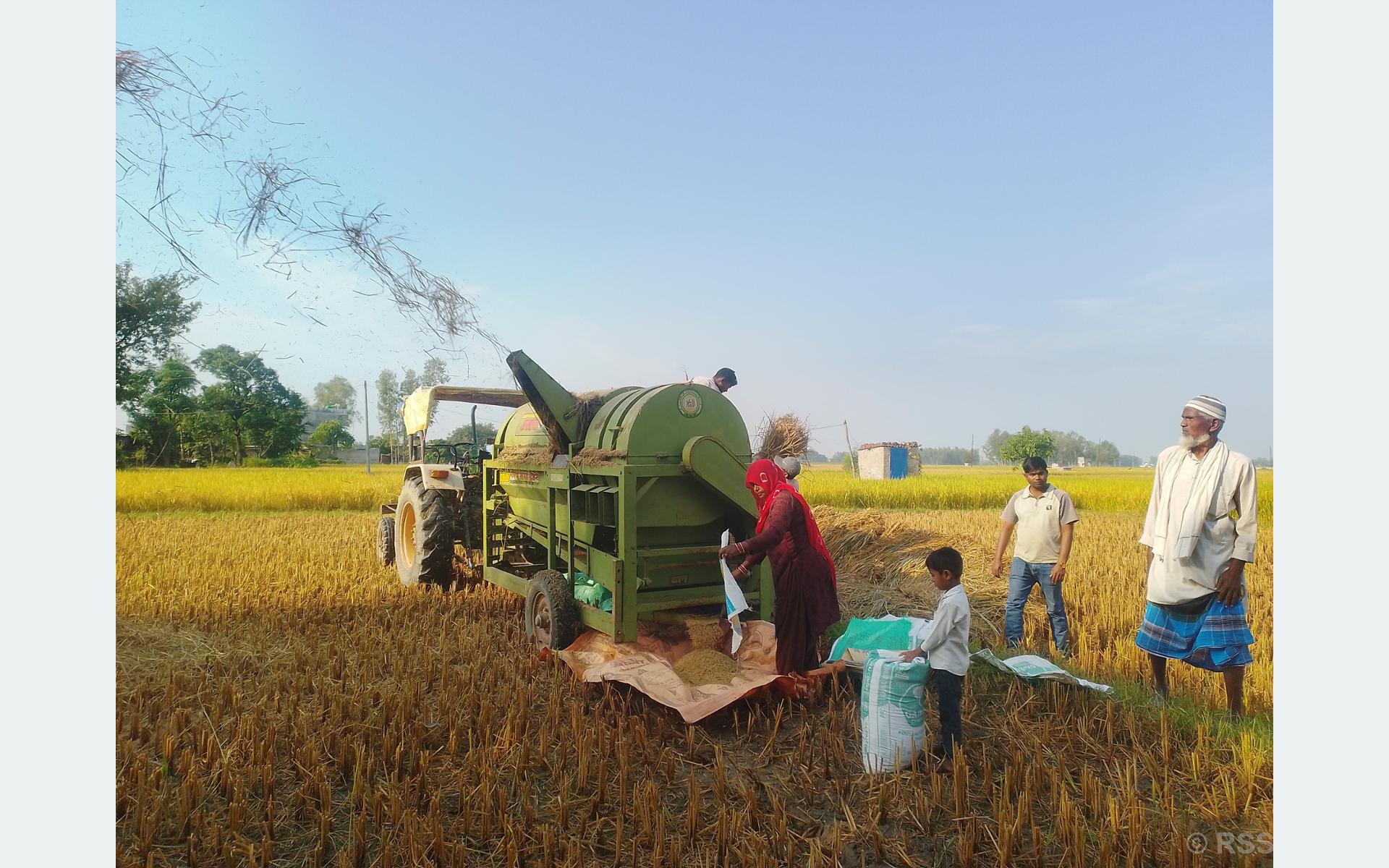
left With modern technology replacing the traditional farming system in villages, rural farming is becoming easier.
Especially for the farmers who are facing shortage of manpower during rice and wheat threshing, the development of technology like rice and wheat thresher machine, cutting reaper has saved the time and labor of the farmers on the one hand, and on the other hand, it has also become a dynamic means of self-employment and income for the youth of the rural areas.
Mohammad Islam Khan, a farmer of Nepalgunj sub-metropolitan city-19, still sees the scene from ten years ago. At that time, the sheaves of ripe rice should be tied up and taken to the field or the manpower should be plowed and threshed rice by making a field. At that time, he did not believe that someone said, “A rice threshing machine will come all of a sudden”. Times have changed today. The same Islam Khan who doubted the existence of the machine yesterday is now a regular user of the thresher machine to thresh the paddy crop.
“Now thanks to this machine, it has become very easy and fast to thresh ripe rice”, Khan told his experience, “All the farmers in the village use the thresher for rice crops. This machine has become a great support for farmers when the manpower working in agriculture is decreasing due to foreign employment and other reasons.”
The introduction of modern agricultural technology in the villages of Banke has suddenly made the traditional farming system easier. Dhruv Kumar Thapa Chhetri, another farmer of Nepalgunj-19 Suiya village, has been using tractors for plowing and thresher machines for threshing rice and wheat for a decade. Before that, in his experience of farming with plows and tillers, technology has completely changed the work.
“It is difficult to find a farmer who works in the village, even the Paihas demand a wage of 600 to 1000 per day”, said Chhetri, “It takes a lot of time to hire a wage worker, but by using a thresher, you can bring in the rice on time without any hassle. It has become very easy from planting to bringing in the produce.”
With the increase in demand for thresher machines in the villages, it has also created opportunities for self-employment at the local level. Amjat Ali Sheikh of Nepalgunj-19 has also been operating the thresher machine for seven years. According to him, especially farmers who have a lot of land and less manpower to work at home demand more thresher.
“The thresher can thresh up to 10 bushels of paddy in an hour”, Shaikh said while explaining its benefits, “there is no hassle of collecting straw or tilling the paddy. The work is fast, the cost is low and the time is saved.”
Sheikh buys a thresher machine for Rs 350,000 and earns up to Rs 150,000 only during the paddy season. As a fee, he charges Rs.2,500 per hour or 12 kg of paddy equal to one quintal of paddy.
Until a few years ago, all the farmers in the village collected the harvested paddy in one place and used threshers in turn, but now it is sad that it takes a lot of fuel and time to bring the thresher machine to each farmer’s field.
Initially, he operated the thresher machine in the village, but now farmers are also buying machines from other villages, so there is competition. Amjat said that the thresher is delivered to the farmer’s field from 5 am to 12 pm at the time of harvesting rice.
Zamansingh Wali, manager of Sakar Agricultural Cooperative in Rapti Sonari Rural Municipality, said that the farmers’ attraction towards thresher machines has increased because it takes a long time to thresh paddy with wages and requires a lot of manpower.
According to him, the thresher machine, a modern agricultural tool introduced as an alternative to the traditional farming system, has had a positive impact on the rural economy. On the one hand, it has solved the problem of lack of manpower in agriculture and helped to bring in crops on time, on the other hand, it has provided an opportunity to the young laborers to become self-reliant and self-sufficient by staying in their own villages.
Wali said that more than eight thousand farmer members belonging to his cooperative are now using modern technology in agricultural work to produce fast and quality products. He says that the use of machines in agriculture is economically cheaper, does not require the use of labor and is also faster, so farmers are becoming technology-friendly.
He mentioned that if the government can provide subsidies or concessions for the purchase of such agricultural equipment, more mechanization in agriculture will reduce the cost of production and more opportunities for self-employment in villages will be expanded.
While labor shortage and increasing costs in agriculture are becoming a challenge for farmers, remaining farmers have started adopting agricultural technology as an alternative. With the start of the rice harvesting season, agricultural machinery has started to take the place of the traditional labor force in the fields.
Krishna Vikram KC, president of Kisan Maha Sangh Banke, said that this indicates that the agricultural profession will be gradually transformed from subsistence oriented to professional and technology friendly. According to him, the interest of farmers towards the thresher used for threshing rice and the reaper machine used for cutting rice has been increasing in recent years.
The lack of manpower to work in agriculture, the increasing wages of laborers and the need to complete farm work on time have attracted farmers towards mechanization. The reaper machine can cut about 10 to 15 bushels of paddy per hour and consumes about one liter of diesel. KC said that it will help to harvest a large area of rice in a short time, thus saving both the time and labor of the farmers.
Farmers have increased the use of modern equipment not only for harvesting rice but also for preparing fields. The mini tiller is being established as the main tool used for plowing. According to KC, a mini tiller can till about five to 10 bushels of land per hour and consumes about one liter of diesel. This has made it possible for farmers to prepare for farming with less manpower.
The impact of mechanization in the agricultural sector is not limited to farming. The use of grass-cutting machines, grain-grinding equipment, and cow mats used in animal husbandry is also increasing. According to KC, the possibility of reducing production costs, managing labor and expanding commercial production will increase if animal husbandry can be connected with technology.
“It is not appropriate to understand the introduction of technology in agriculture only as an option for laborers. It helps farmers to farm on time, manage labor and costs, increase the size of production and connect agriculture with business”, he said.
He mentioned that agriculture will become more sustainable and professional if the government is able to promote the policy of not only ‘giving machines’ but also ‘give machine skills and markets’ while ensuring transparency in subsidy distribution and access to real farmers.
The subsidies that are available from time to time from the local and state governments for agricultural mechanization have also made it easier for farmers to adopt the technology. Access to agricultural technology in Banke district is not limited to paddy harvesting only; It has also contributed to increase the productivity of the overall agricultural sector.
According to Sujita Sharma, Information Officer and Senior Agricultural Dissemination Officer of Krishi Gyan Kendra Banke, most of the farmers in the district are doing agricultural work using modern tools and equipment.
Sharma said that the use of technology in agriculture has brought ease in the work of farmers and has also directly helped to increase production by reducing crop losses. In recent years, the use of technology has made the agricultural sector more systematic and modern.
According to information officer Sharma, the farmers who were worried about the spoilage of rice in the field due to lack of tillage are relieved, which indicates that the Nepali agricultural sector is gradually transforming from traditional to modern.
Information Officer Sharma informed that the Krishi Gyan Kendra is also conducting a program of some percent subsidy for the purchase of various agricultural tools, machines and equipment to make the farmers technology-friendly.
“Agriculture is the basis of our economy. Now it is becoming difficult to increase production and income by depending on traditional labor”, he said, “If technology can be expanded from plowing to paddy harvesting and from animal husbandry to product processing, agriculture can be connected with industry while respecting the labor of farmers. Technology-friendly agriculture can become an important basis for independent and prosperous agriculture in the future.”