

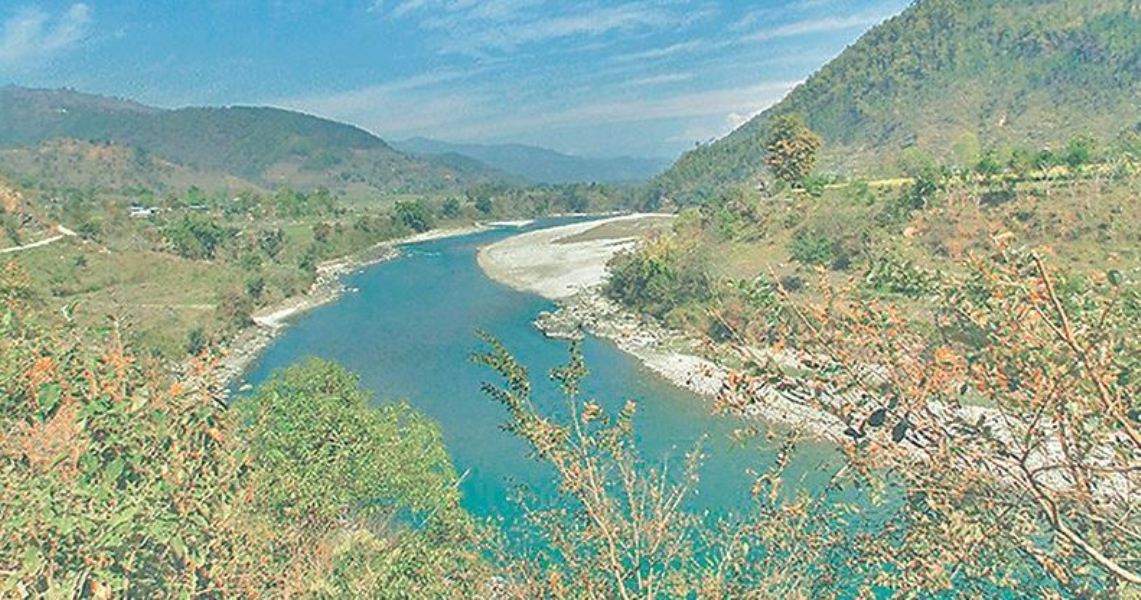
Kathmandu. The Budhigandaki hydropower project with a capacity of 1200 megawatts reservoir is again in confusion due to the unstable policy of the government. After the cabinet meeting held on 30 October decided to give in-principle approval to draft the ‘Budhigandaki Development Authority Bill’, the construction model of the project has been confused again.
In the budget of the current financial year presented by Finance Minister Swarnim Wagle in Parliament on 15th June, it was mentioned that the project will be carried out under the empowered authority model. Before that, the then finance minister Bishnu Paudel had announced in the last fiscal year’s budget that it would be built on a public-private-partnership (PPP) model. Due to the constant change in the model of project construction with the change of government and the budget, the national pride Budhigandaki project has become confused.
After the announcement of the establishment of the authority through the budget, former Energy Secretary Anup Upadhyay had objected through the social network ‘X’ saying that the project would not be built on the authority model. He suggested that the expenditure incurred on the project so far should be counted as government investment and call for the remaining amount.
Commenting again after the cabinet meeting approved the drafting of the bill, Upadhyay wrote, “There is a majority of rednecks in the government. He has decided that an authority should be created to make Budhigandaki. After that, he taught that oil should be rubbed on the knees when there is a headache.’
The project, which was launched as a project of national pride in the financial year 2069/70, was to be completed within 2083/84. According to the 60th report of the Auditor General, the initial cost estimate of the project was 2 trillion 60 billion rupees. But even as the time for the completion of the construction is approaching, the pattern of the construction has not been clear until 9 years have passed.
Officials of the Ministry of Energy, Water Resources and Irrigation say that they will not get bogged down in the name of forming an authority by leaving the approved investment modality. “When the investment model has been approved and the project has gone ahead, it should not be confused with the name of a new structure,” said an official of the ministry. It slows down the pace of work as it takes a long time to create an authority, from the creation of laws and regulations to the construction of structures.
The interim government formed in August 2082 approved the financial investment framework of the project. After the Cabinet meeting of 2nd January 2082 and 12th February 2082 approved the financial framework, on 9th March 2082, the Ministry sent a formal letter to the promoter ‘Budhigandaki Company’ to proceed with the project. However, in the first budget brought with the government led by Prime Minister Walendra Shah, Finance Minister Swarnim Wagle announced that Budhigandaki will be promoted under the authority model.
The Chief Executive Officer (CEO) of the company, Arun Razauria, said that with the decision of the Council of Ministers, the process of preparing a draft and sending it to the Ministry of Law, Justice and Parliamentary Affairs for consultation has started. However, he claims that the ongoing work and contracts will not be stopped even if the process of drafting the bill and forming a new structure is going on.
“The authority bill is being prepared but the contracts and construction works that have already progressed are not stopped,” he said.
The basic cost of this project to be built on the border of Dhading and Gorkha is estimated at 2 billion 77 billion US dollars (about 3 trillion 74 billion rupees). The total cost of the project will reach 4 trillion 6 billion rupees with interest of 32 billion rupees during the construction period. According to the financial modality approved by the Interim Government’s Council of Ministers, the total cost will be 70 percent debt and 30 percent equity.
The promoter of the project, Budhigandaki Company Limited, will own 80 percent of the shares of the Government of Nepal and 20 percent of the Nepal Electricity Authority. There is a plan to reduce the debt load or restructure the share structure by issuing shares to the public based on the financial indicators after the final stage of construction or the completion of the project.
According to the approved investment framework, the government will invest 97.47 billion rupees for equity and 1.50 billion rupees for subsidized loans, totaling 2.48 billion rupees. The government has so far converted 46 billion rupees in compensation distribution to the company’s share investment. Now the government has to ensure additional resources of 2 trillion 28 billion rupees.
Nepal Electricity Authority will invest 24.37 billion rupees for equity. For the remaining amount, a strategy has been made to issue shares of the Electricity Authority, issue energy bonds, take loans from banks and financial institutions, use infrastructure tax funds, and raise investment from Nepalis who are employed abroad and ordinary people.
In addition to this, energy bonds worth Rs 30 billion will be issued under the government’s facilitation, calculated at the Mandatory Liquidity Ratio (SLR), which can be purchased by banks, insurance companies and public funds. The remaining 1 trillion 4 billion rupees loan is mentioned in the modality to be raised through co-financing (consortium) of Employees Provident Fund, Citizen Investment Fund, Social Security Fund, HIDCL, Nepal Telecom and commercial banks. From Ekantipur