

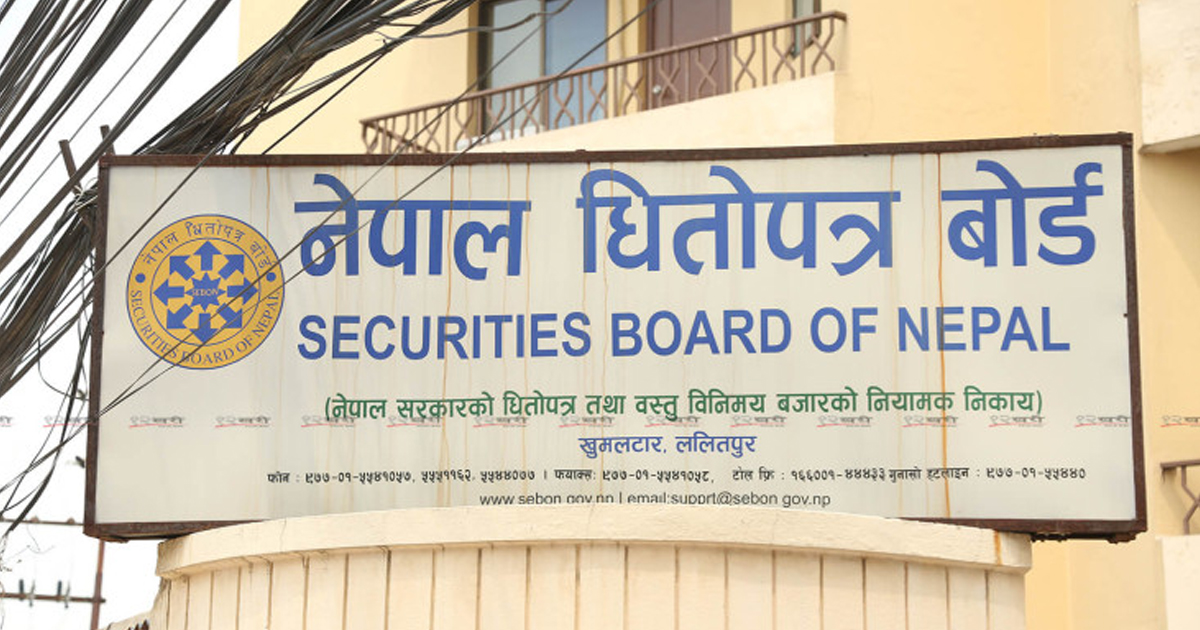
Kathmandu. Panic has spread among investors after the Securities Board of Nepal (Sebon) issued new guidelines on prevention of financial investment in money laundering and terrorist activities. Investors have become alarmed by the provision of re-reporting the details of investors who transact more than 10 lakhs daily to the financial information unit under Nepal Rastra Bank.
According to the new guidelines, if any individual or legal person transacts shares of 10 lakh rupees or more in one day, the broker company must provide the details of the transaction to the Financial Information Unit within 15 days of the transaction in accordance with Section 10 (a) of the Act. In addition, there is a provision in the directive that the broker company should also keep a separate record of the investors doing such transactions.
With the announcement of this arrangement, investors have started criticizing the government for increasing its control over the market. The negative impact of which has also started to be seen in the stock market. However, this monitoring arrangement mentioned in the new guidelines published by the Securities Board is not new but just a continuation of the old one.
Nepal Securities Board spokesperson Niranjay Ghimire clarified that this is not a new arrangement. He said that this rule has already been implemented and it has not affected the real investors.
“Even though the guidelines have been introduced with new amendments, the provision of submitting the details of individuals or companies doing business of 1 million or more in a day is still old,” said spokesperson Ghimire.
In the instructions on prevention of financial investment in money laundering and terrorist activities introduced by the board in the year 2076, it is mentioned that the information of transactions of more than 10 lakh rupees should be reported to the financial information unit several times a day or at once. Brokers have been reporting such transactions since 2076.
Former Chairman of Broker Association and Managing Director of Kohinoor Investments and Securities, Bharat Ranabhat says that he has been providing information about large transactions to the Financial Information Unit for the past seven years. He says that this system will not affect any investor or organization.
“Rumours spread that investors were brought to be strict, but we have been doing this since the introduction of the Asset Clearance Act, this is not a new system, so there is no need to panic,” says Ranabhat.
He said that it would be wrong to say that only the stock market is protected as this provision applies not only to brokers or stock investors but to all sectors including banks, financial institutions and insurance.
“In today’s technology era, one can know who has done a transaction of more than 10 lakhs with just one click. The details are just sending the financial information to the unit through the software, it is not a big deal,” he added.
The board has issued this guide to make the transactions of investors transparent and to identify and control undisclosed investments. However, both regulators and brokers are of the same opinion that they are trying to create unnecessary confusion in the market.
On the other hand, investor Dev Guragai also argues that unnecessary rumors have been spread in the market regarding the guidelines issued under the Prevention of Money Laundering Act.
“Since all payments in the stock market are made entirely through the banking system, the source of the funds has already been confirmed in the investor’s bank account. Therefore, there is no objective reason for investors to fear if the broker is reporting the amount received in his account above 1 million according to the rules,” he said. He also urges investors not to get involved in rumours.
According to broker Ranabhat, cases of money laundering in the securities market are very low compared to other sectors. Since share buying and selling is done entirely through the banking system, the bank itself withholds the unopened amount. The broker informs the Financial Information Unit only if the money is transferred from the bank and if there is any doubt. Therefore, investors should not be afraid, he said.
The board has instructed the indicator organization (broker) to pay special attention to seven types of transactions. For example, there are transactions that are regularly conducted in the secondary market in the name of minors, transactions that do not change the actual ownership, transactions that are prohibited by the current law on securities, and other transactions that are considered offenses by law.
In the same way, it has been instructed to be careful regarding the transactions through the transfer of rights of securities, bulk transactions outside the transaction system (NEPSE) and transactions identified by the index organization on the basis of risk as special transactions.
Through the guidelines, the board has instructed to develop a system to identify suspicious transactions and activities. Nepal Financial Action Tax Force (FTF) has been seen to be weak in controlling financial investment in money laundering and terrorist activities. FTF has placed Nepal in the “grey list” for the second time in February 2082.