
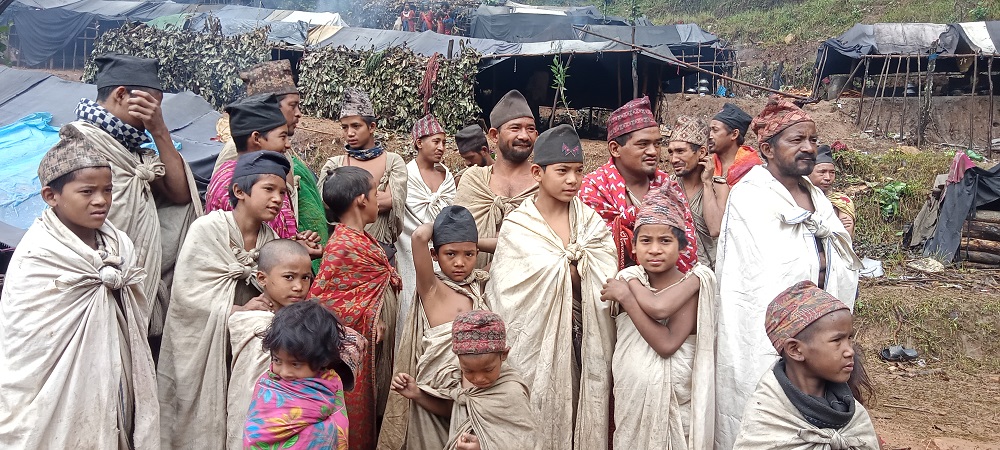
Surkhet. The Government of Karnali State has introduced the ‘Endangered Route Community Mainstreaming Policy, 2083’ to protect the survival, identity, language, culture and human rights of the endangered Route Community. After the rapid decline in the population of the Raute community in the last decade, the provincial government has introduced a special policy to ensure their protection, empowerment and dignified living.
In the national census of 2006, the population of Raute community was 618. In the 078 census, this number has reduced to 134 people. The Karnali government has formulated this policy for the Raute community with the conclusion that its existence is in crisis due to the declining population, rising death rate, malnutrition, lack of health services and external influences.
The government of Nepal has listed the communities whose population is less than 0.05 percent of the total population as minorities. Kusunda, Raute, Hayu, Kisan, Meche, Vanakaria, Surel, Raji, Lepcha and Kuswadia communities are being given social security allowance as extremely endangered communities.
There are three gotras in Raute community namely Kalyal, Raskoti and Swavanshi. Their main occupation is hunting and making wooden materials and exchanging them for grain. They have been adopting a nomadic lifestyle without permanent residence.
Due to weather, festivals and traditional reasons, they migrate from one place to another. Raute who mostly prefer to live in the forest area sometimes go to the village and earn a living by exchanging or selling their materials for food.
At present, they are mainly living in Surkhet, Dailekh, Jajarkot and Salyan districts of Karnali province. They also live temporarily in Achham in Far West and Dang in Lumbini Province.
The language spoken by the Raute community is ‘Khamchi’. The protection of the original language, culture and traditional knowledge of the Raute community has been given special priority in the policy. Under this, the provincial government has a plan to preserve the Khamchi language by writing it down.
According to the Ministry of Social Development of Karnali, arrangements will be made to discover, document and protect the lifestyle, culture and intangible heritage of the Raute community. In addition, the provincial government plans to prepare a ‘corridor’ and a detailed profile of the Route community.
The government is working towards improving the production of traditional wooden materials made by the Raute community and making it a means of income generation. In order to ensure the availability of wood necessary for the production of materials, the government has introduced a system for planting, protecting and providing membership in community forests for the community through policy.
According to the said policy, the provincial and local governments will facilitate the marketing of the materials produced by the Raute community. Those materials will also be used in government offices, museums and exhibition places. It is mentioned in the policy that arrangements will be made for the promotion and sales distribution of their products through koseligriha and other means in urban areas.
Keeping in mind the nomadic lifestyle of the Raute community, education, health and nutritional services will be provided through the nomadic system. In order to provide basic education at the place where the community lives, temporary housing will be constructed in Surkhet, Dailekh, Jajarkot, Salyan and other districts according to their wishes.
There is a policy to provide free health care services to the Route community and provide necessary food, clothing and medicine to reduce the problem. The policy states that programs will be conducted to address the special needs of women, children, senior citizens and persons with disabilities of the Route community.
A special security arrangement will be arranged to control the increasing external interference in the Raute settlement. They will be prohibited from serving and selling alcohol. There is a policy to monitor and control external persons and activities in the settlement area.
The government will form a ‘Route community mainstreaming steering committee’ under the chairmanship of the social development minister to implement the policy. According to Karnali government, the secretaries of various ministries, representatives of local level and representatives of tribal areas will be members of the committee.