

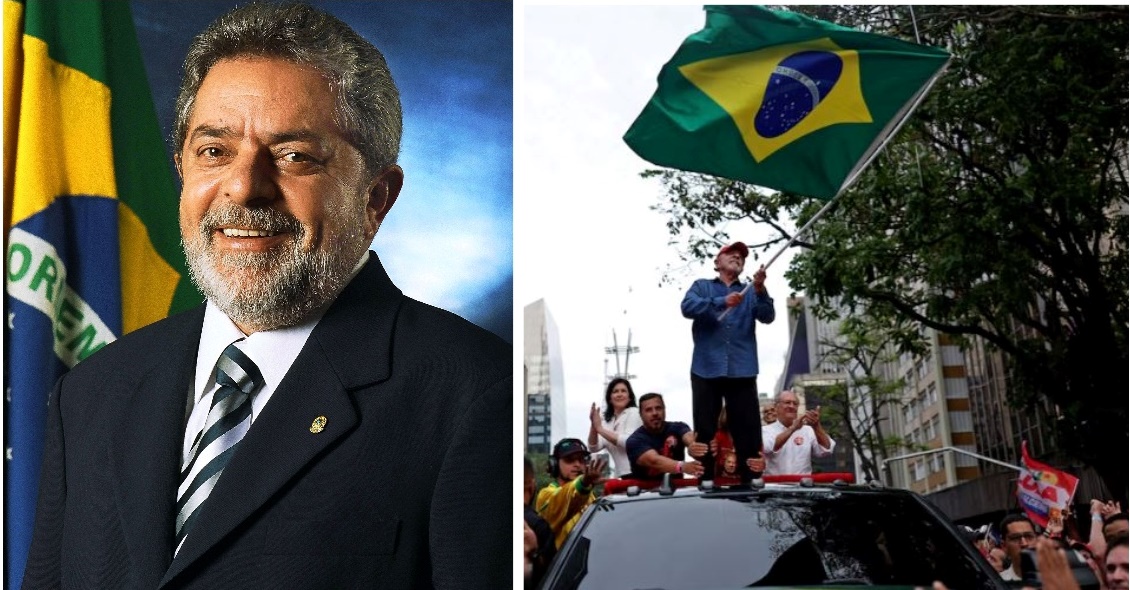
Rio de Janeiro. The right-wing wave that is spreading in Latin America has stopped after reaching Brazil. Along with this, in the last 18 months, the series of victories achieved by the right wing in presidential elections in seven countries of Latin America came to a complete stop.
Leftist President Luiz Inacio Lula da Silva won 51.8 percent of the votes in Sunday’s elections. Former President Jair Bolsonaro’s son Flavio Bolsonaro was competing with him in this election. Flavio got 48.2 percent of the votes.
Lula has been pointing out the need for deep cooperation between emerging economies. Under his leadership, Brazil is establishing itself as an important partner in BRICS. Brazil’s relations with China, Russia and India are deepening. He is a supporter of non-aligned foreign policy.
Flavio’s plan was to disrupt this situation and bring Brazil closer to America. He said that relations with the US had deteriorated during Lula’s tenure and promised to improve them.
Flavio had put forward a plan to include Brazil in the US military alliance against drug gangs. However, with the victory of Lula, it was seen that this campaign would not be completed. Analysts say that the U.S. strategy to provide easy access to Brazil’s important minerals has also been challenged by Lula’s victory.
During the election campaign, US President Donald Trump openly supported Flavio. Flavio’s father, Jair Bolsonaro, had a very good relationship with Trump when he was the president of Brazil. Zaire was defeated by Lula in the 2022 presidential election.
The court sentenced him to 27 years and 3 months in prison on the charge that he tried to stay in office after the election results were published. Flavio has been saying that there is political revenge against his father. He also made this issue an election issue.
Flavio was ahead of Lula in the early elections. However, Lula won in the second and decisive stage. Lula’s victory has dealt a blow to Trump’s campaign to strengthen his grip on the Western Hemisphere. This victory shows that Brazil, which has the largest economy and the largest population in Latin America, wants to have a “close, not balanced” relationship with Washington.
Analysts say Lula’s victory has added a challenge to the Trump administration, which has been using heavy tariffs, strict sanctions and military power to establish its hegemony in Latin America. Lula accused the US of trying to interfere in Brazil’s internal politics during the election campaign. Despite this, there are grounds for cooperation between the two sides.
The US wants to use Brazil’s abundant rare earth reserves to reduce its defense industry’s dependence on China. On the other hand, Lula wants exemptions from foreign investment and customs duties for Brazilian exporters.
According to Will Freeman, a Latin America analyst at the Council on Foreign Relations, the 81-year-old Lula has the ability to work practically with the Trump administration. The Bolsonaro family had a good relationship with some people in the Trump administration. However, I don’t think that the Americans will put this family at the center of the relationship between the two countries,” Freeman said. “Lula wants to establish a practical relationship with the United States. ‘
Brazil has refused to join the US-led military alliance ‘Shield of the Americas’ to target drug gangs. This reveals Lula’s commitment not to be influenced by powerful countries and stick to the principle of co-existence.
Last May, Lula objected when the Trump administration declared Brazil’s two biggest criminal gangs, First Capital Command and Red Command, as terrorist organizations. He said that America is making various excuses for intervention. “Being treated like children is not acceptable to us,” he said targeting the criminal gangs, “We will fight against them in our own homes.”
The issue of drug and immigrant smuggling through various countries in Latin America has become an issue of American politics for a long time. Trump is taking it up a notch and is cracking down on the border and fighting criminal gangs.
Countries that depend on trade relations with the US are cooperating with the Trump administration on this matter. Local police are joining forces with the US military to raid suspected drug networks in Ecuador. According to US Defense Minister Pete Hegseth, Honduras, Guatemala and Colombia have also agreed to joint military operations.
However, the Guatemalan government denied Hegseth’s claim and stated that there was no such cooperation. Brazil is not Honduras. This is a big country. Which has its own independent history and the army here does not like the presence of foreign forces on its territory,” said Brian Winter, the editor-in-chief of America’s Quarterly policy magazine and a Latin America analyst. The US also has less excuse to pressure Lula for military cooperation. Because most of the cocaine entering Brazil is either consumed within the country or sent to Europe and Africa. It will not come to America from there.
America’s Eye on Rare Minerals
According to studies so far, Brazil ranks second in the world in the natural reserves of rare minerals (rare earth) needed for the production of powerful magnets used in missiles, smartphones, wind turbines and electric vehicles.
A large part of this mineral, which is needed to manufacture modern weapons and equipment, goes from China, which is in the first place, to the United States and the rest of the world. To reduce this dependence, the US is eyeing Brazil’s rare minerals. If Flavio Bolsonaro had won the presidency, America’s access to rare minerals would have been easier.
Lula’s victory is a blow to the American strategy. Because Lula is thinking of selling his rare minerals freely in countries other than America. In the past, he rejected the agreements that the US tried to make on rare minerals. Instead, Brazil is a founding member of the World Artificial Intelligence Cooperation Organization (WICO), an initiative of China.
Last month, USA Rare Earth, a US government-owned company, fully purchased Brazil’s Serra Verde for $2.8 billion, making it one of the few companies outside of Asia to produce all four types of rare earths needed for magnets.
Suspicious of the growing role of the US, the Lula administration has rapidly pushed forward legislation to tighten monitoring of important minerals. In this process, the Lula administration may also review the Sierra Verde Rare Earth Agreement, analysts said.
According to the US Geological Survey, Brazil produces about 90 percent of the global production of niobium, an essential element for jets, rocket engines and other military equipment. If Brazil imposes any restrictions on its exports, the supply chain of US defense manufacturers could be affected.
Monica de Bole, a senior researcher at the Peterson Institute for International Economics, said, “Brazil has a strong basis for bargaining.” When Lula won, America became weak.
Despite his strong public statements, Brazilian President Lula is also taking initiatives to improve relations with US President Trump. He visited the White House last May to discuss trade, organized crime and critical minerals. Flavio Bolsonaro’s claim that his party and family should come to power in order to make an agreement with America was weakened by this visit.
Although Lula won the presidency, the leftists are in the minority in parliament. In the recently concluded elections, Bolsonaro’s Liberal Party became the first party in the lower house. This party has also become the first party in the upper house, the Senate. Which will put Lula in trouble for policy-making.
This term is considered the most challenging for Lula, who has been president for three terms before. Because Brazilians are worried about the high cost and the problems it has caused in their living. It is not easy for Lula to meet their expectations.
“Lula’s hands are tied,” says Guilherme Casaroes, associate professor of Brazilian studies at Florida International University. Almost every attempt he tried to make in the last term was stopped by the Congress. It will stop even now.
In Latin America, as soon as they come to power, the parties and coalitions are clashing. In Chile, Bolivia and Peru, the right-wing parties currently in power are gradually losing public support. Whereas, some time ago, their rise was big.
In Brazil, Lula has succeeded in breaking the anti-government right-wing wave. However, in order to meet the expectations of the voters, he has to compromise on various issues with the parliament and Brazil’s neighbors. Which may decrease his public support soon. Ap