

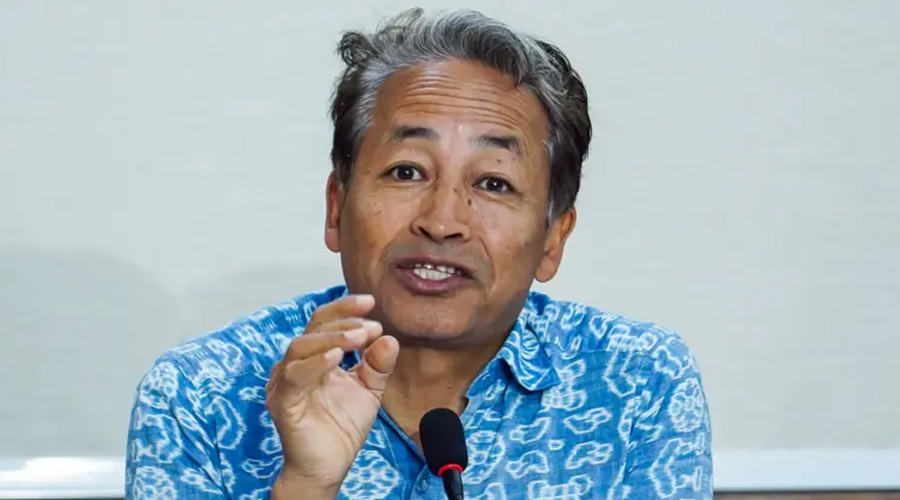
Kathmandu. Sonam Wangchuk, a climate activist from Ladakh, has warned that efforts to suppress peaceful protests in India may have serious consequences. He gave examples of the protests in Nepal, Sri Lanka and Bangladesh and suggested the Indian government to listen to the demands of the protestors instead of suppressing their voices.
According to a report by India Today, speaking at the IPF festival held in Mumbai, Wangchuk said that peaceful demonstrations should be considered as a means for the government to understand the public’s response. According to him, such demonstrations help the government to understand the problems and dissatisfaction of citizens and to improve its working style.
He mentioned that in countries like Britain, Norway and Sweden, demonstrations can be held outside the parliament building, but in India, the demonstration site has been designated far away from the parliament. He said that the Jantar Mantar in New Delhi is also far away from the Parliament Building.
Wangchuk argued that the demonstration should not be kept away from the center of power. According to him, a peaceful demonstration helps to bring out the dissatisfaction of the citizens and manage the pressure on the government.
His statement came at a time when there was a debate in India about government action against protesters and the right to protest. The central government’s role was also questioned regarding the issue of calling for demonstrations in Jantarmantar. The protestors demanded the resignation of Chief Election Commissioner Gyanesh Kumar and alleged irregularities in the special intensive review of the voter list.
Wangchuk has warned that if there is no opportunity to peacefully express dissatisfaction, the consequences could be similar to those seen in Nepal, Sri Lanka and Bangladesh.
Wangchuk said that it is not appropriate to require prior permission for citizens to demonstrate. According to him, although the permit system can be used for the purpose of keeping information about the program, it should not be used as a means of limiting the right of citizens to protest.
He mentioned that it is a constitutional right to demonstrate peacefully on the streets. He said that instead of arresting the protestors and suppressing their voices, the issues raised by them should be heard.
Earlier, Wangchuk went on hunger strike for 26 days in support of the demands placed before the central government. The demand was related to the resignation of the then Union Education Minister Dharmendra Pradhan. Wangchuk said that when the government takes unnecessary steps, dissatisfaction among the citizens will increase and the government itself will have to bear the political damage.
Wangchuk also questioned the deployment of paramilitary forces to control the protesters. He argues that instead of using security forces to control internal protests, more attention should be paid to the country’s border security.
Wangchuk also reiterated the demand that the local residents should play a decisive role in the governance of Ladakh. According to him, the decision of how to manage an area requires the participation of its residents. He argues that they or their representatives should participate in decisions related to the future of the region as they have more information about the local geography, environment and social conditions.
According to Wangchuk, after the reorganization of Jammu and Kashmir in 2019, the role of local people in the governance system of Ladakh has weakened. He said that although administrators appointed from outside may have good intentions, they may not adequately understand the specific ecology and local needs of Ladakh.
Wangchuk was placed in preventive detention under the National Security Act (NSA) following the violent protests in Ladakh in September 2025. He was released in March 2026.