

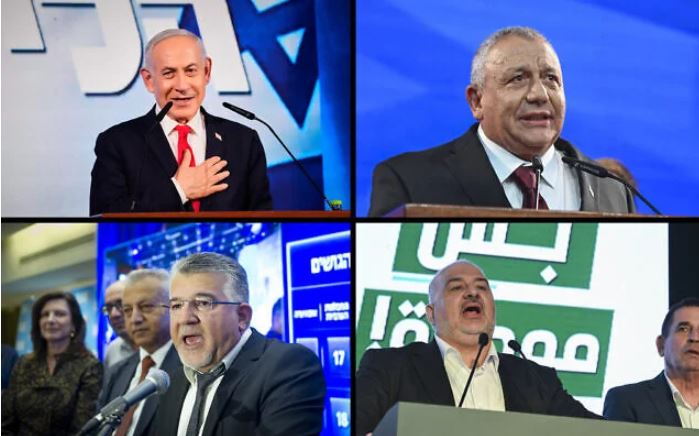
Kathmandu. Israel’s Central Election Commission has counted 89.8 percent of the votes by Wednesday afternoon, and Prime Minister Benjamin Netanyahu’s coalition will win 53 seats in the parliament Knesset and Gadi Eisenkot’s Yasser coalition will win 48 seats.
The initial forecast is that both the alliances will not be able to achieve the majority of 61 seats required for the formation of the government. It is seen that the two parties representing the Arab community will jointly win 19 seats. The party is seen as a potential decisive force after Arab voters turned out in record numbers in Tuesday’s election, aiming to oust Netanyahu and his far-right allies from power.
Previously, the maximum number of seats for Arab parties was 15. According to the Election Commission, the votes counted have included the results of almost all regular polling stations. The Commission has said that it will take some time to announce the final result as it has to check the rest of the ordinary ballot papers.
Apart from this, the ballots cast by soldiers, prisoners, diplomats stationed abroad and other voters who could not reach the regular polling station, about 430,000 to 480,000 ballots placed in double envelopes, are yet to be counted.
The counting of these ballots is expected to be completed by this evening. All the results are expected to be announced on Thursday. The final official result is scheduled to be published on November 4. Although the final results are yet to be announced, no major changes are expected in the seat distribution. Because of this, there is confusion about the formation of the government after the elections in Israel.
Major parties may have to compromise on their electoral commitments to form the government. If no agreement can be reached, Israel can go to another election. There are four possible scenarios.
Government of National Accord led by Netanyahu
It is said that Netanyahu may try to get Eisenkot to participate in the government of national consensus. However, since Eisenkot campaigned with the promise of removing Netanyahu from power, it has been analyzed that such an agreement will be difficult.
On the night of the election, Eisenkot asked Netanyahu to retire from political life, saying that the “culture of lies, division and incitement” under his leadership should end.
There is also a possibility that Netanyahu may abandon his far-right and ultra-orthodox partners and form an alliance with Eisenkot’s Yasar Party. However, since he has called for the formation of a right-wing government from the Likud headquarters, he has indicated that he will stay with the current partner.
It is said that if the conflict with Iran flares up again, the pressure for the formation of a government of national consensus may increase. Before the election, Israeli and American media published details of Netanyahu’s request for a new attack on Iran and to ensure American involvement. It is said that critics may accuse Netanyahu of using the regional conflict for his own political interests.
Eisenkot-led government with the support of Arab parties
Another option to gain a majority for the opposition coalition is to get the support of the Arab parties. However, for this, it is said that the opposition parties may have to reconsider their previous commitments.
Arab parties are expected to perform better than expected and win 19 seats. It is said that the significant participation of the Arab community, which accounts for about a fifth of Israel’s population, contributed to their performance. It is mentioned in the details that the United Arab List Party has indicated that it will participate in the opposition government and the Joint List Party will support it from outside.
However, most of the Jewish parties in the opposition coalition have rejected the possibility of forming a government together with the Arab parties. The leader of “The Democrats” Yair Golan is in favor of such cooperation. It is said that such an alliance may be difficult to sustain due to differences in policy regarding Gaza and the occupied West Bank. If a government is formed with the support of the Arab party, there will be significant changes in Israeli politics.
Netanyahu’s majority, including the right-wing parties of the opposition front
It has been analyzed that Netanyahu may try to bring Naftali Bennett or Avigdor Lieberman, the right-wing leaders of the opposition coalition, to his side. Some of their agendas, who hold strong views on security policy, are compatible with Netanyahu’s. However, both campaigned on the issue of removing Netanyahu from power and making military service mandatory for the ultra-Orthodox community as well.
It is said that such cooperation may have differences because Netanyahu’s ultra-Orthodox partners have opposed the proposal to make military service mandatory. The option of forming a new alliance by eliminating ultra-orthodox parties is also being discussed. However, it has been analyzed that it will be difficult for such a group to get the necessary seats for the majority according to the available electoral mathematics.
Next election
It is estimated that Israel may go to the next election if no agreement can be reached on other options. It is said that Netanyahu may remain as acting prime minister until new elections are held.
Some analysts estimate that the participation of the Arab community in the new elections may decrease and the right-wing voters may be more united. It is said that the possibility that about 70,000 Israelis who returned from abroad to vote may not return to the next election may also affect the result.
Similarly, it is said that if the small right-wing parties that could not cross the election threshold get less votes or do not compete in the next election, Likud and its allies may benefit.
From 2019 to 2022, elections were held five times in Israel because the parties could not agree on the formation of the government. It is said that the current deadlock is likely to repeat the same political uncertainty. With the help of The Times of Israel and the BBC.