

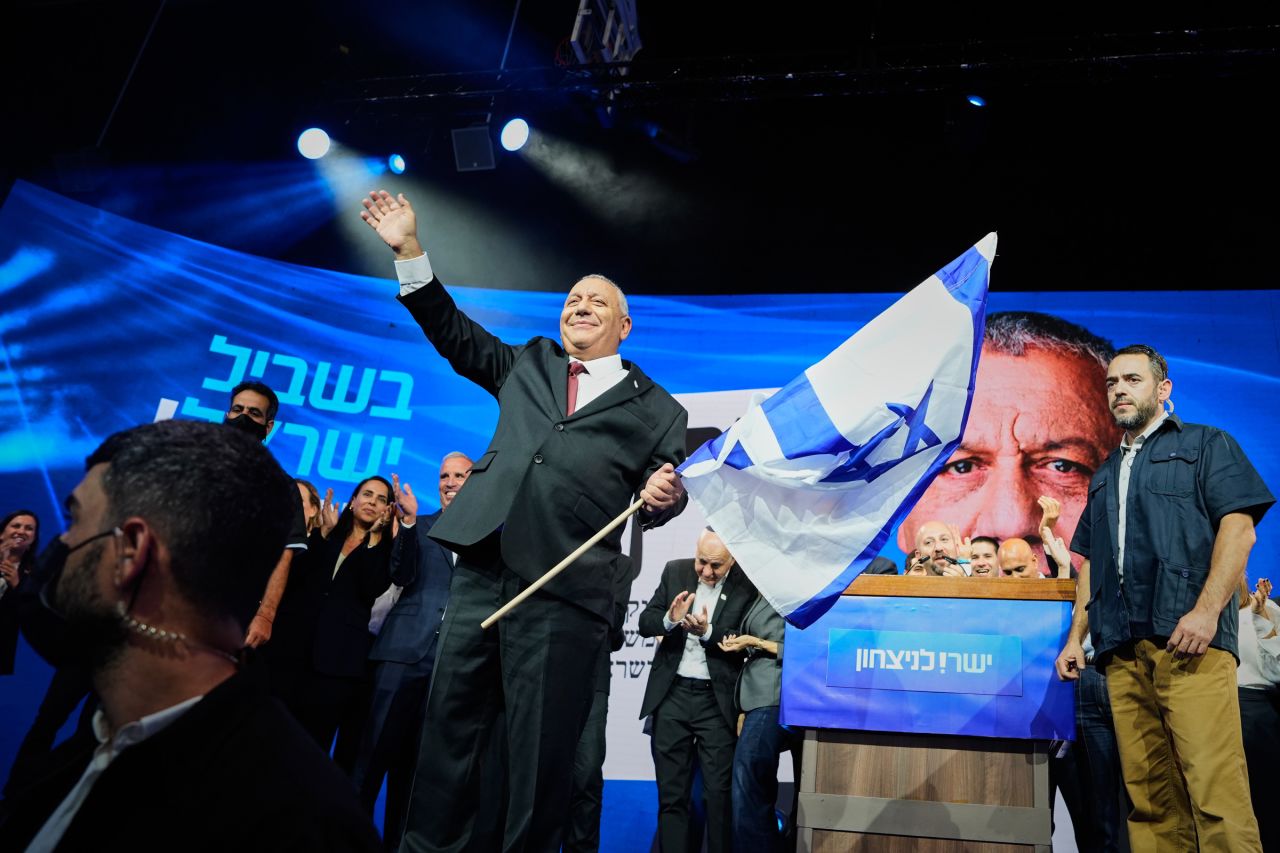
Kathmandu. Although Israel’s pro-Prime Minister Benjamin Netanyahu coalition is ahead in the Israeli election count, none of the parties have been able to gather the necessary majority to form a new government. In such a situation, it is seen that the Arab-led parties can become decisive in the formation of the government.
As of 10:03 am local time, with 72.4 percent of the votes counted, it is estimated that the pro-Netanyahu coalition will win 54 seats and the group led by opposition leader Gadi Eisenkot will win 48 seats. Arab-led parties are estimated to get 18 seats.
The Knesset, the Israeli parliament, has 120 seats. The support of at least 61 seats is required to form the government. However, the counting of votes so far has not shown that any coalition will get a clear majority. The rest of the vote counting and collaboration between political parties will determine the government formation equation.
Meanwhile, Yair Golan, leader of the Democrats Party, which is part of the opposition coalition, has called for the formation of a government including Arab-led parties. He claimed that Netanyahu has been defeated on the social network X and asked the opposition coalition to gather the support of the Arab parties.
Netanyahu lost. I know how to count to 120. 65 is more than 55. “This is how Israeli democracy works,” Golan wrote.
He said that the politics of increasing division between the Jewish and Arab communities should be ended and a government should be formed that includes all citizens. He says that change is not possible by ignoring the opinion of Arab citizens.
Before the election, Golan was one such leader of the opposition coalition, which said it could cooperate with the Arab-led Joint List and the Ram Dal. However, other leaders of the opposition alliance, including Eisenkot, said that they would not cooperate with that party because of the lack of common values and recognition.
Even though the pro-Netanyahu coalition is ahead of the opposition in the current polls, it seems that it will be difficult for him to get the necessary majority to form the government. If supported by the Arab-led parties, the opposition coalition is likely to reach the required number of seats to form a government.
The election results also have an impact on Israel’s economy. The Israeli currency shekel weakened by 0.7 percent to 3.0765 shekels against the US dollar as the uncertainty about the formation of the government increased.
Final results may change as counting continues. Votes cast by some voters, including soldiers, will be counted later. After the final results, President Isaac Herzog will discuss with the leaders of various parties and give the responsibility to the candidate who has the highest chance of forming the government.
The candidate who will be given the responsibility of forming the government will initially have 28 days. If necessary, the President can grant additional 14 days. If the first candidate fails, the next MP can be given the responsibility. Even after that, if the government is not formed, the parliament may be dissolved and new elections may be held.
In Israel, elections have been held several times before due to political deadlock. Therefore, it has been analyzed that if there is no agreement between the parties, there may be a situation of having to go to the election again.