
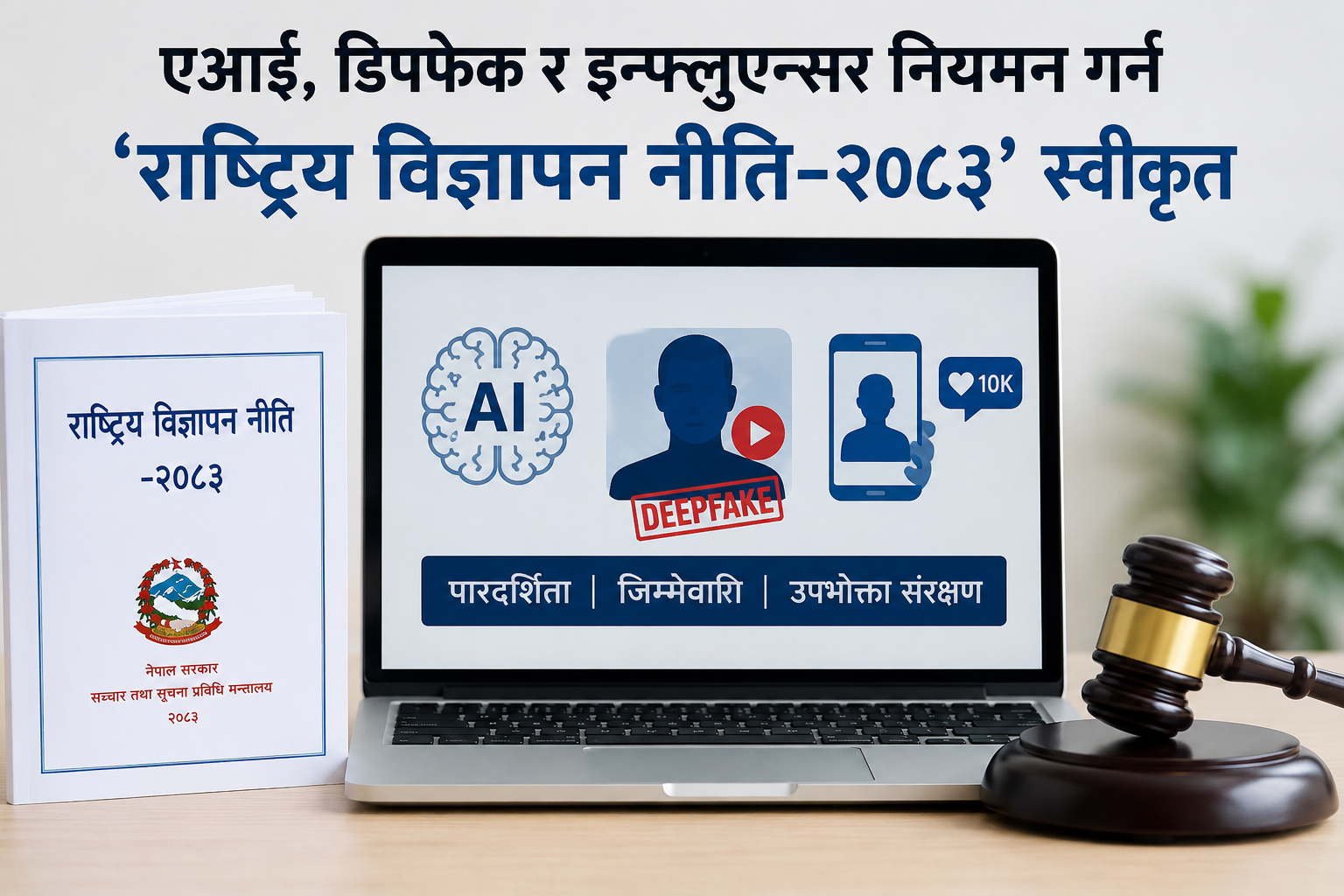
Kathmandu. The government has approved the ‘National Advertising Policy 2083’ to regulate social media, digital media, AI, deepfake and influencer marketing. The new policy mandates self-disclosure on sponsored content and influencer marketing, prohibits factual and misleading advertising, and provides compensation to consumers.
According to this policy issued by the government, advertising through social media and digital media will be formally regulated. The policy approved by the cabinet meeting on Thursday has brought the challenges of modern technology such as AI, deepfake, influencer marketing and sponsored content under the scope of regulation.
Sponsored content and influencer marketing on social media must be self-declared. It is mentioned in the policy that the overall advertising market will be uplifted through the capacity development of individuals and organizations working in this sector by encouraging the use of modern technology developed in the advertising sector.
Mandatory self-declaration of sponsored content and influencer marketing on social networks, “Advertisements such as deepfakes that require self-declaration of sponsored content and influencer marketing and artificial intelligence will be regulated,” strategy 9.13 states. According to this strategy, with the cooperation of all three levels of government, the plan is to be completed within the next two years.
Ranjit Acharya, Head of Prisma Advertising, says that although it is necessary to regulate the use of AI and deepfake in the advertising market, its implementation and monitoring is an important aspect. “When the identities of celebrities and influencers are being misused globally, if it is to be regulated, it will be a big disappointment to our creators,” he said, “but it is not enough for the government to make rules.” Its monitoring and implementation aspect is the most challenging and important.
Social networks, digital platforms and influencer marketing, which have become widespread in recent times, have been brought under formal regulation by the government for the first time. The policy has given the responsibility of organizing advertisements on social networks and digital platforms to the Ministry of Information and Communication with the support of the Prime Minister’s Office and the Council of Ministers.
He pointed out that the Ministry of Information and Communication and the regulator, Advertising Board should be digitally empowered to monitor the digital platform. “If there is no necessary preparation and infrastructure, there is a fear that the policy will be limited to paper only,” he said.
Laxman Humagai, the former chairman of the advertisement board, also stressed that the policy itself is not everything and a strong law (Act) is needed to implement it. “If the law is made and implemented correctly, within the next two to three years, the advertising market of Nepal will feel its positive impact,” he said. For the first time, the participation of all three levels of government in the regulation and monitoring of advertisements has been ensured.
The government plans to ban advertisements that are factual, misleading, prohibited by law and have a negative impact on consumers. “In order to organize the advertisement on social networks and digital platforms, the ratio of advertisements on traditional media and digital media will be determined,” strategy 9.15 states, “startup businesses and small businessmen will be allowed to advertise on social media and digital media up to a certain amount.” The government aims to balance advertising on digital and traditional media.
The policy has made strict arrangements to clarify the limits of advertisement and news in the media. It is said that the trend of giving advertisements on the cover of news and writing news based on advertisements will be stopped. “Advertising as news and presenting news as advertisement and publishing and broadcasting positive or negative news based on advertisement will be discouraged,” said the strategy.
In order to protect the rights of consumers, false advertising has been brought under the scope of compensation. In case of loss due to misleading advertisement, it is ensured that the consumer will get compensation. In this regard, it is said in the policy, “If there is any damage caused to consumers due to untrue and misleading advertisements, necessary compensation will be arranged.”
It is mentioned that advertisements that are against national interest and sensitivity will be completely banned. According to this, it is not allowed to make advertisements that insult the flag, national anthem and national anthems of Nepal. Advertisements that harm Nepal’s sovereignty, geographical integrity, freedom, independence, ethnic and religious tolerance, abuse the national flag, national anthem, Nisana seal of Nepal or any or all of its parts, or insult or devalue the national identity will be banned, the policy says.
The government aims to make the advertisement board more powerful for the implementation of this policy. In the coming days, advertisements will be regulated by the union, state and local levels. The government aims to increase the contribution of the advertising sector to the Gross Domestic Product (GDP) within the next five years. The policy mentions that an integrated information system and data bank will be established to prevent unhealthy competition in the advertising sector and to determine scientific rates.
The government plans to establish an advertising fund in accordance with the law for the implementation of the policy. It is said that arrangements will be made to accumulate funds received from government grants, fees, assistance received from various agencies and charitable organizations, and money received from advertising transactions in the fund.
The government concludes that there is a need for a separate national policy on advertising to bring new trends such as social media, digital media, digital and influencer marketing and AI under the scope of regulation and to address the opportunities and challenges created by the advertising business by involving all three levels of government and stakeholders in advertising regulation.
Humagain, the former chairman of the advertisement board, said that even though it is a challenging task to regulate social media advertisements created through AI or deepfakes, Nepal is capable of regulating them. For this, it is necessary to bring a monitoring system. An advertisement fund has been arranged to raise expenses for it,” he said. “The funds collected in the fund will be managed through regulatory charges raised from the market. The policy has been designed so that there is no additional financial burden on the government’s coffers.
Advertisers are somewhat worried about establishing an advertising fund. Acharya said that it should be clear where the funds will come from. “If more taxes are imposed on advertising business or if the facilities provided by agencies are cut, it will discourage the market,” he said.