
Kathmandu. The current government, which won nearly two-thirds majority in the general election, has prioritized balanced bilateral relations and economic diplomacy and multilateral cooperation.
Based on this, work is being done in the direction of increasing Nepal’s relations with neighboring and friendly countries over the years on the basis of balanced and mutual interests, expanding the areas of cooperation and strengthening the environment of trust. The foreign visits and diplomatic meetings held during the 100 days of the formation of the government will further expand Nepal’s foreign relations in the coming days, as well as increase external cooperation and harmony in the country’s economic prosperity.
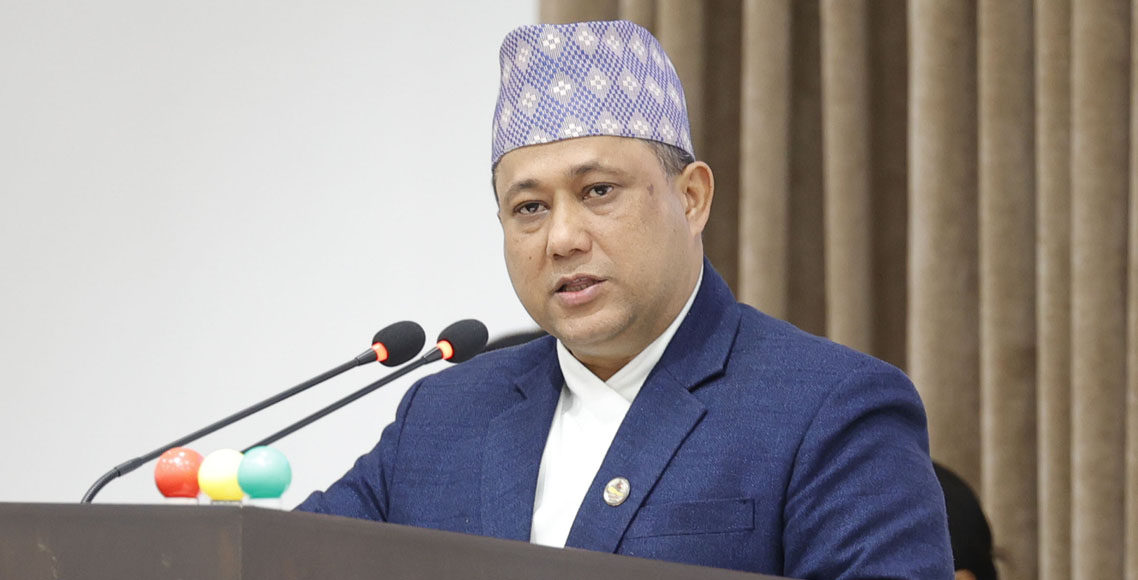
Meanwhile, Foreign Minister Shishir Khanal has made an official visit to two neighboring countries, India and China. Representatives of various countries have also visited Nepal. In addition, intensive meetings with representatives of foreign missions in Nepal are also continuing. Presented here is a part of the interview conducted by Rasas with Foreign Minister Khanal in this context:
वर्तमान सरकारको परराष्ट्र नीति विगतका सरकारहरुले अवलम्बन गरेको नीतिसँग कत्तिको मेल खान्छ ?
The current government has adopted a foreign policy based on the well-thought-out priorities clearly mentioned in the Constitution of Nepal, international commitments, election pledges and the hundred-point commitment letter issued after the formation of the government. Although the 100-day agenda mainly focuses on government reforms, some priorities related to foreign policy are included. Our priorities are focused on protecting and promoting national interests. Increasing the service effectiveness of Nepali embassies and missions abroad, improving the security and consular services of Nepalese employed abroad, creating a special mechanism to bring in investment from Nepali migrants, attracting foreign investment by activating economic diplomacy, institutionalizing high-level dialogue with development partners and neighboring countries, mapping, utilizing and managing the skills, knowledge, networks and investment potential of Nepali migrants and promoting the country’s reputation and image through the effective deployment of benign forces. The current government wants to maintain harmonious relations with all friendly countries and development partners, including its neighbors, keeping national interests at the center. Our efforts will be to maintain a balanced relationship with all, including the two neighboring friendly countries India and China, emphasize on economic diplomacy and promote a new style of diplomatic dialogue focused on the national interest while maintaining smooth relations with all.
वर्तमान सरकार गठनपछि भएका मुख्य कूटनीतिक उपलब्धिहरु के लाई लिन सकिन्छ ?
Diplomatic steps have been taken according to the priorities of the government while conducting the foreign policy according to the principles directed by the Constitution of Nepal. A clear message has been sent to the neighboring and international world about the new government’s foreign policy. The Ministry of Foreign Affairs is working as the “first line of defense” in the protection of national interests. We are working on the issues of promoting high-level meetings and cooperation, facilitating and activating meetings of bilateral mechanisms, making economic and public diplomacy effective and facilitating consular services to make service delivery simple and easy. For this, making the Ministry of Foreign Affairs and our diplomacy more powerful and effective is also a priority.
I believe that the visit to India and China, which was completed in a short time after the formation of the government, has made a significant contribution to strengthening the friendly and multifaceted bilateral relations. During the visit to neighboring countries, fruitful discussions were held on expanding cooperation in various fields including infrastructure, ‘connectivity’, border management, energy, trade, investment, agriculture, technology transfer, information technology and digitization, tourism, chemical fertilizers, petroleum and natural gas exploration and people-to-people relations.
Important work has been done on strengthening the Nepali Missions abroad, preparing a “Country Specific Strategy” focusing on economic diplomacy, holding an inter-ministerial coordination meeting and determining our negotiation-focused strategy and priorities. We have brought new programs including International Health Day, Soft Power Promotion Program of Nepal, Nepal Diaspora Global Network establishment and operation, Lumbini Fellowship etc. Similarly, the Gurkha issue, the release of Nepali prisoners in Ukraine and other issues have been coordinated through virtual communication with the ministers of the respective countries to solve the problem. In addition, we have also placed special emphasis on compliance with the diplomatic code of conduct. The issue of joint courtesy meetings at the level of the Honorable Prime Minister is also seen as a new style in diplomatic practice.
आर्थिक कूटनीति, सौम्य शक्ति प्रवद्र्धनमा वर्तमान सरकारको प्राथमिकता कस्तो रहेको छ ?
I have already said that after the formation of the current government, foreign policy and international relations focused on promoting the national interest and image of the country are being prioritized. The government has given priority to the issues of ‘digitization’ and ‘software upgrade’ for strengthening the consular service and enhancing the international image and reputation of the country through the effective deployment of public diplomacy by exposing the benign power of Nepal to make economic diplomacy particularly effective. The government has paid special attention to all the components of benign power including culture, heritage, promotion of political values and foreign policy.
The government is working with priority in the direction of achieving good governance and economic prosperity while being committed to the established norms of Nepal’s constitution, foreign policy and international relations. We have also promoted regional and international cooperation. Since the subject of foreign relations is sensitive, everyone has equal responsibility, contribution and role in this matter. Based on the principles established by the Constitution of the United Nations Charter, Non-Alignment, Principles of Panchashil, International Law and recognition of world peace as the basic principles of Nepal’s foreign policy, an independent and balanced foreign policy has been conducted keeping in mind the paramount interest of the nation.
केही दिनअघि यहाँले गर्नुभएको भारत भ्रमणबाट नयाँ शिराबाट भारतसँगको सम्बन्ध विस्तार भएको भन्ने चर्चा भएको थियो । विगतका भ्रमणहरूको तुलनामा यो भ्रमणको महत्व के आधारमा विशिष्ट मान्न सकिन्छ ?
After the formation of the present government, I visited India on the invitation of the Indian Foreign Minister on behalf of the government. Since this was the first high-level foreign visit after the formation of the new government, there was a lot of interest inside and outside the country. The relationship between Nepal and India is based not only on the relationship between the two governments but also on open borders, cultural proximity and people-to-people ties. During the visit, a focussed and result-oriented discussion was held on trade, energy, investment, ‘connectivity’ and border management.
In the past few years, both sides have reiterated their commitment to manage the ups and downs in relations due to border disputes and political disagreements through dialogue. Both sides expressed their commitment to advance the traditional friendly relations between the two countries with ‘new energy’. At present, the bilateral mechanisms between the two countries are active and smooth. Work is being done keeping economic cooperation at the center. Therefore, this visit can be considered special.
यहाँको भ्रमणपछि निकट भविष्यमै प्रधानमन्त्रीज्यूको भारत भ्रमणको अवसरमा सीमा, दुईपक्षीय व्यापारलगायतका विषयमा कुनै ठोस सहमतिको अवस्था निर्माण भएको हो ?
Nepal wants to further strengthen the bilateral relationship with India by focusing on economic development. We are committed to solving the border issues through diplomatic negotiations based on historical treaties and maps in accordance with the spirit and spirit of the close relationship between Nepal and India.
भारत भ्रमणबाट फर्केको लगत्तै यहाँले अर्को छिमेकी राष्ट्र चीनको पनि भ्रमण सम्पन्न गर्नुभएको छ । यो संयोग मात्रै हो कि कूटनीतिक चातुर्यता पनि हो ?
Neighborhood relations are very important when it comes to the country’s international relations and foreign policy. We have close relations with our ally China. In this context, rather than calling the visit to China a coincidence or a diplomatic tact, it should be considered that this visit was completed in the direction of further strengthening our relationship with China. From these visits, important discussions and agreements have been made on strengthening bilateral relations, expanding economic cooperation and strengthening mutual trust, understanding and people-to-people relations.
चीन भ्रमणका क्रममा सहयोगका कुनै सहमतिहरू पनि भए कि ?
In talks with Chinese Foreign Minister Wang Yi, bilateral relations, investment, infrastructure development cooperation were discussed. During the visit to China, the issues of infrastructure development, investment, tourism, agriculture, technology and trade expansion were discussed. We want to advance our relationship with China as an economic and development partnership. China has also committed to continue infrastructure construction and economic cooperation with Nepal. China has pledged to advance high-quality ‘Belt and Road cooperation’ with Nepal, expand cooperation in the fields of power transmission lines, highways, border crossings and air links. China has reiterated that it will help Nepal to transform from a ‘land-locked’ state to a ‘land-linked’ country.
आगामी दिनमा नेपालको परराष्ट्र नीति कस्तो हुनुपर्ने देख्नुहुन्छ ?
World politics is now entering a new phase of intense competition and balance of power. There are also very interesting projections on the subject of the new world order. In addition, the need for Nepal to adopt a balanced diplomacy has increased. On the one hand, there is a need to expand foreign relations keeping our national interests at the center, and on the other hand, there is a need to maintain bilateral and multilateral relations in order to find solutions to the challenges brought by the rapid development of globalization and information technology. The government is working with the national interest at the center. Therefore, a reasonable, effective and development-oriented foreign policy for the protection and promotion of national interests while examining the changing world environment is the next need.