
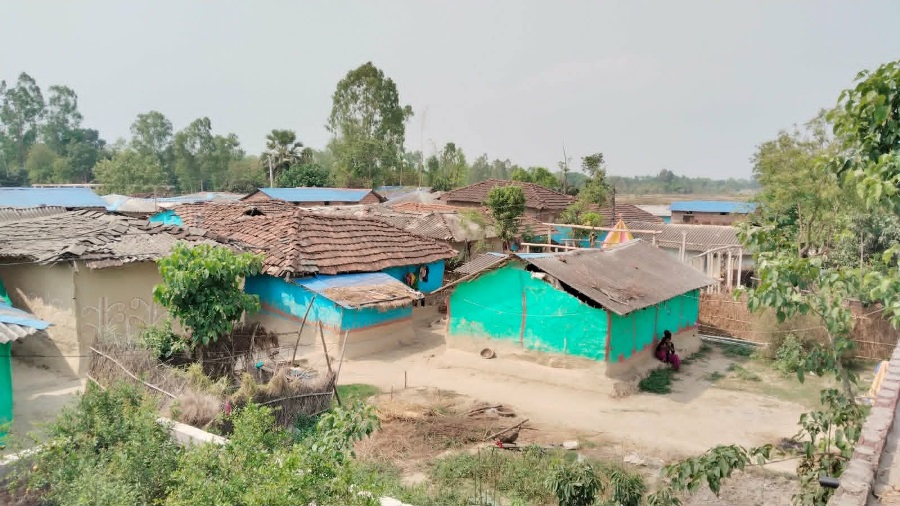
Janakpurdham. Even after eight years have passed since Nepal was declared an open defecation-free country, residents of one Musahar Dalit settlement in Dhanusha are still forced to defecate in the open. Despite the government’s open defecation campaign and investment in the sanitation sector, most of the families in Pachharwa Musahar settlement located in Sahidnagar Municipality-5 of Dhanusha are forced to defecate in the open.
For Urmila of that settlement, defecating in the open has become a necessity of daily life. As there is no toilet at home, he has to go to the fields to defecate in the dark at night or early in the morning. “It is embarrassing to defecate in the open, some farmers even abuse”, he says, “This problem has become more complicated for women.”
There are more than 100 households in the settlement, only three houses have toilets. The rest of the family has been defecating on the banks of fields, bamboo groves and kholsa for years. The ward was declared free of open defecation in 2075. But this settlement of the Dalit community is far from the reach of sanitation facilities.
According to local Shobendra Sada, there are about 370 people living in the settlement. The elderly, women, men and even children are forced to defecate in the open. Some families do not have the necessary land for toilet construction, while others are unable to construct it due to lack of finances, according to local Param Devi Sada. He says that some have not built toilets in the hope of government support.
According to Paramdevi, women are forced to go to the fields at night after men sleep or before morning light. “When living in an open place, there is fear of snakes and poisonous insects, there is also the worry that someone will see”, he says, “When the fields get flooded during the rainy season, the problem becomes more serious.”
Most of the families in the settlement are Sukum residents. They do not have enough land, nor the financial resources needed to build toilets. Since there is no land other than the small house where they are living, the residents of those settlements have to depend on other people’s farms. Local Ramdayal Sada says that this raises questions related to not only cleanliness, but also human dignity and security.
According to Ramdayal, due to open defecation, the environment around the settlement is becoming dirty. “Due to the lack of toilets, the risk of diseases such as diarrhoea, diarrhea and typhoid has increased”, he says, “Children and the elderly are more affected by the lack of sanitation.”
According to Ramdayal Sada, Central Secretary of Harwacharwa Adhikar Manch, more than 1,000 families are without toilets in Sahidnagar municipality alone. According to him, there is still a problem of toilets in the slums of Dhanusha’s Sabala Municipality, Videh Municipality, Mithila Vihari Municipality and Kshireshwarnath Municipality.
Nepal was declared an open defecation-free country in 2075. At that time, it was claimed to be the first open defecation-free country in South Asia. But the reality of Pachharwa Musahar settlement has raised questions on the effectiveness of the announcement. Kamlesh Yadav, a local youth of Sahidnagar Municipality, said that even though billions of rupees have been spent in the name of cleanliness campaign, the inability to reach basic facilities to the poor, Dalit and Sukum residents is a challenge.