
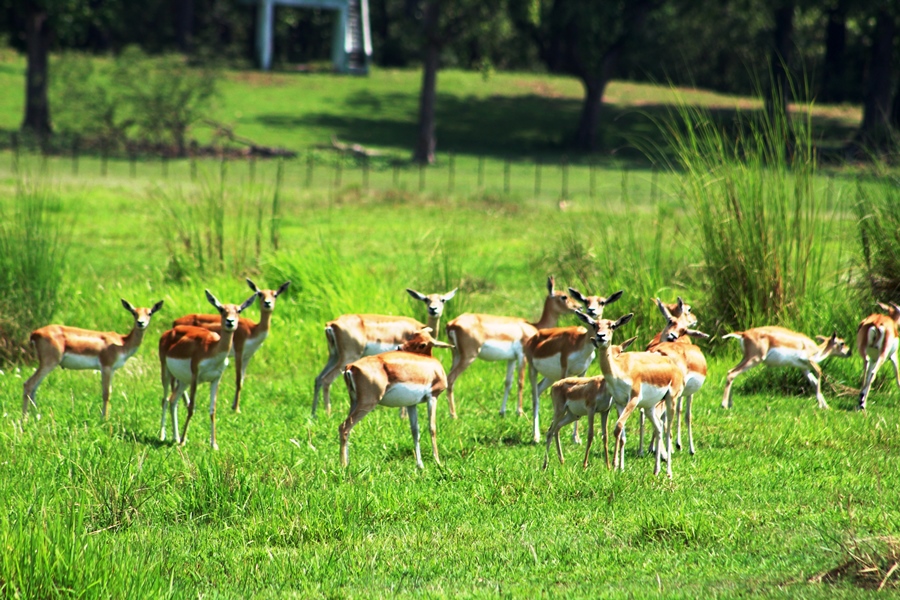
Kanchanpur. The number of Krishnasara, a rare wild animal protected in Hirapur Conservation Area of Kalaphanta National Park, has increased to 313. About a decade and a half after the start of the conservation program, although the number of krishnasar has increased significantly, management has become challenging with the increasing number.
According to the latest statistics of the park, there are 81 adult males, 20 mid-adult males, 102 adult females, 26 mid-adult females and 84 females of Krishnasar, information officer of the park, Purushottam Wagle said. According to him, with the success of the conservation program, the number of krishnasar is continuously increasing.
“Now the main challenge is management”, Information Officer Wagle said, “Since the risk of disease increases when there are too many in the same area, the department is studying the options of releasing them openly in the natural habitat or transferring them to other suitable areas.”
According to the decision of the Ministry of Forest and Environment, preparations are being made to restore the Krishnasar in Chitwan by adjusting the balanced ratio of males and females from Shuklaphanta and Khairapur conservation areas of Bardia. “It is also necessary to maintain hereditary (genetic) diversity”, Wagle said, “According to the breeding management plan, spreading conservation in different areas is more effective in the long term, improving the new generation.”
In the Hirapur branch of the park, an area of 58.8 hectares has been fenced and protected. Initially, the conservation area which started with an area of 7.5 hectares in the year 2012 has been gradually expanded to its current size.
Since Krishnasar likes open grasslands, it is seen that it is challenging to protect them from leopards, husky dogs and poachers when left in their natural habitat. Along with this, the infectious disease transmitted by loose quadrupeds is also a major conservation challenge, said Information Officer Wagle.
The park has been doing the work of conservation of grazing area, grassland management and food management by planting crops such as corn and lentils. Information Officer Wagle said that due to lack of regular budget, there is difficulty in resource management. In 2012, 22 adult males, four mid-adult males, 12 adult females and four mid-adult females were brought from Nepalgunj’s mini zoo for Krishnasara conservation in Shuklaphanta.
In the same year, three adult males, two adult females and one unsexed krishnasar were transferred from Sadar Zoo in Lalitpur for rehabilitation. In 2015, 14 Krishnasaras were brought from Khairapur conservation area of Bardia, consisting of three adult males, one half-adult male and 10 half-adult females.
A total of 42 Krishnasaras were transferred from all the three areas, including eight adult males, five mid-adult males, 24 adult females, four mid-adult females and one unsexed. The number of 42 krishnasars that have been relocated has increased to 313 in about a decade and a half, which is an increase of about seven times, according to the statistics of the park.
To protect the health of Krishnasar, grains, bran, rice bran, maize and gram have been fed regularly. Information officer Wagle informed that drug-mixed food will also be provided from time to time to prevent the infection of parasites such as worms and worms. .
According to the National Parks and Wildlife Protection Act, 2029, Krishnasar is one of the protected wildlife of Nepal. Once abundant in the open grasslands of Nepal, India and Bangladesh, this species became endangered due to habitat destruction, poaching and natural disasters.
Hirapur conservation area is now becoming a center of attraction for domestic tourists. Domestic tourists arrive daily to see Krishnasar. A rare and attractive wild animal, Krishnasar’s main food is grass, dubo, siru, bamboo etc. In Hinduism, it is also considered as ‘friend of Lord Krishna’.
Bharat Bahadur Bista, Chairman of Sundevi Consumer Committee, said that the Krishnasar conservation area should be developed as a more manageable tourist destination. According to him, Gharbas (homestay) program has been started in Simalphanta settlement near Krishnasar conservation area. “There is a need to upgrade housing and arrange for tourists to travel to the Krishnasar conservation area”, he said, “This will help the income of local residents and also increase the internal income of the park.” He says that emphasis should be placed on tourism infrastructure.
Vinay Kumar Jha, assistant chief conservation officer of the park, said that the promotion of para-tourism has been prioritized along with Krishnasar conservation and informed that the conservation area is being further organized by maintaining a balance between the participation of the local community and conservation.