
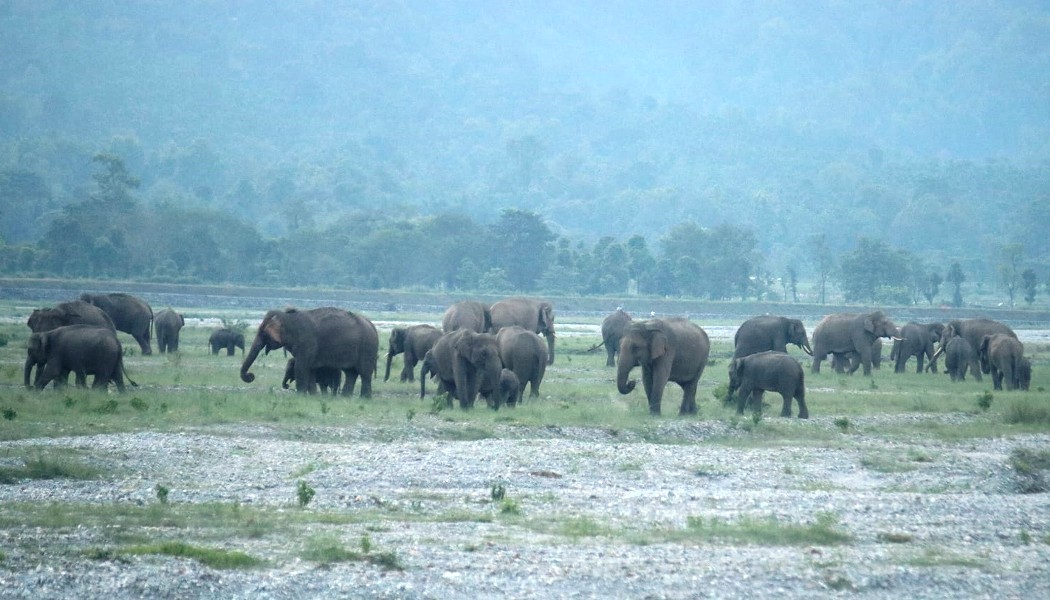
Jhapa. The middle of June is the main time for farmers to sweat in the fields to bring in the food crops for the whole year. However, the residents of Mechinagar-4 Bahundangi in Jhapa are worried about saving lives and money more than the sowing of seeds.
Since the wild elephants that came from India with the elephants (baby elephants) have started staying in the village all day long, the residents are now forced to live in fear. Herds of elephants coming in the number of 40 to 50 every day sometimes return to India and sometimes they spend the whole day in the tea plantations and bushes of Bahundangi. According to the local residents, there is fear that some untoward incident will happen in the village because the elephants that come with the pack are more aggressive.
There is a situation where parents are not even able to send their children to school due to the fear of elephants. Children’s studies have been affected due to the fear of encountering elephants on the road. Farmers have stopped planting paddy in the June mud and are walking all day long to drive away elephants with their lives in their hands. Local youths, villagers and the police administration team are trying to drive the elephants hiding inside the tea plantations to a safe place away from the human settlements by sounding sirens and adopting various measures, but this effort has proved to be only short-lived.
Ward President of Mechinagar-4 Arjun Karki said that the team of local government and security agencies are constantly deployed in the field for the safety of citizens. He said, “With the help of local youth, Nepal Police and Armed Police, we are working to chase the elephants from slums and tea plantations towards India by sounding sirens. This problem cannot be solved by the single efforts of the local level, the federal government must take concrete steps for this.”
Neelkanth Tiwari, a local resident of Bahundangi, who has been suffering from the problem for a long time, expressed his anger and pain and said, “We submitted a memorandum to the Prime Minister to take initiatives for control through the Chief Minister and Chief District Officer as it has become difficult to protect the people. But there was no hearing.”
The conflict between Bahundangi and elephants has been going on for decades. This is a natural route (corridor) from ancient times for elephants to travel from Assam and West Bengal in India to Koshitappu Wildlife Reserve in Nepal. Due to the expansion of human settlements and deforestation, elephants have started entering the village after the path of the elephants has been blocked.
The electric wire fence (fencing) installed at the cost of crores in the border area to stop the elephants has become dilapidated in many places, while the elephants have found a new way to enter the village by pressing the wire with tree branches or by cutting down poles. Similarly, there is not enough food (bamboo, cyru, banana) for the elephants in the forest area and they are attracted to the village because they get the grain or paddy stored in the village.
This problem will not be solved just by playing the siren at the local level or driving for a while. For this, it is necessary to coordinate the ‘cross-border’ between the governments of Nepal and India to manage the old elephant corridor. For the time being, if the local administration does not repair the fencing, adopt high security vigilance in the affected areas and guarantee proper compensation to the farmers, it seems that there may be a humanitarian crisis in Bahundangi.