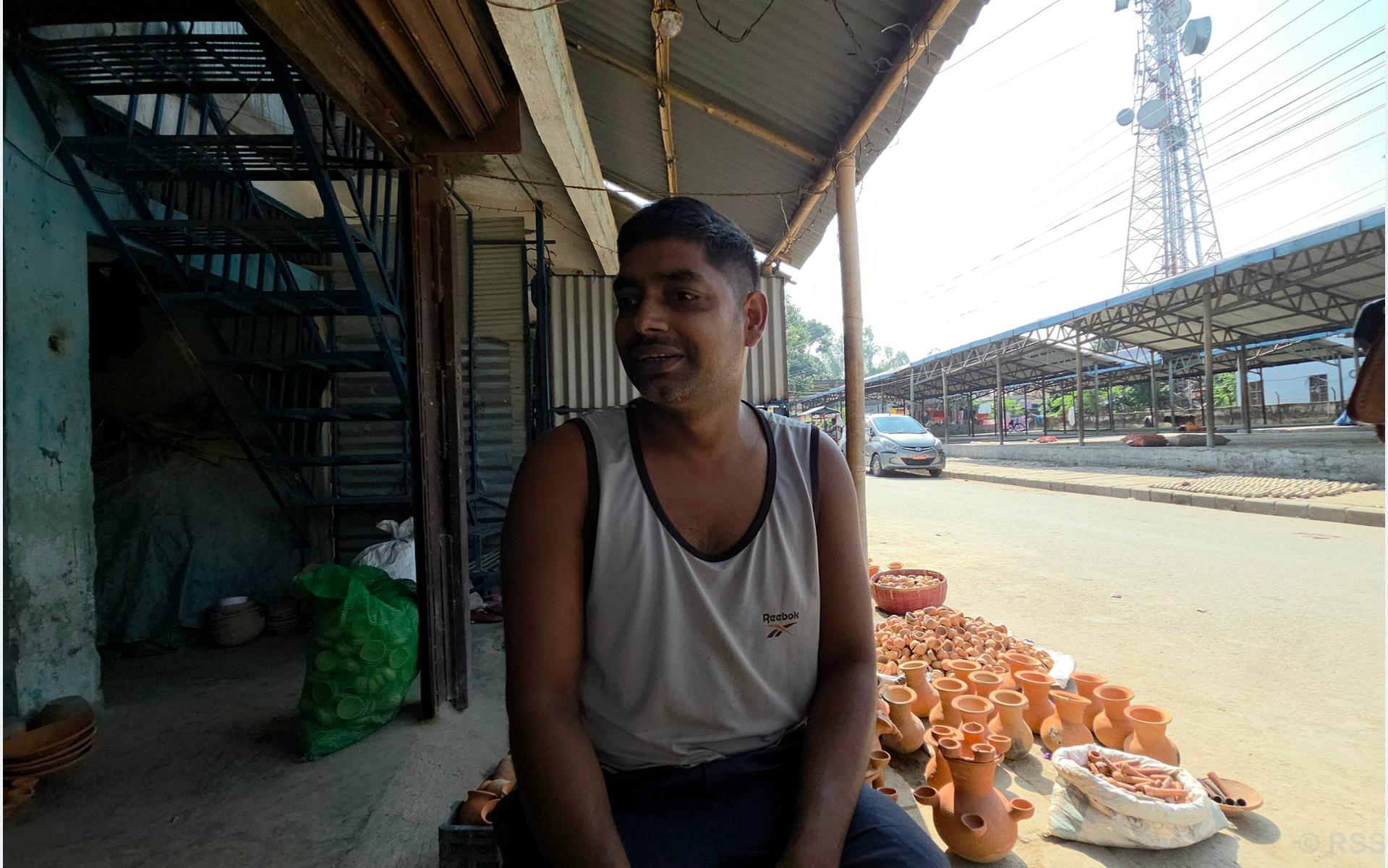
Sunsari Sriram Pandit of Inaruwa Municipality-2 Thursday has been continuing his ancestral profession of making pottery.
As the use of plastic utensils in the market is increasing, the use of clay materials is decreasing, but he has not left the profession he has been doing since his ancestors. Pandit said that the use of earthenware is decreasing from village homes to city markets with modernity, but it is continued as it is an ancient profession.
Earlier, he had to knead the clay by hand to make pots of different shapes, but now, he has the experience that the work is easier with the use of machines. “Earlier, it used to take a lot of time and effort to knead the soil by hand and make the material. Now, with the introduction of machines, it has become easier to make the clay material, it takes less time and effort”, Pandit said.
Clay glasses, lamps, palas, elephant statues, vases, khutrukes and various materials used in worship have been made. Pandit said that even though normal items are sold throughout the year, the demand is high during the festivals of Tihar and Chhath, so sales are also high.
“Even if it looks easy, it takes effort to make clay materials. At first, clay has to be brought. Then it is mixed with water and kneaded, given different shapes with the help of a machine, dried in the sun, colored and burnt in a kiln before it is ready for sale”, he said.
Pandit said that although clay used to be brought from Sunsari’s Chimdi, now they have stopped getting clay there, so they have to bring clay from Saptari to make pots. According to him, it costs Rs 10,000 to Rs 15,000 for soil transportation in a tractor and Rs 20,000 for bringing it in a tipper. Pandit informed that material worth about Rs. 150,000 can be made from one cart of soil.
He informed that only during Tihar and Chhath festivals, items worth Rs 1 lakh to Rs 2 lakh are sold. “This is our ancestral profession. This is also the source of income. We have been earning our family’s livelihood by doing this business throughout the year. There is no other profession. We do not keep track of how much material is sold in a year and how much is saved by cutting expenses. It is enough for the family to eat”, Pandit said.
He says that since he has his own business, he can work at a time that suits him and be with his family. He says that if you have your own business in the country, you don’t have to go abroad. There is no need to carry the material made by Pandit to the market for sale. Due to the Thursday hot bazaar near the house, the customers come to the house to buy the material and take it away. So there is no problem of market for sale.
According to Pandit, many people involved in this profession have changed their profession after the use of earthenware decreased. Now only a few are continuing the profession that their forefathers have been doing. “Since it is the profession that my grandfather has been doing, I have continued it. I have been supporting the family by doing this work. I am happy to preserve my ancestral profession”, Pandit said.