Jhapa. The foundation stone of Nepal’s second inland petroleum pipeline ‘Siliguri-Jhapa Petroleum Pipeline and Greenfield Terminal Project’ was jointly laid today.
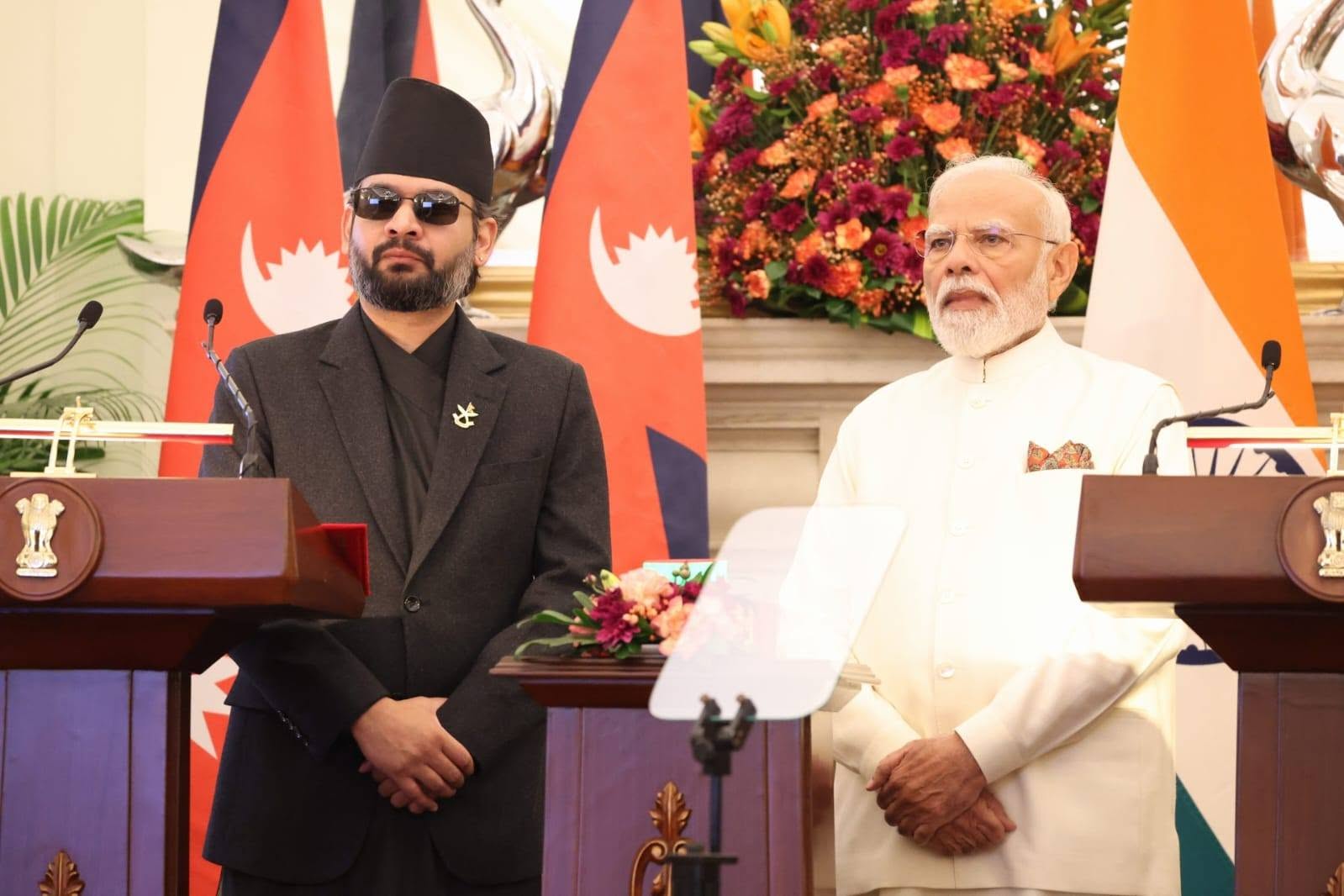
During the state visit to India, Prime Minister Balendra Shah and Indian counterpart Narendra Modi launched the project by remote pressing through virtual technology from New Delhi.
Under the ‘Government-Government’ (GTU) agreement between the Government of Nepal and India, this project will be built with 100 percent subsidy from the Government of India and the technical support of the Indian Oil Corporation (IOC), said Project Head Surendra Mahato.
The cost of construction of the pipeline and terminal is estimated to be around Rs. 12 billion. According to the bilateral agreement, the project is set to be completed within 54 months (four and a half years) from the date of construction.
According to him, the total length of this pipeline will be 49.6 kilometers, 35 kilometers towards India and 14.6 kilometers towards Nepal.
The pipeline that starts from the terminal of IOC in Siliguri, India, enters Nepal near Mechi bridge and reaches Ward No. of Mechinagar Municipality of Jhapa. 6, 10, 11 will reach the proposed terminal at Mechinagar-13, Charali and will end.
According to the bilateral agreement, Nepal Oil Corporation has managed the pipeline route from Kankarvitta to Charali and the land for the storage area.
The government In 2074, 23 bighas, 3 katthas, 13 dhurs of land have been managed in Charali and the field office has also been put into operation, the project chief Mahato informed.
As the corporation has completed pre-feasibility study, detailed project report (DPR) and preliminary work of land management, it is said that IOC will soon start the work of laying the pipeline and construction of the storage house.
In pipeline construction, eight inch diameter carbon steel pipes will be buried underground at a depth of at least one and a half meters. He said that state-of-the-art SCADA system and fiber optic sensing technology will be installed for security and leakage control.
The total storage capacity of the state-of-the-art greenfield terminal to be built in Charali will be 32,800 kiloliters, said Manish Neupane, head of administration of the field office of the project. In which 32 thousand 200 kiloliters of diesel and 6 thousand 600 kiloliters of petrol can be stored.
He informed that the terminal will be equipped with ‘smart vertical tanks’, truck loading facilities with eight ‘bays’ that can be filled with fuel at once, and two fire fighting water-foam tank systems.
He said that while laying the pipeline, rivers like Mechi, Ninda, Hadia and Phulbasa have to be crossed, so that the ecological system of the river and aquatic life will not be affected, the technique of ‘Horizontal Directional Drilling’ (HDD) will be adopted. According to the project, the natural flow of the river will not be obstructed as the pipe will be taken from a depth greater than the surface of the river.
In order to reduce the air pollution and fuel loss by converting the vapor released during the operation of the terminal, a ‘Vapor Recovery System’ and an ‘Oil Water Separator’ will be installed to process the water mixed with oil.
During the visit of then Prime Minister Pushpa Kamal Dahal ‘Prachanda’ to India in June 2080, a bilateral agreement was reached with Indian Prime Minister Modi regarding the construction of this pipeline.
In October 2081, a formal agreement was signed between Nepal Oil Corporation Executive Director Dr. Chandika Prasad Bhatt and Indian Oil Corporation Director Senthil Kumar in New Delhi to implement the same agreement.