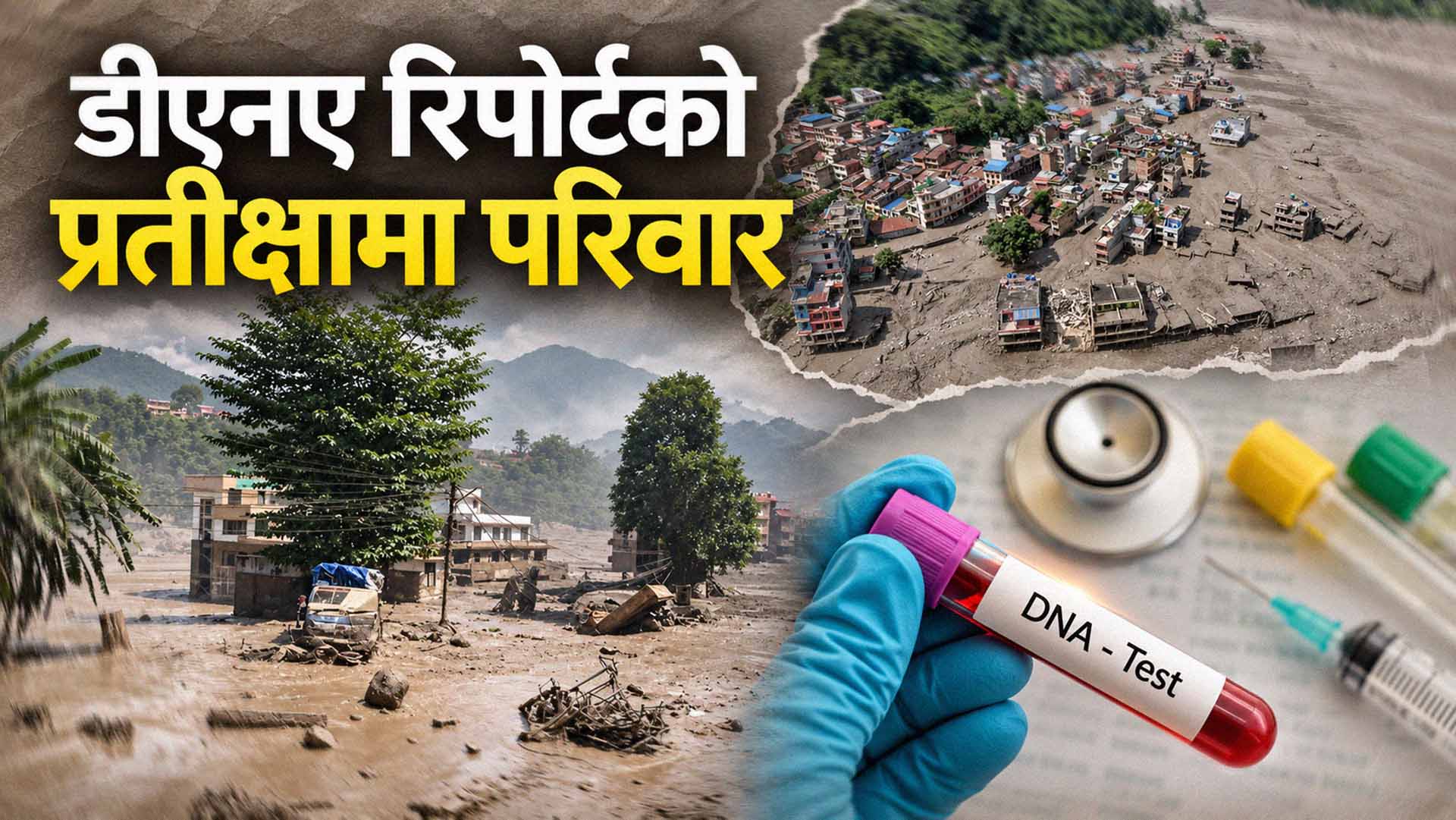
Kathmandu. It has been three months since 53-year-old Taranath Choulagai of Doramba, Ramechhap went missing in the Rasuwa flood. His family cremated him 20 days after his disappearance, hoping to find Saas. However, as the real condition of Taranath is not certain, the family is still worried.
The family of Taranath, who went missing in the severe flood in Rasuwa on August 10, is now waiting for the results of the DNA test.
Taranath’s daughter Shanta Chaulagai and wife Sumitra Chaulagai provided samples in Kathmandu after the government started the process of DNA testing to identify the abandoned corpses and body parts found in the flood. However, even after three months, the results of the test have not been received, Shanta said. A form called ‘Declaration of missing and dead body’ came. I have filled that form and submitted it. After that, nothing else happened,” she said.
He says that the family is in more confusion as there is no official information about his father’s condition.
Similarly, Analal Rokaya’s brother Shersingh, sister-in-law Bishnumati and nephew Deepak of Nepalgunj are also missing in the flood. The family complained that they had to spend the festival in pain as they did not get any information about the relative’s condition and the results of the DNA test did not come. He says that it is difficult for the family to fulfill social and religious rituals as it is not decided whether the relative is alive or dead.
Shanta and Analal are only representative characters. Other families who lost relatives or disappeared in the Rasuwa flood are also waiting for identification and the finalization of the government process. They have been in uncertainty for a long time due to the results of the DNA test and the administrative process not proceeding.
More than 1500 bodies and organs have yet to be identified
According to the latest statistics of the National Disaster Risk Reduction and Management Authority and the Nepal Police, 1,263 dead bodies and more than 500 partial human parts found in Rasuwa, Nuwakot, Dhading, Nawalparasi, Chitwan and other districts after the Rasuwa flood have yet to be identified. The situation of having to identify a large number of corpses and body parts also shows how complicated the post-disaster identification process is.
Due to the rapid flow of the flood, the body is not found in complete condition and different body parts of the same person can be found in different places, so DNA test alone is not enough for identification. Therefore, experts say that fingerprints, dental tests and other scientific evidence should also be analyzed.
What is the DVI team doing? When will the relatives get the body?
The identification process of dead bodies and body parts of the dead and missing persons due to Rasuwa flood is continuing. For this, a Disaster Victim Identification (DVI) team has been formed and the process of DNA testing and identification of dead bodies has been started.
The head of DVI team Dr. According to Srijan Kunwar, identification of dead bodies and various body parts found in the flood is being done according to scientific methods and international protocols. She said that the body will be handed over to the family only after the identification process is completed.
According to him, the DVI team includes fingerprint analysts, DNA analysts, forensic odontologists and legal experts. The team is working to identify the body through the analysis and coordination of various evidences. DNA testing alone is not enough to identify the bodies found in the disaster. In this case, there is no whole body. Many of their body parts have been dismembered.” She says, ‘DVI is a process that requires sources other than DNA to identify someone. The dead body should be submitted only after scientifically confirming the identity by integrating various bases including teeth and fingerprints.
He said that due to the rapid flow of the flood, the body is not found in complete condition and different body parts of the same person can be found in different places, so the identification process has become complicated. It is possible that body parts of the same person may be found in different places in Nuwakot, Dhading or Rasuwa. Therefore, it is not possible to reach a conclusion based on one part or one piece of evidence.” she said.
Handover of body only after identification is confirmed
Dr. According to Kunwar, this is the first exercise in which the process of body identification has been systematically carried out by forming a DVI team in accordance with international protocols in open natural disasters in Nepal.
Preparations are being made to hand over the identified dead bodies to the families in a phased manner rather than at once. For that, coordination with the family, necessary consultation and scientific and legal process related to identification will be completed, she said. There should not be a situation where one person’s dead body can be transferred to another person in haste. We transfer only after completing all the procedures so that there is no error,” she said.
The number of people who will be transferred in the first phase of the body transfer has not been determined. She said that the transfer process will be started by gradually informing the families whose identity has been confirmed.
He said that even after the flood, the body parts and remains can be found in different places, so the work of identification will continue. If additional organs or remains of a person are found later, they will also be identified and managed according to scientific methods.
However, even though the identification process is progressing scientifically and legally, it is getting more difficult every day for the families who are waiting for information about the condition of their relatives. For them, not only the results of the DNA test, but also clear information about the condition of their relatives and the finalization of the relief process have become a matter of waiting.