Twelve. The splendor of Sama Chakewa, the original festival of Terai-Madhes, which is a symbol of brotherly love, is now overshadowed in Terai Madhes.
Nowadays, in villages, it is seen that young girls form groups and play grass chakewa. From the night of Govardhan Puja, they started playing Sama Chakewa. This original festival, which is played till the Kartik Purnima, has now increased the excitement in the village. This festival is especially celebrated by the Madhesi and Tharu communities living in Rautahat, Bara, Parsa, Rautahat, Sarlahi, Sirha, Saptari, Dhanusha, Mahotari, Nawalparasi and other areas of Terai-Madhes.
According to local priest Dhirendra Mishra, after Lord Krishna spent his childhood in Gokul and came to Mathura, Sama Chakewa, celebrated by Radhika and Lord Krishna’s 16,000 gopinis in memory of Lord Krishna, has been transformed into the original festival of brotherly love and harmony.
“During this festival, first the brother is killed by the sister in a song and then he is brought back to life through the song,” he said.
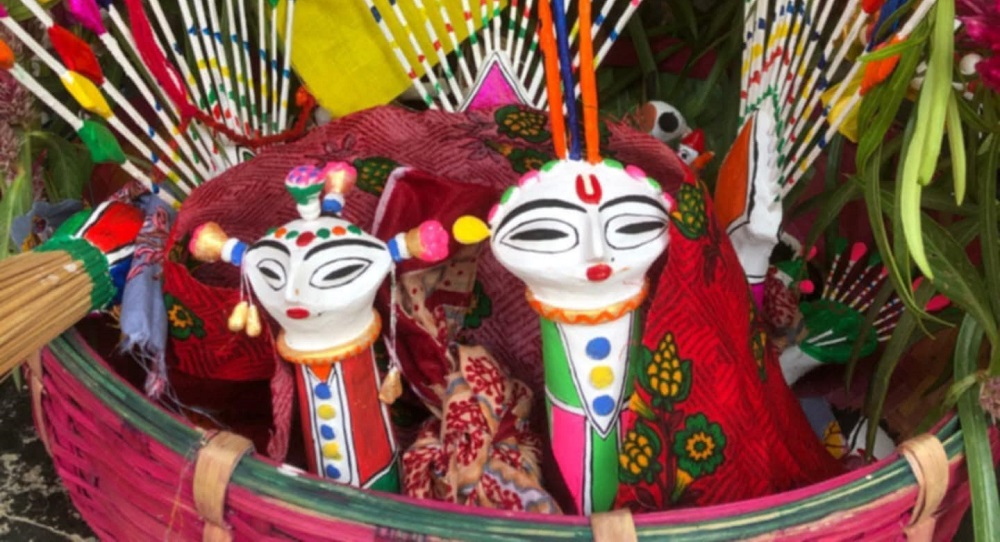
During this cultural festival, which is celebrated for two weeks, at night, especially the virgin girls of the village gather and sing folk songs to idols made of clay. On the last day of the festival, on the night of the full moon, the idol is broken down while singing a traditional song, and then it is thrown into a nearby river, reservoir, pond or lake, and the festival is duly completed after offering sweets to the brothers and sisters.
“On the day of idol worshiping, the girls collect the offerings collected from their parents and buy milk, sugar and vegetable dishes from them,” said Sonikumari Thakur, a girl from Kalaiya sub-metropolitan city-2 Oudhapur, “We collect the rice available at home and cook it.”
He informed that the food cooked in that way will be served reverently by calling the brothers and sisters of the village along with him. In Sama Chakewa, there is a custom of five people including Chakewa (brother), Sama (brother-in-law), Khidlich (sister), Brindavan and Chungala (brother) who are kept in colorful pots and go around the village to collect food and gifts.
Khushbu Kumari, a local teenager, said that on the last day of the festival, it is customary to organize a feast and feed the dear ones and friends from the grain and cash raised as offerings. There is also a tradition of entertaining by dancing and singing on this occasion. Saraswati Choudhary, a local teenager, said that on the occasion of the festival, in most of the villages of Tarai, various types of dances reflecting the original traditions will be performed.
“We have arranged a dance”, he said, “for that we have collected donations from the village.” In the context of that festival, in order to strengthen the blood relationship between brothers and sisters, it is common to imagine a bad character and punish it and play Chakewa.
Umesh Lal Das, president of Civil Society Bara, says that the community here should be alert and serious to keep the festival alive, which is becoming endangered in Terai Madhes. According to him, as Sama Chakewa is a festival that reflects the love between brothers and sisters, celebrating this festival increases love and affection not only in the family but also in the community.