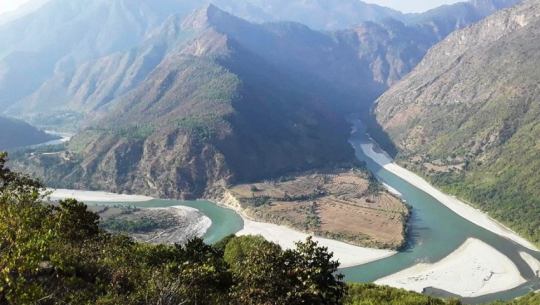
Kathmandu. Nepal and India are going to start the implementation process after finalizing the detailed project report (DPR) of the Pancheshwar multi-purpose project, which has been entangled for a long time. Prime Minister Balendra Shah and Indian Prime Minister Narendra Modi, who are on a two-day state visit to India, have instructed the relevant agencies to finalize the DPR and start the project implementation.
In point number 18 of the joint press release issued after the high-level bilateral talks held in New Delhi on Monday, it is mentioned that both the Prime Ministers have given such instructions to the Pancheswar Development Authority and the Joint Committee on Water Resources.
According to the joint statement, the Prime Ministers of both the countries have emphasized that the DPR of the Pancheshwar project should be finalized soon. After that, there was an agreement to start the project implementation. Similarly, it has been agreed to accelerate the preparation of DPR of Saptakoshi and Sunkoshi multi-purpose projects for the mutual use of water resources and to reduce the impact of floods.
The 6,480 MW Pancheshwar project envisaged under the Mahakali Treaty in 1996 has not been able to proceed for nearly three decades due to the failure to reach an agreement on water distribution and cost-benefit ratio. In 2014, the Pancheswar Development Authority was formed and a draft DPR was prepared, but it could not be finalised. Even in previous high-level visits, the commitment to advance the project was expressed, but no progress was made in implementation.
Similarly, the DPR study of Saptakoshi and Sunkoshi multi-purpose projects related to annual flood control and use of water resources in Eastern Nepal and bordering Indian areas has been slow for a long time. The latest agreement has reiterated the political commitment of both countries to advance these three projects.
Earlier, in a joint press conference held at Hyderabad House on Monday, Prime Minister Shah said that the rivers flowing through the Himalayas will remind the two countries of the common future and the climate challenge. During the visit, both the Prime Ministers jointly laid the foundation stone of the Lower Arun Hydropower Project with a capacity of 669 MW.