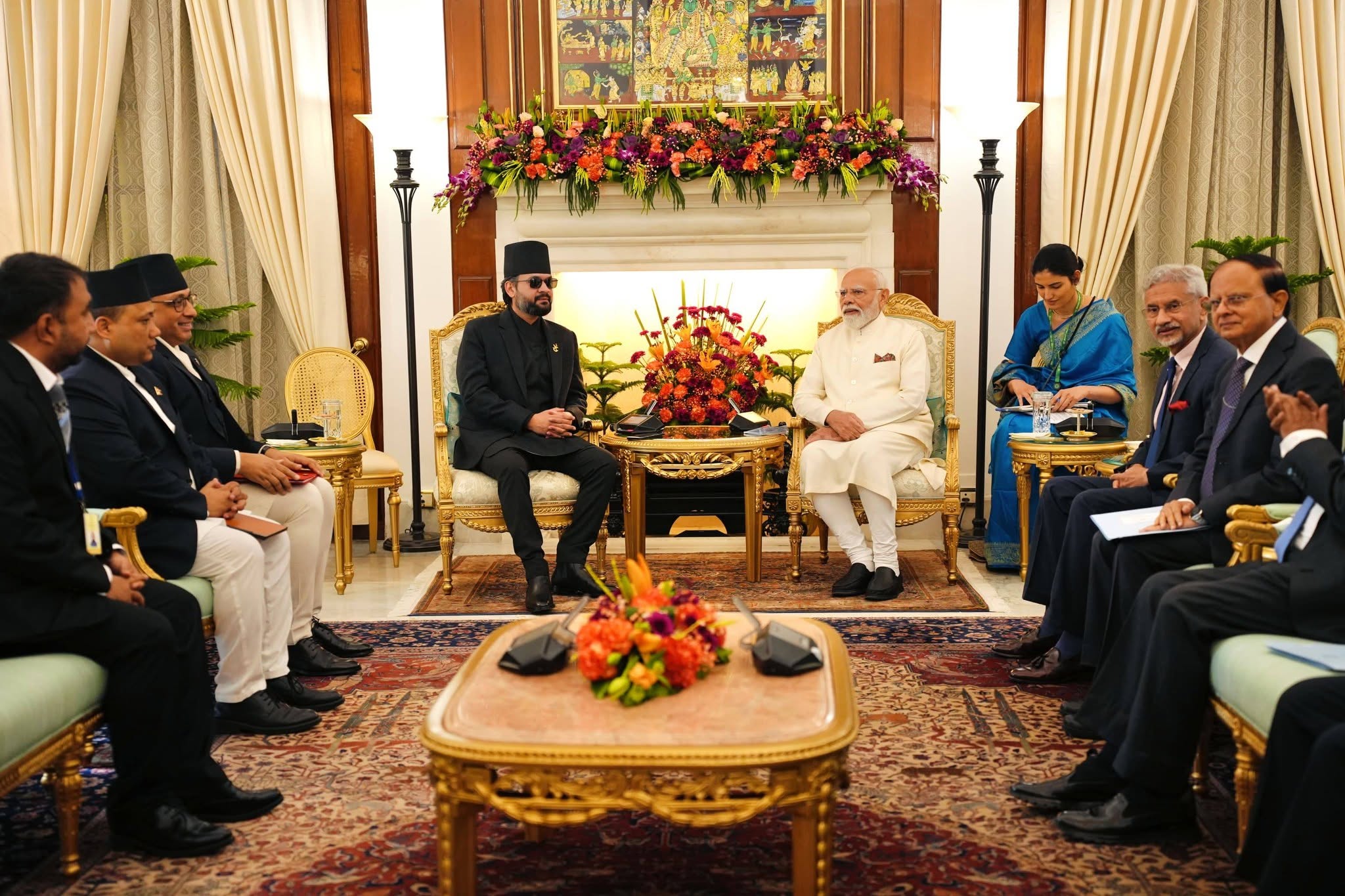
Kathmandu. During the two-day state visit of Prime Minister Balendra (Balen) Shah to India, important agreements were reached between Nepal and India in the fields of development assistance, air and land connectivity, energy, water resources, education, health, security and technology. India has announced to provide development assistance worth 24 thousand crore Nepalese rupees to Nepal and there has also been an agreement to make the Kathmandu-Bhairawa-Lucknow air route two-way.
Prime Minister Shah paid a state visit to India from November 22 to 23 at the invitation of Indian Prime Minister Narendra Modi. This is Shah’s first visit to India after becoming the Prime Minister. During the visit, he reached New Delhi with a high-level government delegation.
Prime Minister Shah was formally welcomed at Rashtrapati Bhavan in New Delhi. He reached Rajghat and paid homage to Mahatma Gandhi. Indian Foreign Minister Dr. Shah met Indian President Draupadi Murmu as a courtesy. S. Jaishankar also had a meeting.
Indian Prime Minister Modi held bilateral talks with Prime Minister Shah and hosted a luncheon in his honour. The joint statement mentioned that during the discussion between the two leaders, views were exchanged on major areas of bilateral cooperation between Nepal and India, regional issues of common interest and global developments.
Prime Minister Shah expressed his gratitude for the humanitarian and technical assistance and solidarity provided by India after the devastating floods in Rasuwa-Bhotekoshi region. Due to this flood, there was a huge human loss in Nepal as well as extensive damage to material property.
During his visit, Indian Prime Minister Modi expressed his commitment to continue India’s support in Nepal’s development journey and announced a development aid worth 24,000 crore Nepalese rupees. The said assistance will be equivalent to Indian rupees 15 thousand crores. Out of this, a grant of 5,600 crore Nepalese rupees (3,500 crore Indian rupees) will be provided for post-disaster reconstruction and construction of new infrastructure projects in Nepal. Similarly, Indian rupee-based loan facilities worth 18,400 crore Nepalese rupees (11,500 crore Indian rupees) will be provided for energy sector projects. The joint statement mentions that the process of providing assistance and the project to be selected will be finalized through mutual consultation.
Both the Prime Ministers have expressed their satisfaction with the progress of the development projects in Nepal. They reviewed the progress in implementation of projects including High Impact Community Development Project (HICDP). The progress made in the work of the Nepal Police Academy, which is being built with the help of the Government of India, has also been welcomed. Similarly, both sides have welcomed the announcement of establishing an agro-industrial park in Chitwan with India’s grant support.
Nepal and India have also passed a joint vision paper on ‘Developed India and Healthy Nepal’. It will present a roadmap for a forward-looking and ambitious partnership between the two countries. It covers economic and development partnership, connectivity, energy and water resources and people-to-people relations, as well as promoting new cooperation in the fields of climate resilience, disaster reduction and management, sports, startups, digital services, space and innovation.
Significant consensus has also been reached in the field of civil aviation. It has been decided to make the B345 Kathmandu-Bhairawa-Lucknow air route, which is currently operating as a one-way route, a two-way route. A technical consultation will be held to decide the implementation framework and finalize other civil aviation related proposals put forward by both the countries.
Modi has also announced to provide a new transit route through Deen Dayal Port (Kandla) in Gujarat, India for the transit trade of Nepal. After the necessary infrastructure is ready, access to Paradip port in Odisha will also be provided to Nepal.
The Prime Ministers of both the countries emphasized on the importance of cross-border connectivity and expansion of border infrastructure. For this, it has been agreed to proceed with the construction of new railways, bridges, integrated check posts (ICPs) and petroleum pipelines.
At the same time, both the Prime Ministers have jointly launched the Sarayu-Kamala Express train service, which will be operated between Ayodhya and Janakpur. It is expected to facilitate the movement between the two countries, promote religious and cultural tourism under the Ramayana circuit and further strengthen the cultural relations between Nepal and India. Moreover, it has been agreed to explore the possibility of expanding contact networks of similar nature to develop Buddhist and Shiva-Shakti religious tourism circuits.
It has been announced that the field location survey for the proposed construction of Raxaul-Kathmandu electric broad gauge railway has been finalized. Both the countries are also going to cooperate in developing East-West railway in Nepal.
Both the Prime Ministers laid the foundation stone for the construction of a new integrated check post in Banbasa, India through virtual means. Both sides have also welcomed the progress of integrated check post being constructed at Bhairahawa, Sunauli and Dodhara-Chandni. Three integrated check posts are already operational between India and Nepal.
A new cross-border motorable bridge connecting India’s Dharchula with Nepal’s Dharchula has also been inaugurated. It is expected to facilitate direct traffic between the western region of Nepal and India.
Both the countries have expressed their satisfaction with the progress made in the joint on-site work related to the repair and maintenance of the border posts. The foreign secretaries of both countries have been instructed to proceed with the remaining border disputes.
As part of petroleum infrastructure expansion, the second phase project of Motihari-Amlekhganj petroleum pipeline has been dedicated to Nepal. Similarly, the foundation stone of the construction of petroleum terminal in Jhapa was also laid by both the Prime Ministers through virtual means. They emphasized that the construction of a petroleum pipeline from Siliguri to Jhapa in India should be started soon. It has been agreed to explore the possibility of cooperation between Nepal and India in the construction of gas pipelines.
Both sides have expressed their satisfaction with the bilateral progress in the hydropower sector. It has been agreed to advance energy cooperation according to the joint vision paper on India-Nepal energy sector cooperation and the long-term electricity trade agreement. Both sides have also agreed on the speedy completion of the hydropower project being built in Nepal with the active participation of Indian companies. On this occasion, the foundation stone of Lower Arun Hydropower Project with 669 MW capacity was also done through virtual means.
Both the Prime Ministers have directed the Pancheswar Development Authority and the Joint Water Resources Committee to finalize the Detailed Project Report (DPR) of the Pancheswar Multipurpose Project as soon as possible. After that, it was agreed to start the implementation of the project. Similarly, it has been decided to speed up the preparation of DPR of Saptakoshi and Sunkoshi multi-purpose projects for the reduction of flood impact and mutual benefit of water resources.
Both countries have also expressed satisfaction with the progress in the process of forming a joint venture company (JV) for the construction of two high-capacity cross-border power transmission lines connecting Nepal’s Inruwa-India’s New Purnia and Nepal’s Dodhara-India’s Bareilly.
In the field of education and manpower development, India is going to establish an offshore campus of the Indian Institute of Technology (IIT) in Nepal. Both parties have expressed the belief that this will help to increase the capacity in the education sector of Nepal as well as help in creating jobs. Expanding collaborations in the areas of technology, startups, digital services and financial connectivity have also been welcomed.
Likewise, both sides have pointed out the need for mutual facilitation to provide services such as banking and telecommunication to the citizens of the other country living in one country.
Eight memorandums of understanding were exchanged between Nepal and India during the visit. Among them, an agreement has been reached between the National Forensic Science University in Gandhinagar, Gujarat and the Criminal Investigation Department of the Nepal Police for academic and research cooperation. A collaboration agreement has also been signed between the National Defense University of India and the National Police Training Institute of Nepal.
Similarly, an agreement has been reached between India’s National Center for Good Governance and Nepal’s Nepal Administrative Training Institute to conduct capacity building and training programs for Nepali civil servants. An agreement has also been reached between the governments of the two countries on cooperation in Ayurveda and other traditional medical systems.
The Indian Space Research Organization (ISRO) and Nepal’s Ministry of Communications and Information Technology have signed an agreement to establish a satellite communication (SATCOM) network for the use of South Asia satellites. Similarly, an agreement has been reached regarding technical cooperation in sustainable urban development and expanding cooperation in the health and pharmaceutical sectors. A memorandum of understanding has also been signed between the two countries on cooperation in the field of animal husbandry and fisheries development.
At the end of the visit, Prime Minister Shah thanked Indian Prime Minister Modi for the hospitality extended to him and his delegation. He has given Modi a formal invitation to visit Nepal. Modi accepted the invitation and informed that the official date of the visit will be decided through diplomatic channels.
In the joint statement, it is mentioned that Nepal-India partnership is based on deep trust, friendship, mutual respect and understanding. It is the conclusion of both sides that close people-to-people relations and economic and development cooperation have further strengthened the relations between the two countries. Continuing the regular tradition of high-level visits, both countries have expressed their commitment to further advance cooperation in the future.
Joint Press Release on Prime Minister of Nepal’s State Visit to India (22-23 November 2026)
1. On the invitation of the Prime Minister of India, Shri Narendra Modi, the Prime Minister of Nepal, His Excellency Shri Balendra Shah completed a state visit to India from 22-23 November 2026. He was accompanied by a high-level official delegation. This was Prime Minister Balendra Shah’s first visit to India after assuming office.
2. Prime Minister Shah was formally welcomed at Rashtrapati Bhavan. He reached Rajghat and paid homage to Mahatma Gandhi. Prime Minister Shah paid a courtesy call on Honorable President of India Mrs. Draupadi Murmu. Foreign Minister of India Dr. S. Jaishankar also paid a courtesy call on Prime Minister Shah.
3. Prime Minister Modi held bilateral talks with Prime Minister Shah and hosted a luncheon in his honour. Discussions between the two leaders focused on key areas of bilateral cooperation, regional issues of mutual interest and global developments.
4. Prime Minister Shah expressed his gratitude for the humanitarian and technical support and solidarity shown by India after the devastating Rasuwa-Bhotekoshi flood that caused huge loss of life in Nepal.
5. Prime Minister Modi reiterated India’s unwavering support in Nepal’s development journey as a close friend and neighbor. India will provide INR 3,500 crore (NPR 5,600 crore) in grant aid for post-disaster reconstruction and new infrastructure projects in Nepal, and INR 11,500 crore (NPR 18,400 crore) for energy sector projects through an INR-based concessional line of credit (line of credit) worth a total of INR 15,000 crore (NPR 24,000 crore). Specific projects and modalities for providing development assistance will be finalized through mutual consultation.
6. Both leaders expressed satisfaction over the progress in implementation of development projects in Nepal including High Impact Community Development Projects (HICDP). They reviewed the progress achieved in the construction of the National Police Academy being built in Nepal with the help of the Government of India. Both the leaders welcomed the announcement of setting up an Agro-Industrial Park in Chitwan with India’s grant support.
7. Both the leaders agreed on a joint vision for a “developed India and a prosperous Nepal”. This joint vision paper provides a roadmap for an aspirational and future-oriented partnership between India and Nepal. It includes initiatives to strengthen traditionally strong areas of bilateral cooperation such as economic and development partnership, connectivity, energy and water resources, and people-to-people relations, as well as new collaborations in the areas of climate resilience, disaster mitigation and management, sports, start-ups, digital services, space and innovation.
8. The leaders reviewed ongoing discussions on matters related to civil aviation to enhance connectivity and promote bilateral economic engagement. Both sides have agreed to make the currently unidirectional B345 Kathmandu-Bhairawa-Lucknow air route bidirectional. A technical consultation will be held to finalize the procedures in this regard and to address other civil aviation proposals currently under discussion by both parties.
9. Prime Minister Modi announced a new connectivity route for Nepal’s transit trade through Deendayal Port (Kandla, Gujarat). Apart from this, access to Paradip Port (Odisha) will also be provided once the necessary infrastructure is ready.
10. Both leaders emphasized the importance of improving cross-border connectivity and enhancing border infrastructure through the establishment of new railways, bridges, integrated check posts (ICPs) and petroleum pipelines.
11. The two Prime Ministers jointly inaugurated (green flagged) the new train service ‘Saru-Kamala Express’ between Ayodhya and Janakpur. Apart from improving connectivity, this rail service will further support religious and cultural tourism under the Ramayana circuit and further strengthen the cultural ties between India and Nepal. The leaders agreed to expand similar networks to develop Buddhist and Shiva-Shakti religious tourism circuits.
12. Both leaders announced the completion of the Field Location Survey of the proposed Raxaul-Kathmandu electrified broad-gauge railway and announced that both sides would cooperate in the development of the East-West railway in Nepal.
13. Both the leaders laid the foundation stone of the new Integrated Check Post (ICP) at Banwasa through virtual medium and welcomed the progress in construction of ICPs at Bhairahawa, Sunauli and Dodhara-Chandni. Three ICPs are already operational between India and Nepal.
14. The leaders inaugurated a new cross-border motorable bridge between Dharchula (India) and Dharchula (Nepal). This will help in improving direct connectivity between western Nepal and India.
15. The leaders expressed satisfaction with the progress made in the joint field work on maintenance of border posts and directed the Foreign/Foreign Secretaries of both the countries to work on the remaining border related issues.
16. During the expansion of cross-border petroleum infrastructure between India and Nepal, the leaders dedicated the second phase of the Motihari-Amlekhganj pipeline to the people of Nepal. The two leaders also laid the virtual foundation stone for the construction of a petroleum terminal in Nepal’s Jhapa and stressed that the work of the Siliguri-Jhapa petroleum pipeline should be started as soon as possible. Both sides agreed to cooperate in construction of gas pipeline between India and Nepal.
17. Both sides expressed their satisfaction with the bilateral progress made in the hydropower sector in line with the ‘India-Nepal Joint Approach Letter on Energy Sector Cooperation’ and long-term electricity trade agreement. Both sides welcomed the active involvement of Indian companies in Nepal’s hydropower sector and agreed to ensure speedy completion of various hydropower projects being developed by Indian companies in Nepal. On this occasion, the two leaders virtually laid the foundation stone of the 669 MW Lower Arun Hydropower Project.
18. Both the leaders directed the Pancheswar Development Authority and the Joint Committee on Water Resources to finalize the Detailed Project Report (DPR) of the Pancheswar Multipurpose Project as soon as possible and start the project implementation work. Both the leaders also agreed on the need to expedite work on DPR of Saptakoshi and Sunkoshi multi-purpose projects to utilize water resources for mutual benefit and minimize the impact of floods.
19. Both sides expressed satisfaction over the progress on setting up joint ventures (JVs) for two high-capacity cross-border transmission lines between Inaruwa (Nepal) – New Purnia (India) and Dododhara (Nepal) – Bareilly (India).
20. Expanding India’s development and capacity-building assistance to Nepal, the two leaders agreed for India to set up an ‘off-shore’ IIT campus in Nepal. This will give great strength to the education sector of Nepal and will also help in job creation. Both the leaders welcomed the expanding cooperation between India and Nepal in the fields of technology including start-ups and digital and financial connectivity.
21. Both sides recognized the need for mutual facilitation to expand easy access to services including banking and telecommunications for citizens residing in each other’s countries.
22. The following Memorandums of Understanding (MoU) were exchanged between the two sides during the visit:
i. Memorandum of Understanding between National University of Forensic Sciences, Gandhinagar, Gujarat, India and Criminal Investigation Department, Nepal Police on Academic and Research Collaboration.
ii. MoU between National Defense University (RRU), India and National Police Academy (NPA), Nepal.
iii. Memorandum of Understanding between the Department of Administrative Reforms and Public Grievances, National Center for Good Governance (NCGG) under the Government of India and the Nepal Administrative Training Institute (Staff College) under the Ministry of Federal Affairs and General Administration, Government of Nepal regarding capacity building training program for civil servants of Nepal.
iv. Memorandum of Understanding between the Government of India and the Government of Nepal regarding cooperation in the field of Ayurveda and other traditional medical systems.
v. Memorandum of Understanding between Indian Space Research Organization (ISRO), Government of India and Ministry of Information and Communications (MOIC), Government of Nepal for establishment of satellite communication (SATCOM) network for utilization of South Asian satellites.
vi. Memorandum of Understanding between the Government of India and the Government of Nepal regarding technical cooperation in the field of sustainable urban development.
vii. Memorandum of Understanding between the Ministry of Health and Family Welfare, Government of India and the Ministry of Health and Food Safety, Government of Nepal regarding cooperation in the field of health and medicine.
viii. Memorandum of Understanding between the Government of India and the Government of Nepal regarding cooperation in the field of animal husbandry and fisheries development.
23. The Prime Minister of Nepal thanked the Prime Minister of India for the warm hospitality extended to him and his delegation; And gave him a formal invitation to visit Nepal. The Indian Prime Minister accepted the invitation, whose official visit date will be fixed through diplomatic channels.
24. The India-Nepal partnership is based on deep trust, friendship, mutual respect and understanding at all levels, and is further strengthened by strong people-to-people ties and close economic and development cooperation. The visit reaffirmed the tradition of regular high-level exchange of visits between the two countries and the commitment of both sides to further develop it.
23 November 2026
New Delhi