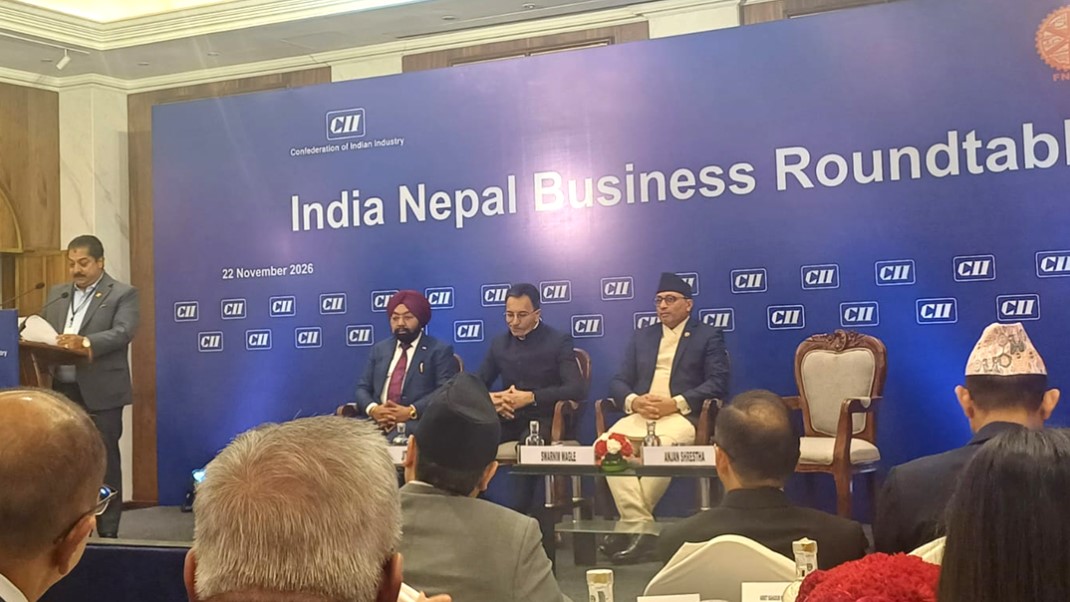
Kathmandu. Anjan Shrestha, President of the Federation of Nepal Industry and Commerce, said that the investment of the Indian private sector in Nepal has not come as expected and has urged the Indian industrialists and businessmen to expand their investment.
Speaking at the Nepal-India economic and business interaction program held in New Delhi on the occasion of Prime Minister Balendra Shah’s first bilateral foreign visit jointly organized by the Federation of Nepal Chamber of Commerce and Industry and the Confederation of Indian Industry (CII), Shrestha said that although trade relations between the two countries are strong, the investment in the Indian private sector is relatively low.
Mentioning that India is Nepal’s largest trading partner, he informed that the trade between the two countries was worth 9.4 billion US dollars last year. He said that more than 80 percent of Nepal’s total exports go to India and the share of Indian investment in the total foreign direct investment is about one-third.
He said that Nepal earned 29 billion rupees last year by selling electricity to India and Bangladesh and this income increased by 68 percent compared to the previous year. He mentioned that one out of every four air passengers coming to Nepal is an Indian citizen and the number of Nepalis living in India is also significant.
Shrestha said that despite such close commercial and social relations, Indian investment in Nepal is less than one billion US dollars. He said that it is a matter of concern that for the last two decades, the investment of the Indian private sector has not come to Nepal as expected.
Mentioning that Nepal should learn investment-friendly reforms, prioritizing investors and efficient bureaucracy from India, he said that Nepal is also advancing reforms in that direction. According to him, arrangements have been made for automatic approval for foreign investment in 102 industries, and the investment process has been facilitated through a one-stop service center. Likewise, the amendment process has been started in about 500 sections of 59 laws.
Shrestha said that in order to further strengthen the Nepal-India partnership, cooperation is needed in seven areas including trade, transportation, communication network, infrastructure, energy, investment and technology. He suggested that the access of Nepali products to the Indian market should be expanded and mutual recognition should be established between the quality certification bodies of Nepal and India. He said that if Nepali products are approved in both countries after testing, the business process will be easier.
Similarly, he emphasized on the need for effective use of Indian ports, electronic cargo monitoring and expansion of transportation services through the Kolkata-Viratnagar railway. His proposal was to develop integrated check posts and commercial shipping centers in Bhairawa, Nepalganj and Dodhara-Chandni.
He said that under the expansion of communication network, operation of Ayodhya-Janakpur train service, extension of rail connection to new border check post, more air flights in Bhairahawa and Pokhara and expansion of digital payment system are necessary. He said that Nepalese tourists visiting India should be able to pay through QR, just like there is a system where Nepali tourists can pay through UPI.
Shrestha said that in infrastructure development, the construction of highways, airports, industrial parks and urban transport systems should be promoted through public-private partnerships. He mentioned that although Nepal has more than 40,000 megawatts of hydropower capacity that can be produced commercially, only about one-tenth of it has been developed so far. He emphasized that the agreement to trade 10,000 megawatts of electricity between Nepal and India in the next 10 years should be implemented.
Presenting tourism, agricultural processing, pharmaceuticals, cement and information technology as potential sectors for Indian investment, Shrestha said that companies like Nepal Lever, Nepal SBI Bank, Dabur Nepal and Surya Nepal have already proved the potential of investment in Nepal. He asked to cooperate with the Indian private sector in transferring technology through joint ventures and developing the capacity of Nepalese manpower.
Shrestha also pointed out that two important guarantees are necessary for Nepal-India economic partnership. First, there is a safe and orderly border system with cargo monitoring, sealing and timely customs clearance, and secondly, investment security, he said. Mentioning that the government of Nepal has taken forward the private investment protection and promotion strategy, he said that it will ensure policy stability and legal and physical security of investment for at least five years.
In the program, Shrestha also raised the problems of jute, steel and Bureau of Indian Standards (BIS) certification being faced by the Nepali industry in the Indian market. He said that the anti-dumping duty imposed by India on Nepali jute production since 2017 was reviewed last September and the retaliatory duty is also under consideration. He said that since the Nepali jute industry employs thousands of farmers and workers in eastern Nepal and also buys raw jute and machinery from India, it should be seen as a partner rather than a competitor of the Indian industry.
Similarly, he informed that Nepali steel exports to India decreased by more than 60 percent in the last financial year after India imposed protective duties on Nepali steel from last December. Although India is the second largest steel producer in the world, the share of Nepali steel in the Indian market is very small.
Thanking India for making the BIS certification process easy in recent times, he said that there is still a problem of goods being stopped at the border due to the delay in renewal of certificates and the rules related to certification of raw materials. In order to solve these problems, he proposed to form a joint task force between the Federation of Nepalese Industries and the Confederation of Indian Industries on trade remedies and quality standards and submit common suggestions to the governments of both countries.
Shrestha said that since Nepal imports a large quantity of goods from India, when the Nepali industry is strong, a large market will be created for the Indian industry as well. He said that India is aiming to become a developed nation by 2047 and Nepal has set a goal of building an economy of US$ 100 billion within the next five to seven years and raising the per capita income to US$ 3,000.
Mentioning that geographical conditions made the two countries neighbors and history made them family, Shrestha opined that business should now become partners in development. He urged the Indian private sector to move from dialogue to commercial agreements and from possibilities to concrete projects and said that Nepal is open for investment.