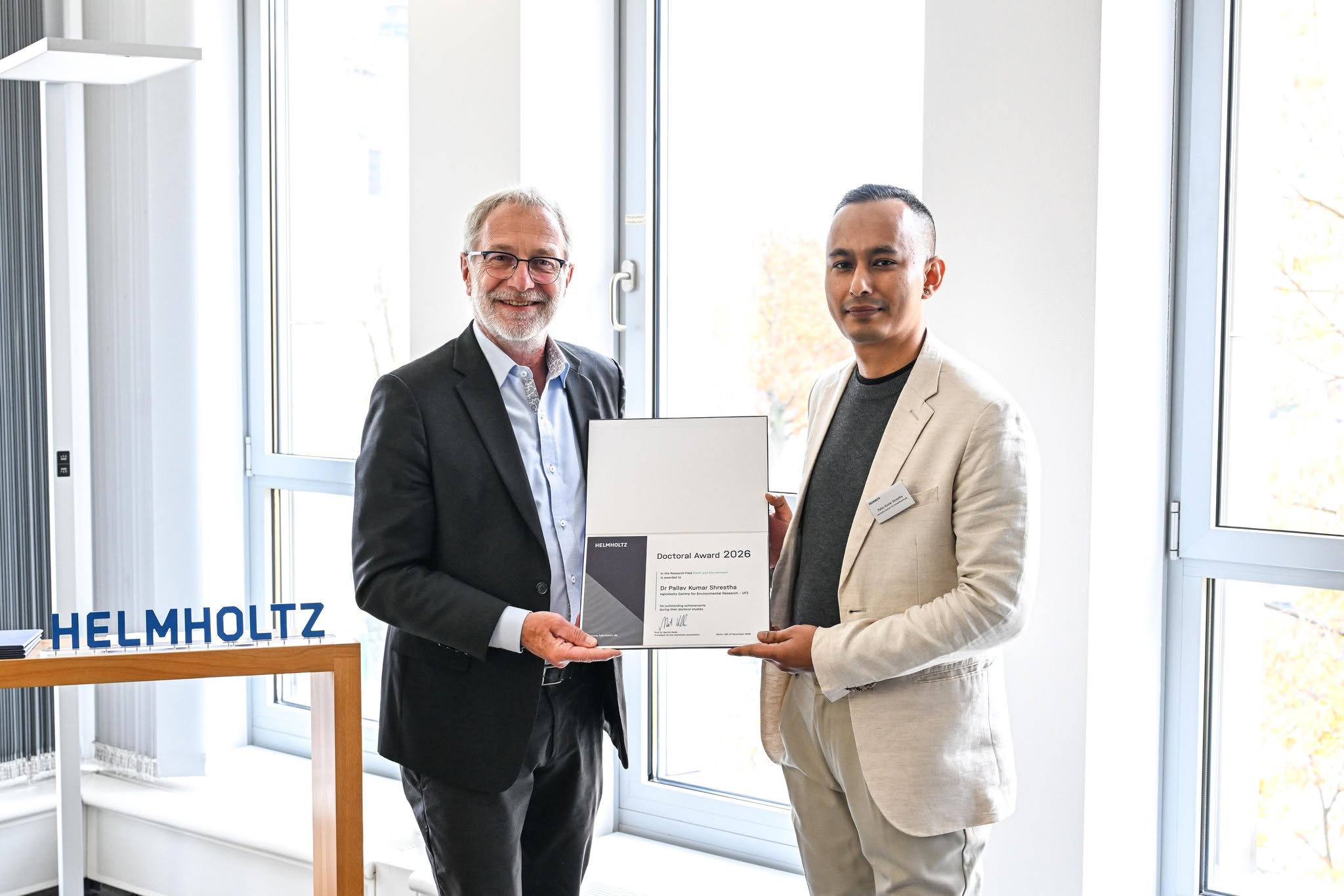
Kathmandu. The academic award of 2026 awarded by Germany’s prestigious scientific organization Helmholtz Association to Nepal’s hydrologist Dr. Received by Pallava Kumar Shrestha. 11 researchers, including him, have been awarded this prestigious award from among more than 8,000 academic researchers from around the world.
Dr. who received this award from Nepal. Shrestha is probably the first person. Chairman of Helmholtz Association Prof. Martin Keller presented him with the award. Founded in the name of the famous German physicist Hermann von Helmholtz, this organization is an umbrella organization of 18 scientific and technical research institutions in Germany. The organization has been encouraging research and innovation in various fields with the aim of using the achievements of scientific research for social benefit through technology transfer.
Dr. Shrestha holds a bachelor’s degree in civil engineering and a master’s degree in water resources engineering from Tribhuvan University, Institute of Engineering Studies, Pulchok. He graduated from the Computational Hydrosystems Department of the Helmholtz Institute for Environmental Research (UFZ), a prestigious environmental research organization under the Helmholtz Association. He is currently working as a postdoctoral scientist in the same institution.
His research is particularly focused on making river flow and flood forecasting more accurate and reliable. In the case that the existing hydrological model cannot adequately cover the watershed area of small mountain rivers, Dr. It is believed that the new system developed by Shrestha will help to accurately estimate the flow of the river according to the location. It is expected to contribute to make flood risk forecasting and early warning system more reliable through effective analysis of available data.
His research is considered very important in the context of Nepal. Here flood forecasting and effective disaster management planning depend on accurate analysis of river flows. Especially since it is difficult to estimate the flow of water in small rivers in mountainous areas, there is a challenge in flood risk identification and preparedness.
Dr. The systems developed by Shrestha’s research are not only limited to the initial concept, but are practical hydrological systems that have been repeatedly tested in Germany and Europe. It seems that such a technology can be useful in a situation where the construction and operation of hydropower projects in Nepal is delayed due to floods and the financial liability increases due to it.
Reliable advance information about river flows and floods will help in hydropower project management, safety of local residents and infrastructure development. So Dr. Shrestha’s research is seen not only as a scientific achievement for Nepal, but also as an important achievement that can be useful in flood risk reduction and water resource management.