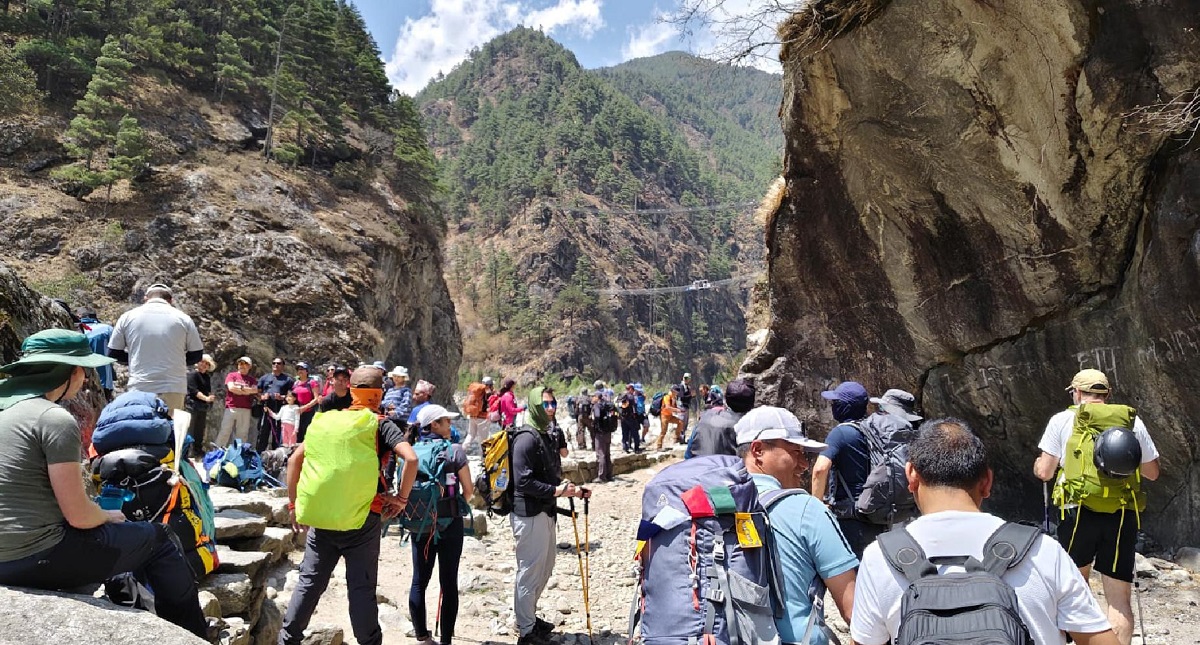
Solukhumbu. As the cold of winter increases, the number of tourists leaving the Everest region has started to increase. In the last one week, the number of tourists leaving the Khumbu region has been seen to be more than double. This has indicated that the autumn tourism season is gradually coming to an end.
According to the weekly data provided by the District Police Office, 1,800 tourists have left the Everest Region (Khumbu) by air in the last seven days, while 529 have entered. The number of tourists leaving is 651 more than entering.
According to the Information Officer of the District Police Office, Police Inspector Mausam Tamang, 877 foreigners and 303 Nepalese tourists have left the Khumbu area during that period. Similarly, 374 foreigners and 155 Nepalese tourists have entered Khumbu.
According to the details, 327 women and 550 men are out of foreign tourists. Among the Nepali tourists, 46 women and 257 men have left. Similarly, there are 102 women and 272 men among foreign tourists and 54 women and 101 men among Nepali tourists.
Dali Sherpa, a local, said that the return of tourists has intensified with the increase in cold in the Khumbu region. According to him, the temperature has started dropping to minus at night in Namche market itself. “The water has started to freeze after the night and morning temperature started to reach minus. That’s why it started to feel cold,” he said.
Among the main tourist seasons in the Everest region, the number of tourists is highest in October and October. After the end of the monsoon, the weather opens up, the mountains are clearly visible and the environment becomes suitable for trekking, so the arrival of tourists increases during this period. However, with the second half of October, the temperature drops, the night becomes extremely cold and the possibility of snowfall increases in the high Himalayan region, so the return of tourists accelerates.
Lamakaji Sherpa, president of the Everest Pollution Control Committee (SPCC) and a tourism businessman, said that the increase in cold in the high Himalayan region will affect the length of stay and activities of tourists. According to him, towards the end of the season, the return rate will increase as tourists manage their trips keeping in mind the weather, temperature, possibility of snowfall and trekking conditions.
Mentioning that the tourism activity of Khumbu region is directly linked to the weather, he said that seasonal changes will affect the movement of tourists. Tourism businessman Spidkaji Sherpa said that although the number of tourists will be high during the fall season, after the onset of winter, travel to the high Himalayan region will become difficult and the number of tourists will decrease.
According to Amrit Magar, station in-charge of Tara Air in Lukla, there is a direct effect of weather conditions and tourist season on the movement of tourists. He said that when the number of tourists increases, air traffic will also increase and as the season weakens, the number of tourists who go out will increase. “Since weather conditions are important for air flights, the flight activity from Lukla airport is also affected by the weather,” he said.
Toyakumar Shrestha, a resident of Lukla, said that with the increase in cold, the movement of tourists and the local tourism business have also started to change. He has experienced that when the main tourist season comes to an end, the activity in hotels, shops, hiking services and other tourism businesses gradually decreases. He said that tourists tend to shorten their trips or return to lower areas when the temperature increases in the higher regions.
According to the latest weekly report of the police, 69 planes and 28 helicopters flew in the Khumbu region during that period. Since air service is an important medium for the movement of tourists, the weather, the tourist pressure and the conditions of the tourism season also affect the flight activity.
Everest region is the main mountain tourism destination of Nepal. Areas including Everest National Park, Everest Base Camp, Namche Bazar, Khumjung, Gokyo, Thame and Lukla are major attractions for international tourists for trekking, mountain viewing and mountain climbing. According to Angchiring Sherpa, a tourism expert, there are more tourists during the two main tourist seasons of the year, spring and autumn.
Spring season from February to May and Autumn season from late August to November are considered as the main tourist season. Laxman Adhikari, Ward President of Khumbu Pasang Lhamu Rural Municipality-4 said that although the number of tourists will be higher during Autumn and Autumn season, as the season ends, the temperature in the high Himalayan region will drop and the weather will change.
According to Tembachiri Sherpa, a tourism businessman, the weather may become more unfavorable in the coming days as the temperature increases in the high Himalayan region and its effect may also be seen in the movement of tourists.
The latest statistics of the police also show that the return of tourists to the Khumbu region has intensified with the end of the autumn season. The fact that the number of outgoing tourists is more than twice the number of incoming tourists has indicated that the tourism activity in the Everest region will gradually decrease.