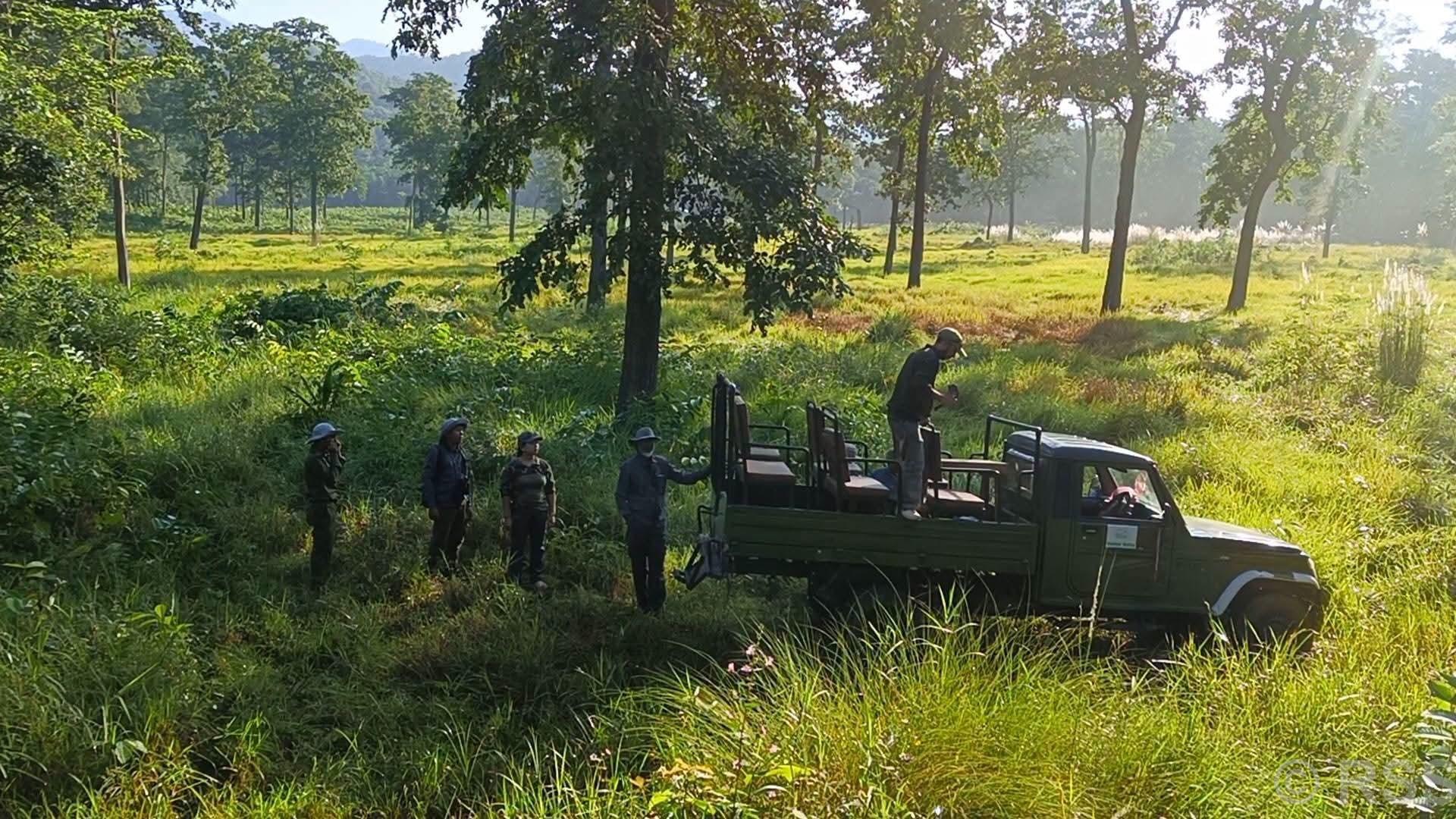
Ranjha (Banke). Banke National Park is becoming a new ‘brand’ for internal and external tourism with its unique combination of wildlife viewing, jungle safari and nature close to the city.
Banke National Park, which can be reached within half an hour’s journey from Nepalganj, has become a destination for meeting nature, watching wildlife closely and gathering exciting experiences in the silence of the forest. This open season of winter, which started with the end of rainy season, the cold air and the scent of greenery, the jungle safari has added new potential and energy to tourism in Banke.
President of Nepalgunj Chamber of Commerce and Industry Chiranjeevi Oli said that Banke National Park has become a new brand for tourism promotion in West Nepal. He mentioned that there is a need to promote tourism in Banke Park by changing our tendency to forget our near potential while discussing distant tourist destinations. “You don’t always have to go far to travel. Sometimes getting to know the world of nature hidden around you and introducing it to others is the first step in tourism development,” President Oli said, “With the resumption of the forest safari that was stopped during the rainy season, winter tourism has started in Banke National Park. In winter, the view of the forest, the opportunity to observe the activities of wild animals and the open weather can give a different experience to the safari.”
According to him, sitting in a jeep and crossing the winding paths of the forest in search of wild animals, listening to the sound of birds, observing the natural vegetation and feeling the vastness of the forest is a special experience in itself. Catching glimpses of tigers, elephants, chitals, nilgai or other wildlife can become an unforgettable moment of the trip. The real joy of a jungle safari is to bask in the natural environment and respectfully observe wildlife in their natural habitat. It can be an attractive destination for families, friends, student groups, nature lovers and those interested in photography during winter season. He says that this natural heritage around Nepalgunj is a good option for those who want to make a short trip with limited time and budget.
A brand of tourism
The importance of Banke National Park is not limited to wildlife conservation. Bhimlal Kandel, President of Banke Hotel Association, said that this has the potential to expand the tourism identity of Banke district, add new activities to the local economy and establish Nepalgunj as the tourism gateway of western Nepal. “A destination is not famous by itself. It needs continuous promotion, easy access, quality services, clear tourist packages and an environment that tourists can experience,” he said, “The role of the private sector can be decisive in tourism development. Hoteliers, travel and tour operators, transporters, restaurants, local entrepreneurs, media and organizations related to tourism can promote this park as a common destination.”
According to him, the hotels of Nepalgunj have started offering the option of park safari while welcoming guests or giving information about tourism. Tourists staying at the hotel can be provided with a package that includes a one-day jungle safari, local food and nearby destinations. When the private sector invests in publicity, its benefits are not limited to a single business. If the traffic of tourists increases, economic activities may spread to hotels, transportation, catering, guide services, local products and small enterprises. Therefore, he suggests that the branding of Nikrinch should be understood as a common financial campaign of Banke.
Tare Hotel promoting tourism
Star hotels here are also active to promote tourism in Banke National Park. With all the five jungle safari routes operating in the park, star hoteliers of Banke have stepped up preparations to prepare a special ‘safari package’ in Nepalgunj and Kohalpur, targeting domestic and foreign tourists, especially Indian tourists, for tourism promotion and tourist attraction in the district.
In order to develop Banke National Park as a major tourist destination and to increase the arrival and stay of tourists in the district, hoteliers have started an initiative to create an integrated tourism package in collaboration with the park administration and local homestays, Nepal Tourism Board, Nepalgunj President Dilli Regmi said. He said that in order to effectively establish sufficient tourist potential in Banke National Park, the strategy of attracting tourists has been put forward by keeping the hoteliers at the center of the plan.
According to Regmi, by connecting the tourism promotion of the park with the hotel business, the plan of the safari package is being made by involving the star hotel operators in order to create a comfortable, attractive and organized package for the tourists and using their experience, investment and professional ability. The proposed package will include transportation arrangements from the hotel to the park, experienced guide, park entrance fee, jeep safari and tasting of local dishes. It is expected to provide all services to tourists through a single package and also directly benefit the local community, homestay and hotel business.
Tourism boom with jungle safari
With the resumption of the forest safari that was stopped during the rainy season, the winter tourism activity has started in Banke National Park. Krishna Chaudhary, President of Gaver Valley Community Homestay 9 Gharwas 0 said that with the end of monsoon, the unpaved paths of the park decorated with greenery have been repaired and the jungle safari has been re-opened for tourists. According to him, Banke National Park, which is known as the youngest national park in Nepal, is rich in biological diversity. The rare and protected wildlife ‘Chausinga’ (four-horned antelope) found here is the main identity of this park. Along with Chausinga, anyone who comes here is thrilled to see tigers, elephants, rhinoceroses, leopards, and different species of birds.
This time, to attract tourists, the park and local tourism businessmen have also announced a new package of only Rs 1,000 with a special discount, which has started attracting domestic and foreign tourists. This package has attracted a lot of middle class and young tourists. Chowdhury said that this package will provide the experience of jungle safari and wildlife observation at a low cost. “The appearance of the forest has changed after the rains. There is greenery and fresh air all around,” said Choudhary, president of Gaver Valley, “With the resumption of jungle safari, the arrival of tourists has started to increase. We are eager to welcome them with local cuisine and culture.”
The attraction of tourists towards Banke National Park has started to increase. According to Birendra Prasad Kandel, chief warden of the park, 1,466 tourists visited the park in the financial year 2082-83. This number was 620 in the previous financial year and 444 in 2080-81. Warden Kandel, the head of the park, said that in order to promote tourism in Banke National Park, the plan has been moved forward in coordination with the private sector.
The number of tigers doubled
The number of tigers in Banke National Park has reached 51. According to the results of the National Tiger Survey 2082, the number of tigers has increased from 25 to 51 now. There were 25 tigers in the park in 2022. According to Kandel, the chief conservation officer of the park, the number of tigers in the park was initially four in 2013 and increased to 21 in 2018.
Chief Conservation Officer Kandel said that the number of tigers has increased due to the management of grasslands for tiger food species. “As the number of tigers increases, the issue of human-wildlife conflict has become a big challenge, but it can be concluded from its joint efforts”, he said, “We have always been working carefully to reduce the damage caused by tigers and to control poachers, we have also brought water from Chure Hills and managed artificial water ponds for wild animals using some solar technology.”
Banke National Park was established as the tenth national park of Nepal covering an area of 550 square kilometers in Banke, Dang and Salyan districts on 28th June 2067, in accordance with the commitment made by the Nepalese government to the international community for tiger conservation. The eastern boundary of the park is Shivkhola, West Kohalpur Surkhet Highway, North Chure Parbat and South East West Highway. This park is an important habitat for tigers and elephants.
In terms of biological diversity, there are eight ecosystems, 124 plant species, 32 species of mammals, more than 300 species of birds, 58 species of fish, 22 reptiles and six types of amphibians. There are 11 species of rare and endangered mammals and 50 species of internationally rare birds in this area. Along with the park, an intermediate zone was also declared here, covering an area of 343 square km in Banke, Dang and Salyan districts.