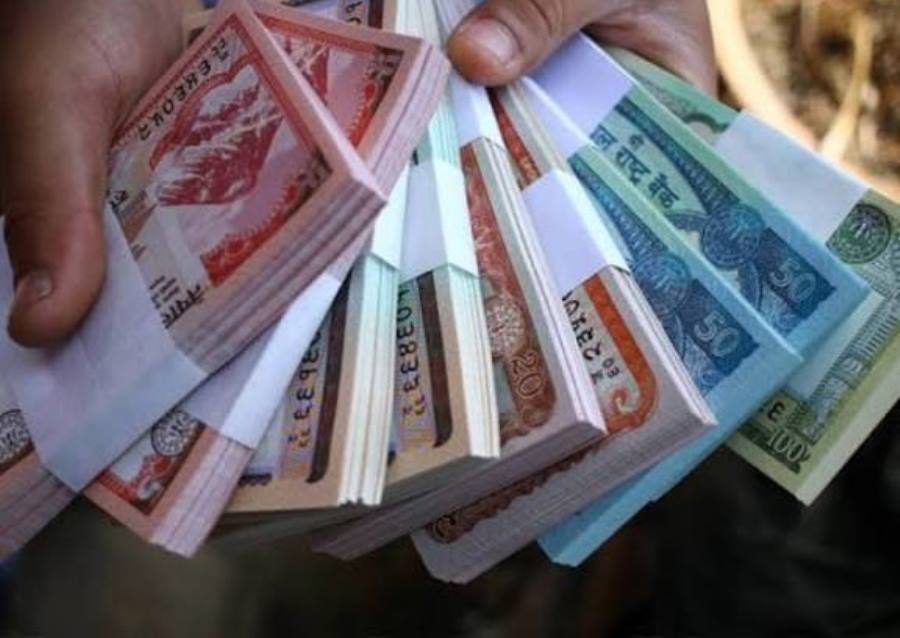
Kathmandu. The trend of Nepali notes being false or invalid is increasing year by year. According to Nepal Rastra Bank, in the last two financial years alone, notes worth 39 billion 61 crore 17 lakh 5 thousand 940 rupees ranging from 5 to 1000 rupees have been declared unfit for circulation.
The National Bank removes from issuance and washes (destroys) unfit (false, dirty and torn) banknotes deposited or collected by banks and financial institutions and the general public.
According to the recent data of the National Bank, compared to the financial year 2081/82, the total number of notes destroyed in the year 2082/83 has decreased, but the total monetary value of the notes destroyed has increased.
According to the data, in the last financial year (FY) 2082/83, the total monetary value of notes not eligible for circulation was 20 billion 74 million 44 lakh 43 thousand 615. In which total 16 crore 2 lakh 62 thousand 324 notes of 5 to 1000 rates have been managed by washing or destroying them.
Based on the price, this year’s fake notes are 2.71 percent higher than the previous year, i.e. 52 crore 91 lakh 81 thousand rupees. In the year 2081/82, notes worth 19 billion 54 crore 12 lakh 62 thousand 325 rupees were destroyed.
From the beginning to the end of June 2083, the details of the National Bank show that the laundering of 7 trillion 65 billion 74 crore worth of unfit notes from banks and financial institutions and general public has been completed.
In the financial year 2082/83, 1 crore 65 lakh 29 thousand 162 notes of 500 rate have been laundered. The total value of which is 8 billion 26 million 45 lakh 81 thousand rupees.
Similarly, 57 lakh 40 thousand 615 notes of 1000 rate have been destroyed, the monetary value of which is 5 billion 74 crore 6 lakh 15 thousand rupees. Recently, 3 lakh 49 thousand 684 fake notes of 250 rate which were not in circulation but reached Rashtra Bank have been destroyed.
According to the data of the Central Bank, in terms of numbers, the second highest number of 293 lakh 90 thousand 513 notes of 100 rupees has been destroyed. The total monetary value of which is 2 billion 93 million 99 million 51 thousand 300 rupees.
After this, 2 crore 39 lakh 25 thousand 379 notes of 50 rate have been washed, the total value of which is 1 billion 19 crore 62 lakh 68 thousand 950 rupees. 2 crore 62 lakh 68 thousand 785 notes of 20 rates have been destroyed, the value of which is 52 crore 53 lakh 75 thousand 700 rupees.
In terms of the number of notes, Rs 10 notes have been destroyed the most. Rs. 3 crore 52 lakh 66 thousand 688 pieces of 10 (total value 35 crore 26 lakh 66 thousand 880) notes have been destroyed. Rs. 2 crore 22 lakh 837 notes of 5 rates have been destroyed, the total value of which is 11 crore 4 lakh 285 rupees.
Facilitation of new or dry notes has been provided for common people on occasions like Dasain, Tihar and Chhath. According to Rashtra Bank, as of November 2, 2083, 9 trillion 165 million worth of notes are in circulation with banks and financial institutions and general public outside the Central Bank.
Rashtra Bank says that the selection (sorting) of ineligible or eligible banknotes is done manually – Anuj Dahal, Executive Director of Rashtra Bank Currency Management Department. According to him, notes with red slips are washed as unfit for circulation during sorting.
He said that in exchange for the ineligible notes deposited by the banks in the Rashtra Bank, the Rashtra Bank will credit (deposit) the same amount in the account of the respective bank.
Similarly, Dahal said that although a certain series (range) will be made public at the time of issuing the serial number of the note, it is not possible to manually track the serial number of each note during collection and washing.