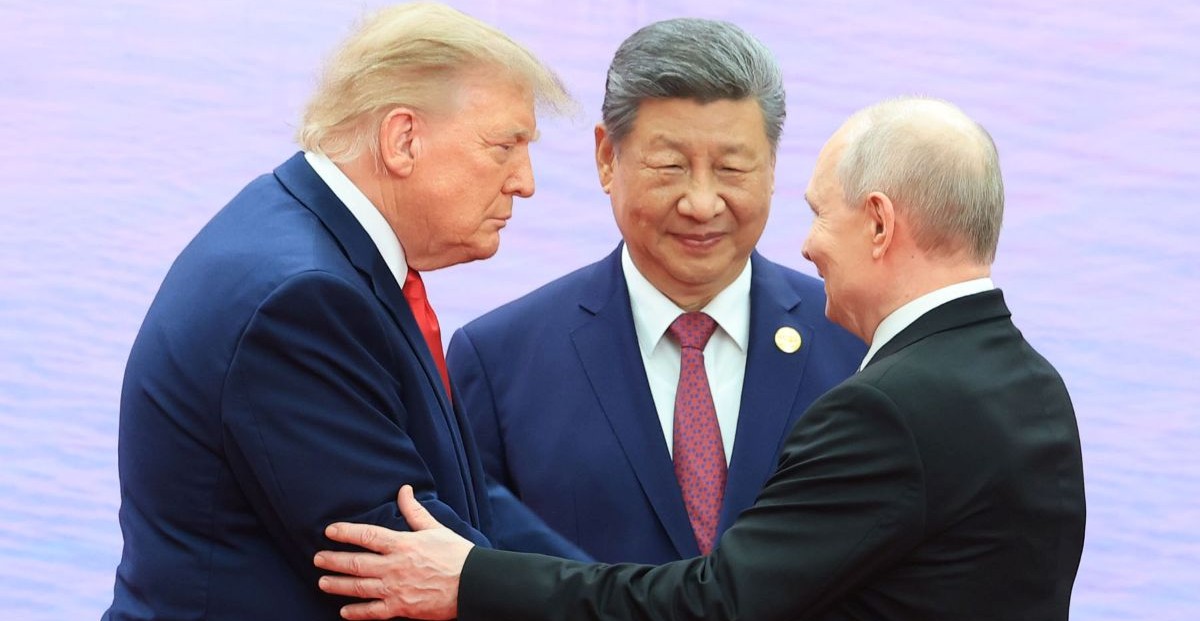
Kathmandu. At an unprecedented summit in Shenzhen, China, on Thursday, the presidents of the US, China and Russia pledged to stabilize energy supplies, stop nuclear non-proliferation and increase mutual cooperation.
Held on the sidelines of the annual Asia-Pacific Economic Cooperation (APEC) conference, the meeting was the highlight of three days of intense diplomacy. Earlier, leaders of various countries, including US President Donald Trump, had gathered in Manila for other summits.
After various bilateral meetings, Chinese President Xi Jinping held a trilateral summit with Trump and Russian President Vladimir Putin. After an hour-long meeting, the three leaders issued a joint ‘Peace Declaration’. These are the five main conclusions of this meeting.
1. Historic Meeting and ‘Peace Declaration’
Trump called this meeting a historic meeting between the world’s three largest countries and mentioned that the three countries have the world’s largest stockpiles of nuclear weapons. In his opening speech, he said, “We are creating history.”
Mentioning that past leaders avoided dialogue with leaders of countries with differences, Trump said that peace will never be established by denying the opportunity.
All three leaders held the view that the responsibility of protecting the world rests on their shoulders. Chinese President Xi urged countries to abandon the “Cold War mentality” and become friends. Putin also said that through constructive cooperation, the three countries can strengthen global stability. After the meeting, the three leaders issued a joint ‘Peace Declaration’.
2. Commitment to stable energy supply
According to the Chinese government media, the three countries reaffirmed the importance of stable energy supply in a joint declaration. After the US attacked Iran in February this year and Iran closed the Strait of Hormuz, an important waterway that supplies nearly a fifth of the world’s oil, the global energy supply has been affected. Similarly, Ukraine’s attacks on Russian energy facilities have further complicated the energy crisis.
However, there is no sign of the end of the war between America and Russia. As all the three countries have their own priorities, it is not clear how the commitment to keep the energy supply stable will be implemented.
The Iran war was not even mentioned in the summit. Trump reiterated that Iran should not have nuclear weapons. According to the Kremlin spokesperson, the Ukraine war was also not a “central topic” of the tripartite meeting. However, it was a major issue in the bilateral talks between Trump and Putin. Trump also asked for Xi’s help in resolving the Ukraine war.
3. Dialogue on Nuclear Weapons
Before the tripartite meeting, Chinese President Xi had banned nuclear weapons and said they should be completely destroyed. He said that no one can win from a nuclear war and every effort should be made to prevent it.
Xi’s opinion was also included in the joint declaration after the meeting. All the three countries committed to dialogue on nuclear risk reduction and non-proliferation. Also, they agreed to maintain strategic stability and international security.
In the opening speech of the meeting, Trump said that the three countries are in a special position to discuss nuclear issues because they have the world’s largest stockpiles of nuclear weapons. He also claimed that Xi had agreed with him that the Strait of Hormuz should remain open and that Iran should not be allowed to possess nuclear weapons.
4. Is it the beginning of ‘G-3’?
According to analysts, while the leaders of the US, China and Russia were gathering together to discuss major world issues, European leaders gathered in Berlin for a meeting of the “Coalition of the Willing” to coordinate support and aid to Ukraine. The leaders of the three superpower countries seem to have taken responsibility for solving the conflicts and problems affecting the world economy.
Next month, Trump is hosting the G-20 summit in Miami, Florida, in which Chinese President Xi is almost certain to attend. Russia is also a member of G-20.
However, after the International Criminal Court (ICC) issued an arrest warrant against Putin due to the Ukraine war, he has not participated in the recent G-20 summits.
European member states have also been showing reluctance to sit on the same platform with him. However, Trump has invited Putin to attend the Miami conference. Since the US is not a member of the ICC, it is not obliged to arrest Putin.
After the tripartite meeting, Putin said the discussions were clear and constructive and helped the leaders understand each other better. Whether this is the beginning of the ‘G-3’ will be clear in the coming weeks.
5. Criticism of the International Criminal Court
Criticism of the International Criminal Court (ICC) is also included in the joint ‘Peace Declaration’ issued by Trump, Xi and Putin in Schengen. All the three leaders said that the ICC and organizations of similar nature should not abuse their rights.
All these three superpowers are not member states of ICC. These are the main reasons for their dissatisfaction with the court. America has had a tense relationship with the ICC for a long time.
Relations were further strained when a court began investigating alleged abuses by American soldiers in Afghanistan. Tensions escalated after an arrest warrant was issued against Israeli Prime Minister Benjamin Netanyahu on charges of war crimes in Gaza. The United States has also announced the goal of disbanding the organization in addition to imposing sanctions on the ICC and its officials.
Russia has also expressed distrust towards the ICC for a long time. Moscow has become a more vocal critic of the court after an arrest warrant was issued against President Putin on charges related to the attack on Ukraine.
Although China has not supported the ICC in the past, it has been taking a relatively soft approach. However, after the arrest warrants were issued against the leaders of various countries, including the former president of the Philippines, Rodrigo Duterte, Beijing has become a strong critic of the court.
In addition, the activists have submitted a petition to the ICC, accusing China of genocide against the Uyghur community in Xinjiang. Beijing has denied the allegations. Al Jazeera