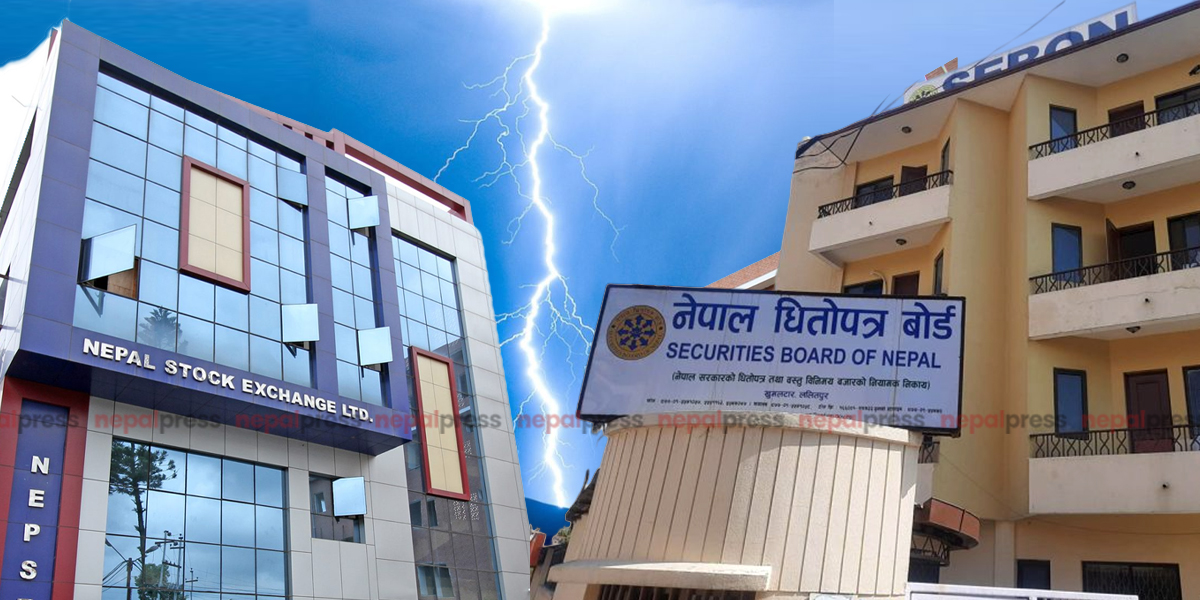
Kathmandu. Securities Board of Nepal (SEBON) has prepared the draft of ‘Alternative Investment Fund Regulations, 2083’. The board is about to bring this new regulation with the approval of the government using the powers given by the Securities Act.
In the draft, private equity funds and venture capital funds as well as hedge funds, which are considered high risk, have also been opened. Similarly, provisions such as increasing the paid-up capital of fund managers, classifying funds into three different categories, bringing foreign fund managers into Nepal, and opening investment avenues to non-resident Nepalis (NRNs) are included in the draft.
According to the draft, the paid-up capital of the company or organization that wants to act as a fund manager should be at least 5 million rupees. It has been arranged that fund managers who have received the license must deliver the capital within three years from the date of commencement of the regulation.
Those who wish to act as fund managers must obtain prior approval from the board before establishing the organization and must register the fund with the board within one year of obtaining the permit, otherwise the permit may be revoked.
Alternative investment funds can now be incorporated in a company, trust or limited liability partnership (LLP) structure. Based on the nature and risk of the fund, it has been classified into three categories. The first category (category 1) includes venture capital funds, angel funds, SME funds, social impact funds and infrastructure funds.
Such funds that invest in the latest knowledge, skills, technology, startups, small and medium businesses and infrastructure projects will get concessions and discounts from the government and regulators. Such funds will not be allowed to take loans and invest except for short-term resource management.
The second category (category 2) includes private equity funds, debt funds, special situation funds and funds of funds and these are also not allowed to invest by borrowing. The third category (category 3) includes hedge funds that are established to invest in any sector with high investment risk.
There will be no hindrance to invest such funds by taking loans. However, the hedge fund cannot be registered and operated until the Board makes a separate guideline and implements it. For fund registration, the fund amount should be at least 150 million rupees, while the fund manager should take a minimum 2 percent share in the fund and maintain it continuously. However, this arrangement will not apply to funds invested by bilateral or multilateral international organizations.
The fund will be closed-ended in nature and the number of unit holders will not exceed two hundred. In addition, there is a provision in the draft that only cash dividends should be given to the unit holders as compensation.
The duration of the fund will be from 5 to 15 years, which will start after the first commitment date (first close). The ‘first close’ should be completed within 12 months of the registration of the fund and the final close should be completed within 24 months. In special circumstances, if at least two-thirds of the commitment has been received within 24 months, a maximum of six months can be extended.
Banks and financial institutions, insurance companies, retirement funds, welfare funds, savings funds, citizen investment funds, social security funds, bilateral or multilateral international organizations, foreign funds, Nepali citizens and non-resident Nepalis (NRNs) can invest in the equity capital of alternative investment funds. Generally, the unit owner has to purchase a unit worth at least 50 lakh rupees.
However, in case of venture capital, SME fund, social impact fund and angel fund, a unit of minimum 25 lakh rupees can be purchased. Fund units can be dematerialized (demat) and listed in the secondary market. But in the case of trading in the secondary market, transactions will be allowed only among qualified investors, not less than 50 lakh rupees.
The draft provides for permission for institutional foreign investors or fund managers registered abroad to operate funds by establishing a subsidiary company in Nepal or through a local fund manager.
In addition, foreign investors can invest their own capital by purchasing units of funds registered with the board. If the foreign investor wants to sell the units and take back the proceeds or dividends, it is stipulated that the board must recommend approval within 7 days of submitting the necessary documents including tax payment.
The fund manager will be allowed to invest a maximum of 25 percent of the total investable amount in one company or sector. However, this sectoral limit will not apply to sector specific funds established to invest in a specific sector only.
Similarly, the fund will be allowed to sell the securities it owns only after one year from the date of distribution of shares (IPO) to the general public by the organization in which the fund is invested. However, securities of organized organizations whose last investment period of three years has been completed by the fund can be sold through the secondary market.
In order to maintain good governance, the draft has tightened the conflict of interest. It is prohibited to invest (cross holding) in the same organization of the fund and the fund manager and to invest in the subsidiary company of the fund manager.
Similarly, it is stipulated that the funds managed by the fund manager who is the founder of the bank and financial institution cannot be used to invest in projects financed by the main bank or to purchase the assets and liabilities of the said bank. It is not allowed to invest in a company or project owned by any one investor who has committed more than 50 percent of the fund size. The fund manager will have a board of directors of at least five and at most seven people, in which if it is a public company, at least one independent director must be mandatory. To become the Chief Executive Officer (CEO), one must have a master’s degree in Economics, Commerce, Finance, Accounting, Management, Law, Engineering or Environment or 10 years of Chartered Accountancy/CFA or 15 years of work experience after graduation.
Similarly, the fund manager will have to submit 2 percent of the management fee received in each financial year to the Securities Board within two months of receiving the fee. According to the draft, the fund manager’s application fee is Rs 50,000, registration fee is Rs 150,000 and the annual fee is Rs 3 lakh.
Similarly, according to the size of the fund, the fund registration fee has been fixed at Rs 5 lakh for up to 500 million, 7 lakh for between 500 million to 1 billion and 10 lakh for above 1 billion.