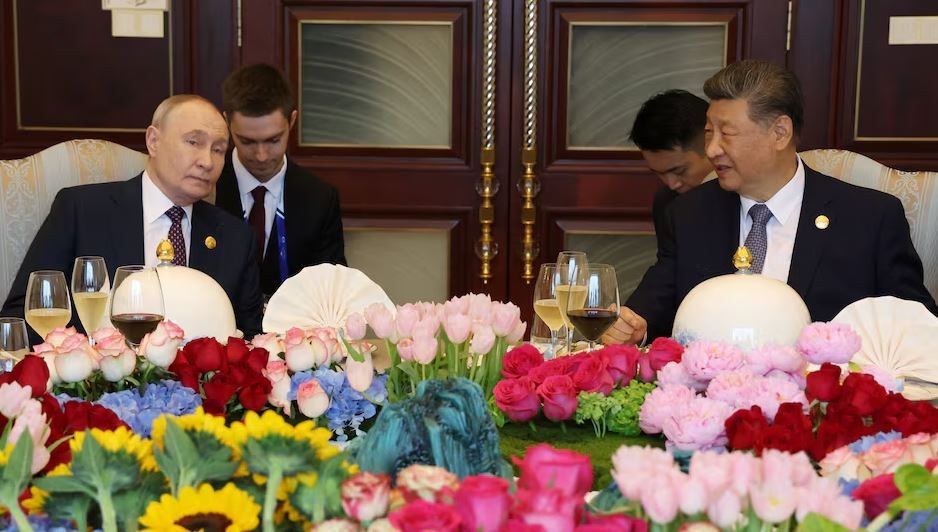
Shenzhen. Chinese President Xi Jinping has pledged to fight trade protectionism firmly. Similarly, the Russian counterpart, Vladimir Putin, has strongly criticized the ban of Western countries.
They expressed this opinion at the Asia-Pacific Economic Cooperation (APEC) summit held in Shenzhen on the eve of the high-level tripartite meeting with US President Donald Trump.
The trilateral meeting on Thursday is expected to discuss issues such as the Russia-Ukraine war, the US-Iran conflict, trade, artificial intelligence (AI) and nuclear weapons.
This historic meeting has been compared to the ‘Yalta Conference’ of 1945, when superpower nations imposed their influence on smaller countries. At that time, the leaders of Britain, America and the Soviet Union played an important role in deciding the world order after the Second World War through the Yalta Conference.
During his speech, Chinese President Xi advocated for open and free trade and said that China will stand as a stable partner even if the US imposes new sanctions.
Beijing has also warned of tough retaliation after Washington announced more restrictions on advanced AI chips. Analysts have analyzed that Xi’s statement will have a good impact on the ‘Global South’ (developing countries).
Meanwhile, Russian President Putin, who appeared on stage after Ukraine destroyed the key Kerch bridge linking Crimea, claimed that Western sanctions had failed completely.
He noted that Europe is becoming weaker, saying that the sanctions have strengthened rather than weakened Russia. Stating that the disputes seen in the world can be resolved through dialogue, he expressed the hope that the tripartite meeting will be of great benefit.
During his visit to the Philippines, US President Trump also pledged to deepen defense cooperation amid the dispute in the South China Sea.
This tripartite meeting, which is going to be held amid geopolitical tensions and trade conflicts, is seen to play an important role in determining the direction of international relations and the world economy in the future. Reuters