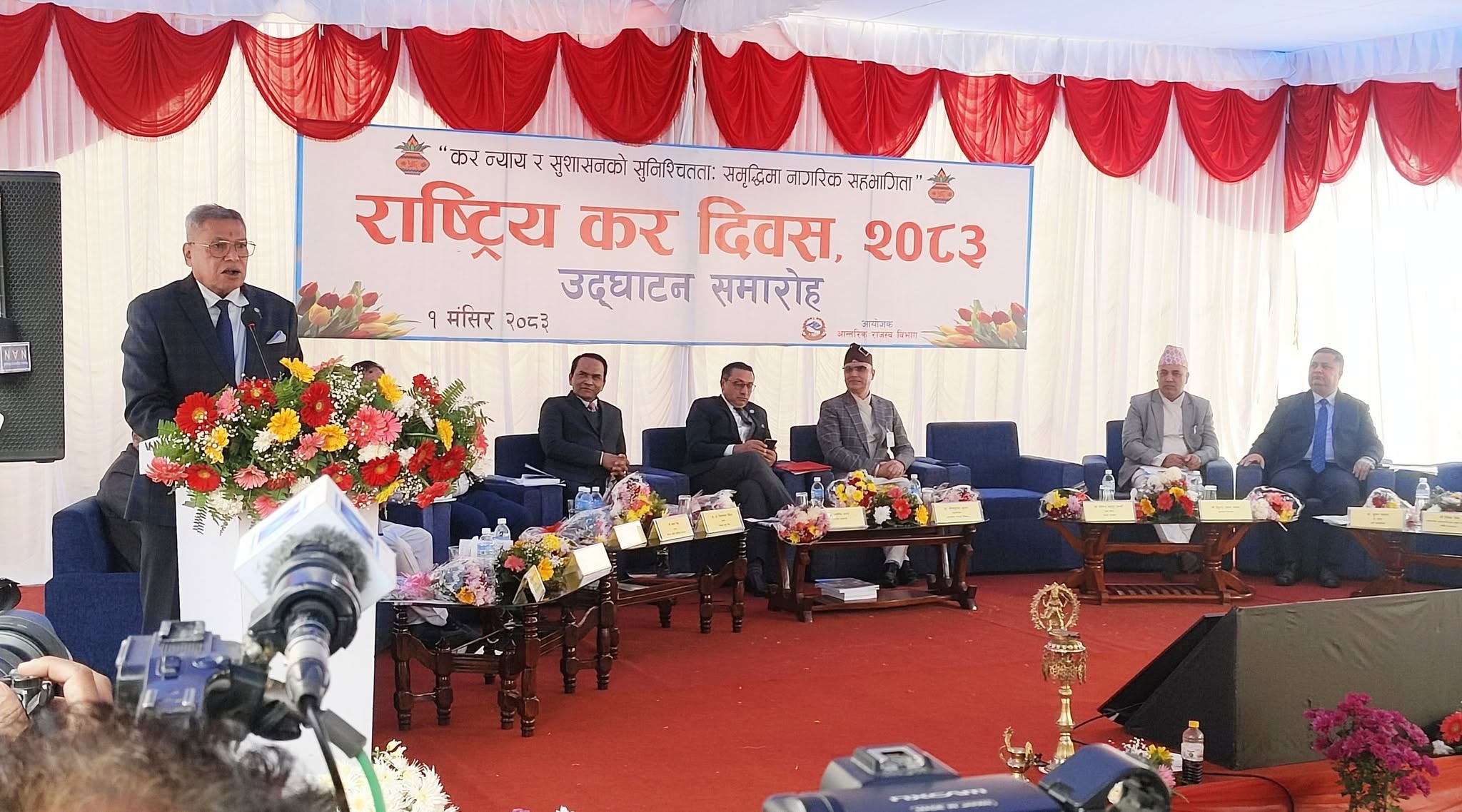
Kathmandu. Kamlesh Kumar Agarwal, President of Nepal Chamber of Commerce, has said that the tax system should not be limited to revenue collection but should be made an effective means of investment promotion, production growth and job creation.
In a program organized on the occasion of the National Tax Day 2083, he said that the success of the tax system is determined not only by the amount of revenue collection, but also by the ease, transparency and trust in the state that the taxpayers feel. Stating that the government’s revenue base cannot be sustained without a strong private sector, he emphasized that priority should be given to industry, trade, investment and employment expansion.
He said that due to the economic recession and slowdown after the Covid-19, the private sector is facing challenges such as reduced market demand, low capacity utilization of industry, high production costs, political instability and administrative complications. Stating that although there is sufficient liquidity in banks and financial institutions, the credit demand of the private sector is low, he opined that the tax policy should be investment-friendly, production-friendly and employment-friendly.
Chairman Agarwal said that the value added tax (VAT) should be implemented at multiple rates, small entrepreneurs and startups with a turnover of up to two million rupees should be charged turnover tax at 55 percent of the turnover and they should be eased from the complicated accounting and audit process. He also requested to remove the excise duty on the goods produced in Nepal apart from the positive list and implement the harmonized system code according to the international standards.
Similarly, he said that the maximum rate of customs duty should not exceed 25 percent and VAT should not exceed 10 percent, investment should be encouraged through documentation of legally acquired assets, and the 25-year-old Income Tax Act, 2058 should be rewritten in a timely manner. He said that provisions related to transactions and transfer pricing, including Section 57 of the Income Tax Act, should also be made taxpayer-friendly and in accordance with international standards.
Mentioning that the next five years should be carried out as a national production and employment campaign for the expansion of economic activities, Agarwal suggested to review the public holidays and adopt a policy of ‘less holidays, more work, more production and more employment’.
He said that the government, workers and industrialists should discuss and study the economic impact before implementation, saying that although the provision regarding wages and social security of workers involved in public procurement is welcome, its impact may affect the labor costs and production of other industries.
He said that sustainable revenue is not possible without a strong private sector and emphasized that there is a need for cooperation rather than competition between the government and the private sector, trust rather than mistrust and facilitation rather than control.