bow In the villages of Mithilanchal, when the evening falls, the atmosphere becomes joyful with bamboo bowls holding colorful clay figures in hand, lamps burning in them and folk songs echoing in the group. The songs of Sama-Chakewa resonating in the collective voices of girls and women bring to life the love for brothers, the intimacy between sisters and the cultural traditions of Mithila that have been handed down from generation to generation.
Sama-Chakewa, which begins with the Chhath festival in Mithilanchal, is not just entertainment or a religious ritual, it is also an emotional expression of love, dedication, sacrifice and family ties. This tradition of presenting the story through songs and dialogues by making different shapes of clay into characters is known as the unique song folk theater of Mithila.
Sama-Chakewa festival which starts from Kartik Shukla Panchami is celebrated for 11 days till Purnima. During this period, sisters, daughters-in-law and women of Mithilanchal gather in groups at night and play Sama-Chakewa. They sing traditional songs wishing their brothers good health, long life, happiness, peace and prosperity.
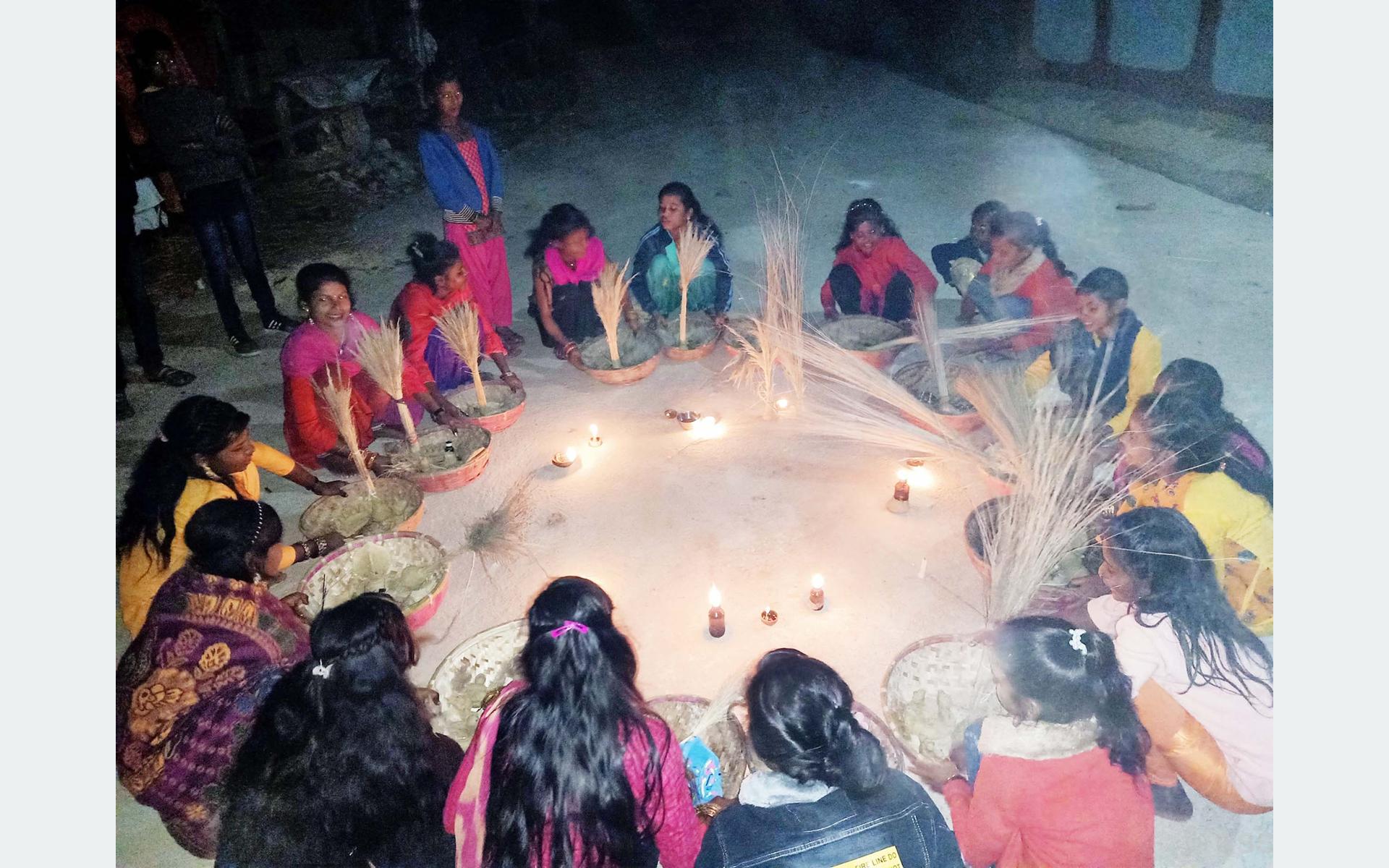
On the first day of the festival, it is a tradition for women to dig soil from their brothers. From that clay, figures of various characters such as Sama, Chakewa, Chugla, Satbhaiya, Forest Partridge, Jhanjhi Kukur are made. After the clay figures are dried, they are decorated with different colors and placed on bamboo plates. At night, lighting lamps, these figures are taken to village squares, intersections, ditches and public places. After that, the characters are brought to life through collective singing, dancing and dialogue.
According to the president of Madhes Pragya-Pratishthan and cultural expert Rambharos Kadi, Sama-Chakewa festival is a cultural ritual performed by sisters for the longevity and prosperity of their brothers. It has a beautiful combination of songs, music, dramatic performances and folk beliefs. According to him, in other folk dramas, men act as characters, while in Sama-Chakewa, women present the story through songs and dialogues, using clay figures as characters. During this, folk songs like ‘Gamke adhikari tohe baraka bhaiya ho, bhaiya hatdash pokri khunai diy, champa phool lagaidiya’ and ‘Samachko samachko aiha ho, aiha ho, gundh khetme bhasia ho’ are sung. In these songs, love for brothers, family relations, social life and intimacy with nature are expressed.
Folk drama comes to life in Mataka characters
The most distinctive aspect of the Sama-Chakewa festival is the presentation of stories through clay figures. In it, Sama and Chakewa remain as the main characters. Sama is a female character and Chakewa is a male character. Apart from this, characters like Chugla, Dholia, Bhariya, Satbhaiya, Khajanchidaiya, Vanitatar, Jhanjhi Kukur, Bhaiya Battakani, Maliniyan and Vrindavan are also made. These characters represent various aspects of Mithila’s social, family and natural life. Chugla represents the tendency to cheat and spoil relationships in society, while Vrindavan highlights the relationship with the forest and nature.
The women keep all the clay figures in one dala while singing. The characters are made to move according to the words and expressions of the song. In some cases, Chugla’s mouth is burnt with fire and Vrindavan is also set on fire. Songs like ‘Vrindavanme Agi Lagal, Keo Ne Mizhabhe Hai’ make the folk drama more emotional. Sama-Chakewa is an original folk theater based not only on the worship of clay idols but also on songs, acting, dialogues and group participation. Women are not only its actors, they are also the facilitators and presenters of the story.
Tradition and Law
With the beginning of the Sama-Chakewa festival, the work of making various clay characters begins. Sunpat is used along with mounds of clay to make the shape of the Chugla, which makes it easier to light the fire later. Similarly, to make Vrindavan, a figure is prepared by tying dried Radi grass. At night, after eating, women and girls come out of their homes with lighted lamps. They gather in groups and sing songs and give the characters like Sama-Chakewa and other characters to eat. There is also a tradition of feeding the characters with snow as a symbol of water.
Then everyone keeps their dalas in a circle and goes around singing songs. The story of various characters is presented along with the order of the song. The method of burning Chugla’s mouth and setting Vrindavan on fire makes folk drama more interesting. This sequence is repeated every night until the full moon. According to Lal Babu Jha, a retired teacher and priest of Kshireshwarnath Municipality-5, Mahendranagar, on the last day of the festival in the morning, the clay figures are re-dyed and dried. In the evening, it is a tradition to fill the brother’s far from Sama Chakewa by feeding Dahi Chiura and make the brother to break Sama-Chakewa figures. After that, the sisters take the Sama-Chakewa figures outside the village to a field or reservoir and immerse them. After the immersion, the brothers are offered curds and dishes and are wished for long life and prosperity. This is how the festival ends. According to 32-year-old Anita Yadav of Kshireshwarnath Municipality-2, the preparation of Sama-Chakewa starts from the day when the Kharna ritual of Chhath festival is performed. With the preparation of Chhath, women prepare soil, bamboo sticks, dyes and other materials needed for sama-chakewa. According to him, while playing sama-chakewa, the meeting, collectivity and intimacy among the women of the village increases.
The story of Sama-Chakeva connected with the Puranas
There are various religious and cultural beliefs about the origin of Sama-Chakewa festival. Culture experts say that it is discussed in Padma Purana and Skanda Purana. According to Arun Choudhary, a knowledgeable professor of Maithili culture, according to popular mythology, Sama or Shyama was the daughter of Lord Krishna. Her husband was Charuvakya. A dispute arose after Chugla gave wrong information about their love and relationship.
According to the story, Lord Krishna cursed his daughter Shyama to take the form of a bird after listening to Chugla. After knowing the condition of his sister, his brother Samb did severe penance to restore his sister to her previous state. It is a religious belief that the sister regained her old form on the day of Kartik Purnima, pleased with her penance.
It is mentioned in the story that unable to bear the separation of his wife Shyama, her husband Charuvakya also assumed the form of a bird and started living with her. There is a legend that even though the opponents tried to make them suffer by setting fire to Vrindavan, where they lived, they finally returned to human form due to the penance and help of their brother. Thus, in the original story of Sama-Chakewa, the context of love, dedication and brotherly support between husband and wife is found. Culture experts say that the love and intimacy between brothers and sisters has been established as the main emotion of this festival as the form of the story changes over time through oral tradition.
People’s life of Mithila as reflected in folklore
Sociologist Poonam Chaudhary says, “The songs of the Sama-Chakewa festival reflect the social life, family relations, nature, love and human feelings of Mithila. These songs have been handed down orally from one generation to the next for generations.”
In songs like ‘Dalale Bahar Veli, Bahino Se Phalan Bahino’, the sisters present the importance of their dala and the figures placed on it. In the dialogue of the song, there is also an occasion where the brother complains about the loss of the dala and asks what kind of material was used to decorate it. This shows that there is a beautiful combination of family dialogue and drama in folk songs.
On the last day of the festival, the song ‘Samadowni’, which is sung while returning from Sama-Chakewa immersion, is considered to be particularly emotional. Through this song, Sama is bid farewell by inviting him to come again next year. It also gives emotional and cultural significance to the end of the festival. The social and cultural life of Janakpur and Mithila are also included in the songs of Sama-Chakewa. It reveals the richness of Mithila’s historical identity, local lifestyle and folk culture.
The Sama-Chakewa festival, which is a cultural heritage to be handed down to the new generation, has been strengthening the relationship between brothers and sisters as well as collectiveness, cooperation and cultural unity. This festival, which is celebrated with the active participation of women in particular, provides them with an opportunity to present their art, creativity and cultural identity.
According to Anita Yadav of Kshireshwarnath Municipality-2, during the Sama-Chakewa festival, the women and girls of the village gather together to sing songs, make clay figures and complete traditional rituals. It has also provided an opportunity to the new generation to learn about their language, folklore and culture. Celebrated with special enthusiasm in the districts of Madhes including Mahottari, Dhanusha, Sarlahi, Sirha, Saptari, Bara and Parsa, Sama-Chakewa border region of India is also popular in places like Sitamarhi, Madhubani, Darbhanga and Muzaffarpur in Bihar.
Sama-Chakewa is an important example of the intangible cultural heritage of Mithila, presented through clay figures, bamboo dalas, lamps, folk songs and group dances. It not only tells the story of the relationship between brothers and sisters, but also conveys the message of love, harmony, coexistence and family unity in the society.
With the influence of modernity, the protection and promotion of festivals like Sama-Chakewa seems necessary when traditional folk songs and cultural practices are overshadowed. The Maithili Development Fund has been organizing the Samachkewa Mahotsav for the past few years with the aim of preserving its originality through the participation of schools, local levels, cultural institutions and the new generation, so that this unique folk drama that carries the identity of Mithila can remain alive for the next generation.
Jeevnath Chaudhary, the president of the fund, has informed that this year too, the Samachkewa competition will be organized in Janaki temple premises from 5th of November. Chowdhury, the chairman of the fund, said that the Sama-Chakewa Mithila culture is a culture that strengthens the love between brothers and sisters, so they are organizing the festival with the aim of protecting and promoting it.