
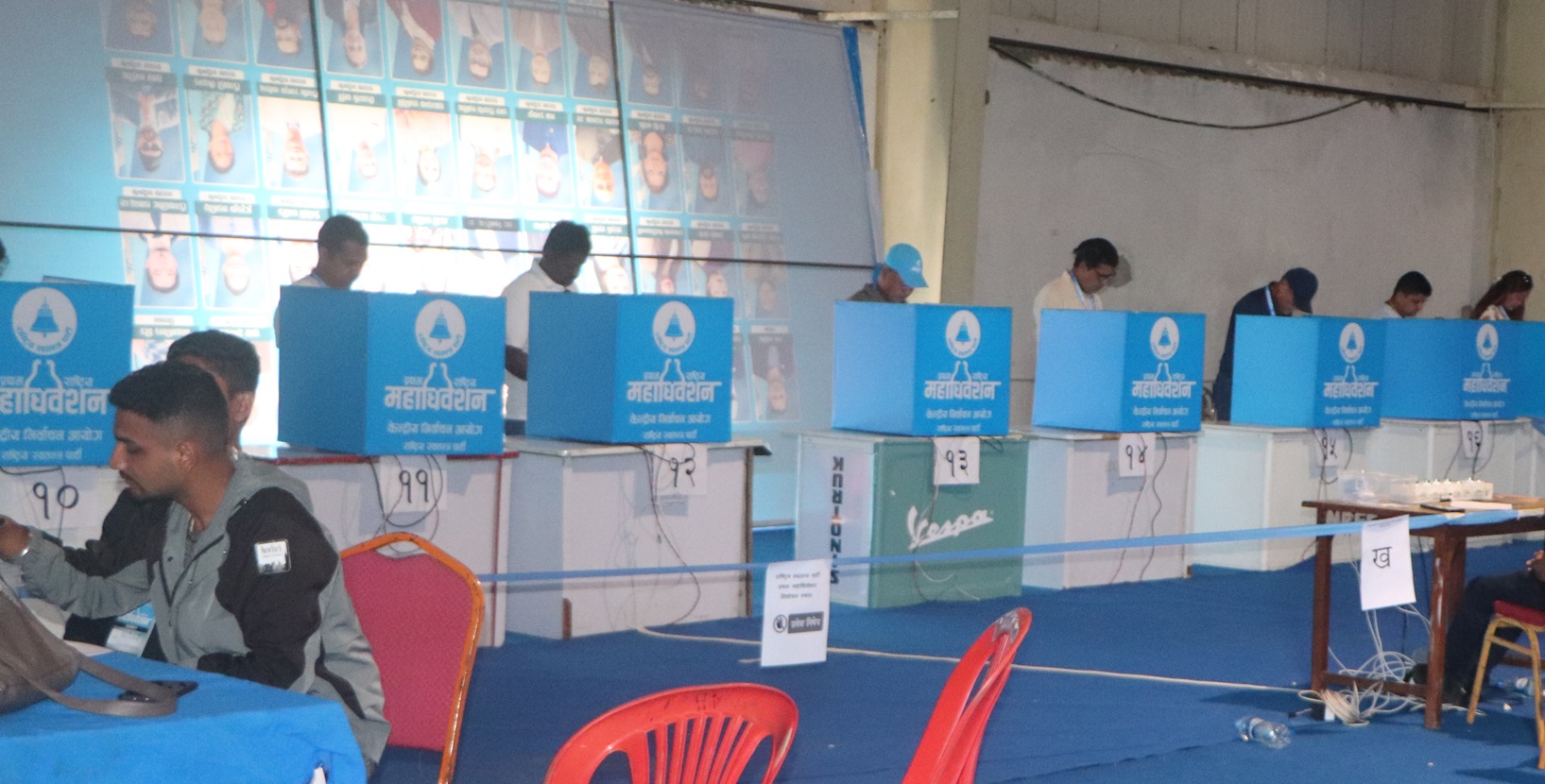
Kathmandu. Technology developer Rama Laxman Rimal has expressed serious concern about the spread of confusion on social media and some media regarding the electronic voting machine of Nepali technology used in the first convention of Rashtriya Swatantra Party (RASWPA) recently held in Chitwan.
Rimal, who has been researching and developing the electronic voting system in Nepal for the past 13 years, issued a press release on Thursday and clarified that the comments made beyond the technical reality have caused confusion among the common citizens.
Various questions and confusions arose regarding the issue of ‘voting for 64 people in the same post’ in the election of RSVP. As revealed in the statement, it was not a machine malfunction but a demand for the RSVP’s own election statutes and candidate selection process.
There was a provision to elect a total of 99 central members in the convention of the RSWP, out of which 35 people should be elected by geography (5 people each from 7 provinces) and the remaining 64 people should be elected from the open category. 210 candidates were in the fray for the 64 open seats. Therefore, the machine was configured accordingly (multiple choice) due to the political and legal imperative that a single voter could choose up to 64 candidates.
Like the press release
Why are there 64 people in one post?
In any election, the role of electronic voting equipment is only in the last stage of the election process, i.e. voting. The Election Commission is responsible for the nomination of candidates, claims and objections, withdrawal of nominations, designation of posts and groups (clusters), serial numbers of candidates and preparation of the final list. The final official list received from the Election Commission with signatures and the details of the candidates in the same order are included in the voting device without any changes.
In this convention too, we initially prepared a voting system based on separate clusters. But at the last moment, the Election Commission received a revised final list including open and inclusive candidates in one group and the instructions to vote accordingly. Based on our experience, we have given technical suggestions that this system may make the voting and counting process more complicated, but the Election Commission has informed that this system will be maintained according to the party constitution.
Therefore, the arrangement of 64 candidates in one group seen in the voting machine is not a decision made by us, but an arrangement implemented as per the final official list and instructions received from the Election Commission. We have no right or role to change the position, group, number of candidates or serial number as the electronic voting device only executes the information received from the Election Commission.
How did the candidate’s name and serial number get corrupted?
Some have expressed their understanding that the names and serial numbers of the candidates are kept different in the voting machines. In this regard, we would like to clarify that the details of the candidates in the voting machine have been included without any change based on the final list officially signed and provided by the Election Commission.
In the election process, as the final list approved and issued by the Election Commission is the official record, it is customary for the candidates to spread their campaigns on the same basis. Therefore we have no right or role to add, remove or change any name, serial number or other details on the machine. In this convention as well, the final list received from the Election Commission with signatures has been incorporated literally into the machine. Therefore, any change or error regarding the name or serial number of the candidate is not due to the voting machine or our technology.
Why was compulsory voting done?
When we went to the RSVP party office before the election, we saw banners like ‘Right to Reject’ and ‘Right to Recall’ hanging in the parking lot. Accordingly, it was mentioned in the clause that we will prepare the machine for optional voting at the time of agreement.
When the Election Commission gave us the final list at midnight and we loaded the list in a machine and showed it to the Election Commission, they told us at that time that it should be made mandatory. We said that if it is not according to the agreement, it will bring problems. After they asked us to make it mandatory, we asked for written instructions mentioning the clauses of the agreement.
Accordingly, only after they give written instructions, we have made it compulsory to cast a specified number of votes for one group of candidates instead of voluntary voting in the machine.
Why did the photo of the candidate not come?
One of the main features of the electronic voting device is that the candidate’s name along with the photograph can be included in the electronic ballot paper so that the voter can easily vote by viewing the photograph. Keeping this facility in mind, provision was made in the agreement to prepare electronic ballot papers with photographs of the candidates.
Accordingly, we had initially prepared a voting system with photos of candidates from different clusters including geography. But at the last stage of the election process, the Election Commission decided to change the preparation of keeping women and open groups separately and include them in one group. Accordingly, the final official list with the new composition was provided to us only at around 11:30 pm.
After receiving the final list, we had previously informed that it would take at least 8 to 10 hours to prepare a new electronic ballot paper after re-matching the photos of each candidate. However, it was technically not possible to prepare an electronic ballot paper with a photograph due to the Election Commission’s directives and time constraints that polling should begin within an hour of receiving the final list.
Therefore, according to the instructions of the Election Commission and the management side, based on the final official list, a voting system was prepared without a photo and the election was conducted at the scheduled time. It’s natural for voters to raise questions about not including a candidate’s photo, and we respect that. However, this situation was created not because of the technical limitations of the voting equipment, but because of the extremely late receipt of the final roll and the time constraints of starting the election immediately thereafter.
Why is the result late?
While collecting all the data for the counting of votes of the election which ended at 12 noon on the 10th of Ashadh, it was reported that the migration election has not started yet. It was said that the counting of machine votes, not the election itself, will affect the results of the migration, so it will not be counted until the results of the migration are done.
After the migration voting was over at 6 pm, we counted 2,92,941 swastika marks from 80 machines in just 10 minutes and provided them to the Election Commission. The time taken by the Election Commission to bring the vote results to official results is not due to our system, but due to the internal process of the Commission.