Kanchanpur. The traditional houses that reflect the original identity of the Ranatharu community are being displaced recently.
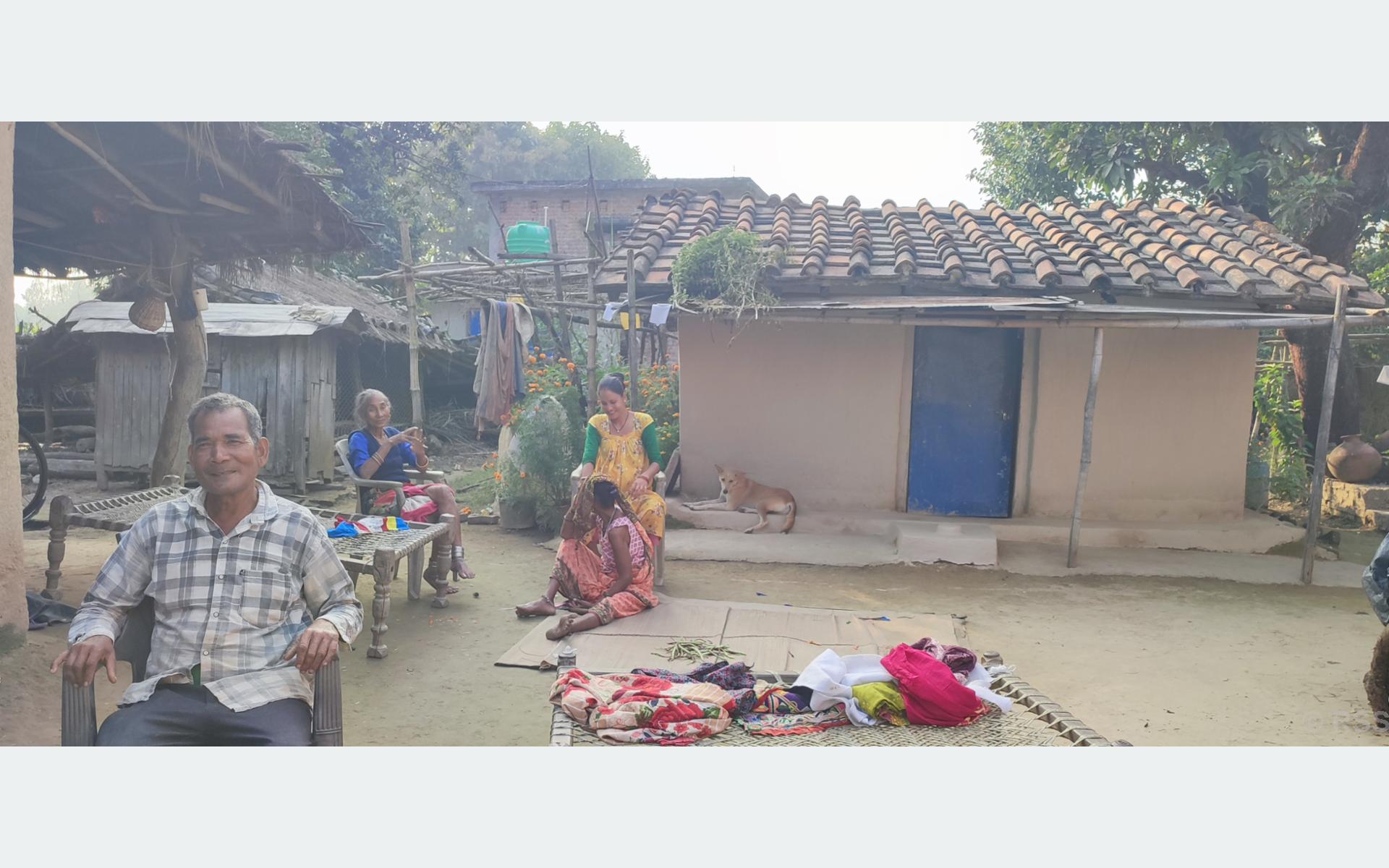
The attractive houses made of mud, thatch and wood are the identity of the Ranatharu community. The materials used in house construction used to reflect the original lifestyle, culture and lifestyle of the Ranatharu community.
However, such traditional houses are rarely seen today. Rajkumar Rana of Bhimdatta Municipality-19, Baghfanta, Kanchanpur says that instead of traditional houses, concrete houses are being built in the Ranatharu community.
“For the construction of houses, huge sal poles are needed”, said Rana, “wood cannot be brought from the forest like before, so the traditional houses have stopped being built.”
Local resources and traditional skills are used in the construction of traditional houses. He says that the texture of the walls, roof, courtyard and rooms of the house are also connected with the original characteristics of the community.
“The wood used in house construction starts rotting after ten/fifteen years due to insects and then it has to be replaced”, said Rana, “The present generation is starting to build modern houses due to the difficulty of getting wood, and the hassle of having to bring another one after ten/fifteen years.”
He says that not only the house, but also the traditional clothes of the Ranatharu community, the home-made utensils that are used daily are disappearing. Ghagaria, Angia, Uniya, the traditional dress worn by the women of the Ranatharu community, are now disappearing.
“Not only the houses, but also the traditional clothes of the Ranatharu community are disappearing”, local Suda Rana said, “it is difficult to find even people who sew traditional clothes.”
Pasuram Rana, the leader of the Ranatharu community, says that the influence of modernity in the Ranatharu community is not only felt in the traditional houses but also in the festivals celebrated by this community. “It is a characteristic of a traditional house that is hot in winter and cold in summer,” he said, “Nowadays, traditional houses are not built, the influence of modernity has also reached our festivals.”
He said that the Ranatharu community’s month-long festivals like Holi and Teej are getting shorter. Men used to wear dhoti and kurta like women, but except for one or two elders in the village, no one wears such clothes now, he says.
Bhakari and other items made of clay used by this community to store grain are disappearing.
Recently, due to the improvement of the family’s economic situation, the increasing attraction of the new generation towards houses with modern facilities and the decrease in the availability of traditional building materials, the practice of building original houses is decreasing in this community.