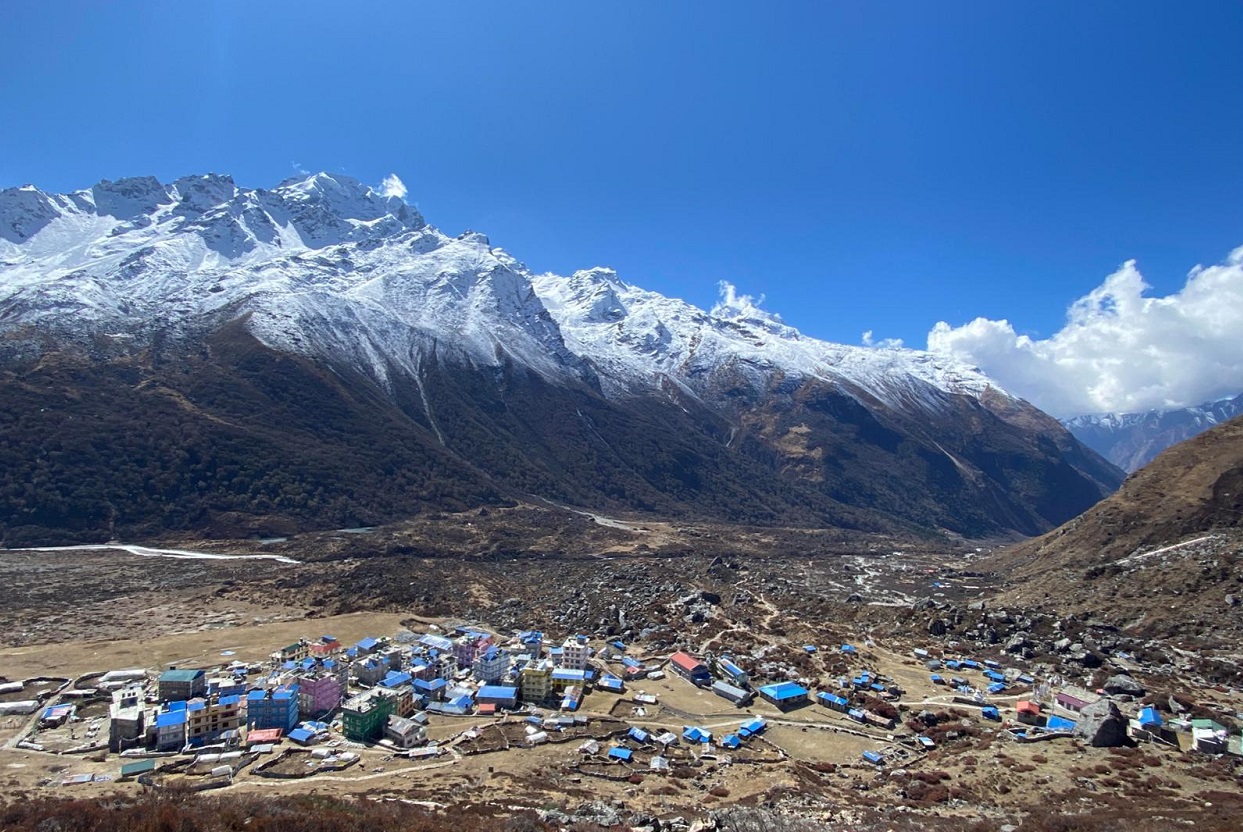
Langtang. White snow range around. High rocky mountains and a small beautiful valley in between. After seeing the ‘Langtang Valley’ nestled in the lap of the Himalayas, I feel like humming the song of singer Taradevi-
"My little village is in the arms of the mountains
My name is Parvati, the daughter of the mountain..."
The ‘Langtang Valley’ grown in the arms of the mountains is beautiful. Even more beautiful than that, the life of the Himalayan people who are as pure and calm as the snow is even more beautiful. On the one hand, the residents are smiling with a smile like snow and on the other hand, they are able to accept the many struggles of life like a rock. Phurpu Sherpa, a 50-year-old from Langtang Valley, says, “We Himalayans laugh like mountains when we’re happy, we can fight like rocks when we’re sad. Sherpas don’t need anything too big to be happy.”
He is happy to see tourists coming to see the Himalayan village. Especially when young tourists of her children’s age come to the village, she considers them as her own children. “Where do you want to go? Come, have tea”, she calls the tourists. From the point of view of business, this may be a normal way of calling customers, but for Phurpu, it is also an emotional connection connected to the intimacy with the tourists and the memories of the children.
After losing a family member in the earthquake, she has been handling the responsibility of life alone. She is a single mother of four children. The earthquake of 2072 brought a huge thunderstorm. She lost her eldest son, daughter and husband in the earthquake. Now one of her two daughters is studying in Canada and the other is studying in Kathmandu.
She said that when she asked to come to the village, her daughter said, “Send a helicopter, I will not come on foot.” Remembering her daughter’s answer, she smiles for a moment. However, in that laughter, the anticipation of meeting with the children and the worry that they will forget me is also hidden. “What is life?”, she expresses the pain of her life in a short sentence.
The life of 72-year-old Tenzhen Lama and his 70-year-old wife Yangzhen Zangdumpa from Langtang is not as easy as it seems. Each person living here has their own story. Out of which the story of Lama couple is interesting. They have one son and three daughters. Two daughters and a son-in-law are in America. Although the children are abroad, their hearts are connected to their own village and mountains.
There is no easy road access to Langtang yet. Even the daily consumables have to be transported with difficulty. Locals say that bringing the rice worth 2,500 in the market to the village adds up to 5,000. From food to construction materials, the residents are forced to pay high prices. On top of that, since Langtang falls within the national reserve, the locals complain that they have to bear the burden of various fees and regulations.
An entry fee of Rs 3,000 per person is charged from foreign tourists and Rs 100 per person from Nepalese tourists. Locals complain that although fees are collected from tourists, there is no work done on footpaths, garbage management and local infrastructure improvements. The daily life of the people of Langtang is not easy amidst the beauty that nature has given with open mind. Residents who make a living from the arrival of tourists are struggling with the lack of roads, health services, food transportation and tourism management.
Langtang Valley in Gosaikund Rural Municipality-4 is one of the popular trekking destinations in Nepal. Every year local and foreign tourists come to Langtang, which is popular after Everest and Annapurna, to see the mountain scenery, the culture and original lifestyle of the local Tamang and Sherpa communities, but the way to reach this destination that attracts tourists and the basic services there have not been organized yet.
According to Karma Lama, the owner of Namaste Hotel located in Big Syafru, there is an interesting legend based on local folk belief behind the name Langtang. According to him, earlier an animal escaped from Tibet with a shepherd. Locals say that the herdsman shot and killed the animal, saying that it caused a lot of pain to the animal, which was tied with a nail and later escaped after the herdsmen tried to bring it back. He said that there is a popular belief that the name of that place has changed to Langtang. Such legends and local culture are the additional attractions of Langtang tourists. However, along with the promotion and protection of natural and cultural heritage, sufficient attention has not been paid to make life easier for the residents here.
Helicopter loading when sick
Another big challenge of mountain life is healthcare. Even if they lead a normal life, the worry of going to the hospital for treatment in case of illness is bothering the locals. “Other times it has been the same, when you are sick, you are worried about not getting treatment”, says Phurpu Sherpa, “If you are sick, you cannot reach the hospital without a helicopter. To arrange for a helicopter, 300,000 to 500,000 should be deposited in the bank account.” The fact that helicopters are the only option in an emergency is a picture of poor access to health services here.
It is more difficult for families with poor economic conditions to raise such expenses. In Langtang, which is known as an attractive destination for tourism, the locals have to take a big financial risk even for general healthcare.
After the flood, the tourist activity decreased
Langtang, which was devastated by the 2072 earthquake, was slowly recovering. Local businessmen say that after the flood of Bhotekoshi river damaged the Syafrubensi area, tourism activities were further affected. According to Raju Gurung, the owner of Original Lama Hotel, trekking through Syafraubensi has been affected after the flood. As a result, the number of tourists coming to Langtang has decreased. “It was also the center of attraction for Nepali tourism. Now the number of tourists has decreased a lot”, he said.
According to him, due to the flood, it is difficult to use the old footpath. Due to the change in the hiking route, the tourists have more difficulties in their movement. This has also affected the income of local people who depend on hotels, restaurants and other tourism businesses. Sonam Sherpa, who runs a hotel business in Langtang, says that Nikunj takes Rs 4 lakh annually.
He complains that the condition and management of the footpaths have not improved even though the locals who are trying to earn from the tourism business have to pay expensive fees. Similarly, according to 27-year-old Pemba Tamang of Kenzing Gumba, there are about 30 houses in that area. Locals have been providing necessary services to tourists with their own efforts.
Lakpa Tenjing Tamang, the representative of Gosaikund Rural Municipality-4, says that although Langtang Valley is full of tourism potential, the three levels of government have not prioritized it. He said that the locals are trying to bring the tourists to the village by repairing the broken footpath with their own efforts. “If a bear in the park eats us, we should be satisfied with five lakh compensation. If the bear dies while we fight to save our lives, then we should be imprisoned for life”, he said, “what to do, our value is not as much as that of animals.”
Abundant potential, poor management
Another challenge in Langtang Valley is the condition of footpaths and waste management. During the journey, passing through the park area, until reaching the Langtang Valley, the garbage collection dustbins are not seen. Large landslides have occurred in some places. Tourists have to travel through dangerous roads. According to Pravin Newpan of Syangja, who went on the Langtang trek during Tihar, although it is an attractive destination for tourists, he complained that not much attention has been paid to making a safe and orderly footpath here. He said, “It is such a beautiful place, it was sad to see the garbage management and the footpaths properly washed.”
Karma Lama, the owner of Namaste Hotel, says, “If the Nepalis clean the sidewalks, there will be no garbage.”
After a six to seven hour bus journey from Kathmandu, one can start the Langtang trek by reaching Big Syafru. Kanjin Gumba is the main attraction of this area. From there, you can reach the ‘Tserko Ri’ at an altitude of about 4,984 meters and have a panoramic view of the surrounding snow ranges. Along with the natural scenery of mountains, glaciers, mountains and valleys, the culture, tradition and lifestyle of the Tamang and Sherpa communities have made Langtang a unique tourist destination. This area is a center of special attraction for tourists who want to understand local culture, experience Himalayan life and enjoy trekking.
In Nepal Tourism Board’s classification of hiking destinations, Langtang is considered as the most famous hiking area after Mount Everest and Annapurna. In order to use its real potential, it seems necessary to invest in the upgrading of footpaths, safe transportation, access to health services, ease of food transportation and waste management.