Mahottari Bhaiyaduj festival is being celebrated in Mithila region today on the day of Kattik Shukla II to wish the brothers long life, happiness and prosperity.
This year’s Diwali festival is coming to an end with Bhaiyaduj, which is celebrated on the last day of Diwali festival. Diwali festival, which started from Dhanteras on the day of Kattik Krishna Trayodashi, is celebrated for six days this year due to the change in date. This festival, which is usually celebrated for five days, has been extended by one day this year.
The sisters of Mithila region along with Mahottari of Madhes region are preparing for the puja of their brothers today. It is a Maithil tradition that on the last day of Yamapanchak, on Kattik Shukla Dwiya, sisters invite their brothers to their homes and worship them. In Mithila this festival is also known as Bhaiyaduj, Bharadvitiya and Bhatradvitiya.
It is customary for married sisters to invite their brothers to their own homes to celebrate the festival, but since unmarried sisters and brothers live in the same house, this festival is celebrated in their own home.
This festival, called Tihar in the hill community, is called Diwali or Diwali in Maithili language. Sobhakant Jha, a teacher of rituals at the Government Sanskrit Secondary School in Matihani and an expert on Maithil folk culture, said that although the method of celebrating the festival is somewhat different between Pahari and Maithil communities, its mythology is the same.
According to him, the tradition of this festival is connected with the story of King Bali’s sisters Ganga and Yamuna wishing for the sun, welfare and longevity of their brother in Satya Yuga.
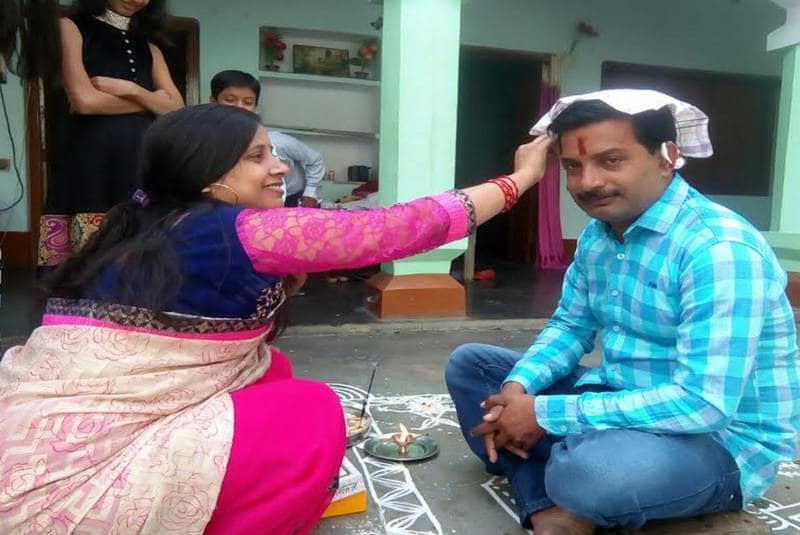
According to Maithil tradition, sisters invite their brothers on Bhaiyaduj. It is customary for the brothers who go to accept the invitation to bring new clothes, ornaments and clothes. At home, the sisters make aripan, i.e. a quadrangular circle, with Pithar (Arava rice flour dissolved in water). After that, there is a tradition of washing the feet with hot water by placing the brothers on wooden poles and keeping them in the corner.
After that, it is customary to give pithar, betel leaves and betel leaves to the brothers who spread the rings and apply the seven-color tika. After the ritual is completed, the sisters sing a song with the wish that the speed and fame of the Ganga and Yamuna will remain with their brothers.
During this process, the method of letting the siblings chew dried bananas is called ‘gravel feeding’. Maithil community experts say that hard banana seeds are called ‘Bajri’ comparing them to thunderbolts. According to Anita Sharma, a female social leader of Jaleshwar Municipality-5 Parsa, this method expresses the wish that the body of the brother will be strong and hard as thunder.
After the puja ritual is completed, the brothers put new clothes, ornaments and cash dakshina on the sister’s anchal. After that, the sisters complete the festival by serving sweets to the brothers. For the worship of this festival, the auspicious date of Dwitiya Tithi is determined on the basis of Mithila Panchang and Vidyapati Panchang.
There are other festivals in Mithila which strengthen the intimacy between brothers and sisters. The story of Rakhi festival celebrated on the moon full moon is also connected with King Bali and his sisters Ganga and Yamuna. Similarly, the Samachkeva festival celebrated from Kattik Shukla Panchami to Purnima is believed to be based on the story of love, affection, dedication and sacrifice between Lord Krishna’s son Samb and daughter Sama.