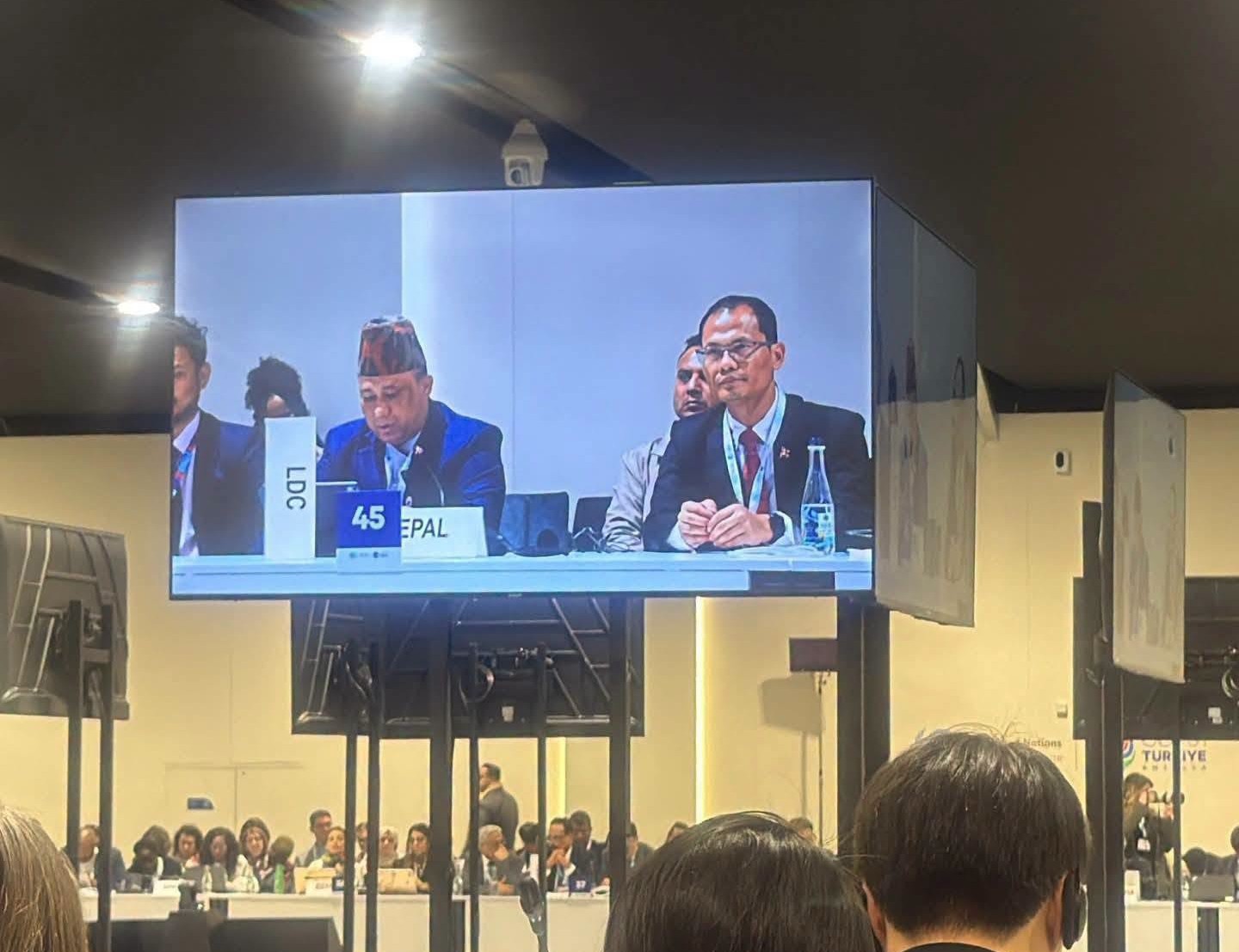
Antalya (Turkey). Foreign Minister Shishir Khanal has said that climate adaptation is not only limited to technical or environmental responses but is also a matter related to climate justice.
Addressing the ‘High Level Dialogue on Adaptation’ held on behalf of the least developed countries (LDC) under the United Nations Conference on Climate Change (COP-31) in Antalya, Turkey, Foreign Minister Khanal said that the least developed countries that contribute the least to climate change are the most affected by its growing and serious effects.
“Adaptation for underdeveloped countries is not just a technical or environmental response, it is also a matter of climate justice. Although our contribution to climate change is the least, we are the most affected by its growing and serious effects”, he said.
During his speech, Foreign Minister Khanal discussed the human and economic damage caused by the recent disasters caused by climate change in Nepal and made it clear that the countries that are at risk of climate cannot wait for further delay for climate action. He mentioned that the underdeveloped countries are continuously advancing local-level and human-centered adaptation efforts through the National Adaptation Plan and emphasized that such national efforts should be supported by international climate finance and support.
He said that international support should be available in accordance with the changing national needs of countries that are particularly vulnerable to climate change and are lagging behind in the race for development. Foreign Minister Khanal pointed out the need to transform the commitment of underdeveloped countries to increase financial support for climate adaptation into a clear, credible and implementable process. In addition, he emphasized that access to climate finance should be made simple and easy.
Foreign Minister Khanal said that according to the global framework for climate resilience (UAE Framework for Global Climate Resilience) and the Belem Adaptation Indicators, adaptation work should be accelerated at the national and international levels. He mentioned that priority should be given to adaptation measures conducted under the leadership of local communities, and emphasized that the capacity of local organizations should be strengthened and communities at the forefront of climate risks should be empowered to determine their own adaptation priorities and areas of investment.