
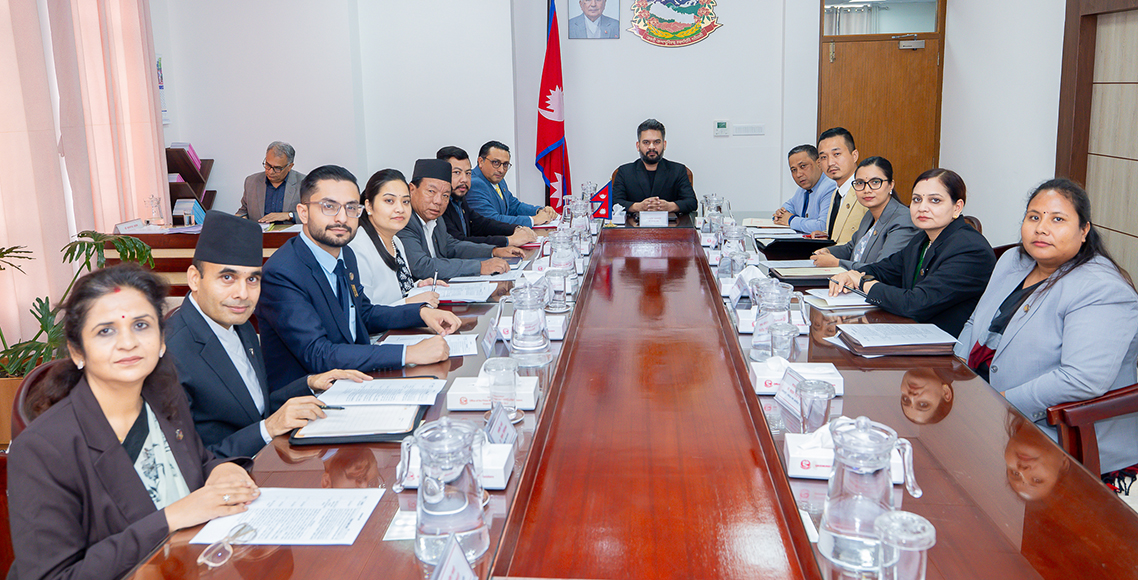
Kathmandu. The government has approved the ‘National Advertising Policy, 2083’ with the aim of making the advertising sector systematic, transparent, responsive and modern technology friendly.
The policy, which was approved by the meeting of the Council of Ministers held on Thursday, pointed out the need to bring social media, digital platforms, influencer marketing and advertising through the use of artificial intelligence (AI) under the scope of regulation along with traditional media.
The government has brought a new policy keeping in mind the growing international competition in the advertising market, the influence of multinational companies, the rapid expansion of digital technology and the need to provide accurate information to consumers. In the policy, it is mentioned that enhancing the competitiveness of local products, creating jobs from the advertising sector, increasing revenue, protecting the rights of consumers and controlling content that is obscene, violent, gender discriminatory and has a negative impact on children. In addition, it is mentioned in the policy that factual and misleading advertisements will be brought under the scope of action and compensation will be provided to the consumers in case of damages.
The government has set a target to significantly increase the contribution of the advertising sector to the Gross Domestic Product (GDP) within the next five years. A policy has been adopted to develop and expand the advertising sector, make the business clean, competitive, dignified and transparent and ensure that consumers have the right to choose quality goods and services. For this, expansion of advertising market, scientific classification of media, effective monitoring and regulation of advertising, coordination between stakeholders and building of institutional structure have been prioritized.
According to the policy, companies that provide special concessions for advertisement of domestic goods and services and companies that sell foreign goods and services will have to spend a certain portion of their turnover on consumer awareness programs. It is mentioned in the policy that the investment made in advertising will be linked with the tax system, the minimum price will be encouraged to be published and special incentives will be provided to the areas that are lagging behind in advertising.
The government has adopted a policy of discouraging the tendency to present advertisements as news and news as advertisements. It has been mentioned that necessary legal and regulatory arrangements will be made to prevent positive or negative news from being published or broadcast based on whether or not the advertisement has been given. Likewise, there is a policy to end the practice of showing other promotional expenses in the name of advertising expenses.
The most important aspect of the new policy is the regulation of digital advertising. The government has adopted a policy of making mandatory self-declaration in advertisements through social networks, digital platforms and influencers. It is said that ‘deepfake’ advertisements created by AI will be legally regulated. Advertisements that are misleading, untrue or have a negative impact on consumers will be strictly controlled. It has been mentioned that in case of damage to consumers, compensation will be provided, while consumer education, public awareness and advertising training will be made nationwide.
In order to maintain the quality of advertisement, the government has put forward a policy to make the self-regulation mechanism, code of conduct and action system effective.
The policy has also given special priority to social justice. Provision will be made that advertisements that discriminate against any class, caste, religion, language, culture, community or gender will not be allowed. It has been arranged that advertisements should be created in such a way as to respect gender and sexual minorities, persons with disabilities and backward communities. In addition, it is mentioned that advertisements that attack Nepal’s sovereignty, national flag, national anthem, national identity and religious tolerance will be completely prohibited. It will also be prohibited to use disasters, grief or sensitive situations for commercial purposes.
The government has adopted a policy of extensive reforms in the government advertisement distribution system. An integrated information management system will be developed to make government advertisement distribution and payment process transparent. Arrangements will be made to publish and broadcast local and state-level information and advertisements through the media of the same level, while public interest advertisements will be distributed in a proportionate and fair manner. Arrangements will also be made to support local language, culture and community-based media through advertising.
Under the institutional arrangements, the union, state and local levels will jointly implement the policy. The advertisement board will be developed as a more autonomous, empowered and resourceful body. Provisions have been made that advertisement monitoring and regulation committee can be formed in the province and municipality advertisement committee can be formed at the local level. Also, it is mentioned in the policy that a National Advertising Council will be formed for monitoring, regulation and self-regulation of advertising. In order to make the advertising market transparent, an integrated information system, information bank and classification and classification of the media will be arranged.
For the implementation of the policy, extensive amendments will be made to advertising laws, regulations, codes of conduct and procedures. An advertisement fund will be established and money received from the government, fees, advertising transactions and various agencies will be deposited in it. Advertising market development, research, statistical system, information bank, media classification, consumer awareness and capacity building programs of advertising professionals will be conducted from this fund. It has also been arranged that the Ministry will review the policy every year and the policy will be reviewed every five years.
After the implementation of this policy of the government, it is expected that there will be significant changes in digital regulation, consumer protection, government advertisement distribution, media classification, advertisement transparency and institutional development of advertisement industry in Nepal’s advertising market. In particular, the provision of clearly regulating advertising through social networks and artificial intelligence for the first time has created the basis for restructuring the advertising market in a new way.