Bhadrapur (Jhapa). The main market of Jhapa is changing. Along with the increase in the addition of commercial buildings, hotels and residential structures, commercial activities and urbanization have also intensified, but the necessary infrastructure for disaster management has not been expanded according to the changing nature of the market. The condition of the basic infrastructure needed especially for fire control is the same. Even though there is a fire hydrant system, there is a problem in fire control because there is no system (fire hydrant point) to fill the fire hydrant from the water pipeline that can be filled immediately.
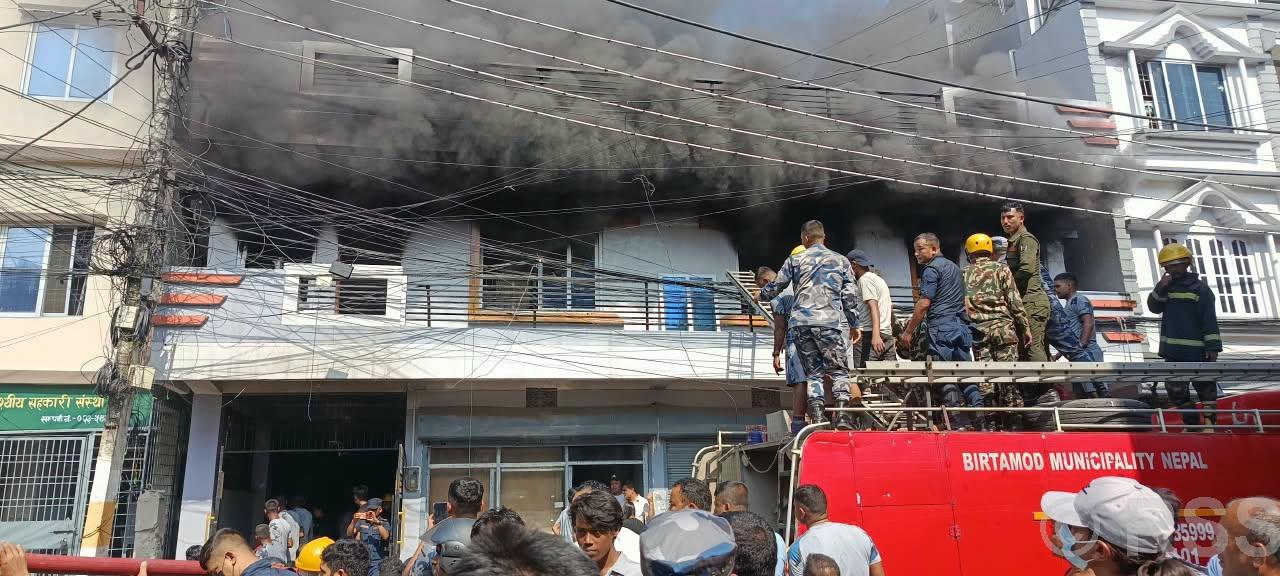
An example of this was seen when a two-storey house of Rajesh Mandal caught fire on Wednesday morning near Siddharth Hotel located in Birtamod Municipality-4. Although seven fire engines of the district were mobilized to control the fire, it was too difficult to arrange water. The fire, which was brought under control after five and a half hours, caused damage worth around six million rupees.
The firemen who reached to put out the fire could not find a certain source of water nearby. Some fire engines reached Buttabari to fill water while some had to go to Birtabazar. The problem was further compounded when the power supply to the water filling motor was interrupted. It also took time to fetch water from the hole inside the Buttabari tea garden. Finally, the swimming pool of the nearby Siddharth Hotel became the source of water for the fire brigade. After the hotel management gave permission to use water, the fire brigade continued to extinguish the fire by drawing water from there.
According to Uttam Khatri, the manager of the hotel, the fire brigade extinguished the fire by drawing water from the pond, and the hotel also added water to the pond.
According to Navin Meche, fire brigade in-charge of Birtamod municipality, about 50 percent of the total water used in fire control was supplied from the swimming pool of the hotel. He says that it is easy to fill the fire brigade with water because there is a water source nearby. “Because the swimming pool of the hotel is near, it was easy for the fire brigade to fill water many times. If they did not get water from there, it would have taken a long time to put out the fire,” Meche said.
This incident, where a private hotel’s swimming pool provided significant support in fire control, has shown how necessary it is to have a water source for public purposes in the market area and easy access to it by the fire brigade.
Increasing fire incidence
Small fire incidents are happening everyday in Jhapa. According to the statistics of the District Police Office, 19 fire incidents were registered in the district last August and October. Due to that incident, there was a loss of Rs. 10 crore 78 lakh 92 thousand 975. In August, seven fires caused damage worth Rs 12 lakh 10 thousand, while in October, 12 incidents caused damage worth Rs 10 crore 66 lakh 82 thousand 975. Especially due to the big fire in October, the amount of damage is significant.
District Red Cross Society Jhapa President Lokraj Dhakal says that fire control infrastructure should also be expanded along with the expansion of the Dhaka market. According to him, tall buildings, commercial establishments and dense settlements are increasing in the market area, but the necessary water infrastructure for fire control has not been expanded accordingly. “It is not enough to reach the fire brigade to put out the fire, it is also necessary to have enough water near the scene,” said Dhakal. He emphasized that water sources including public ponds should also be managed in such a way that they can be used for fire control.
There are no fire hydrants in three major cities.
Birtamod, Bhadrapur and Damak, the major urban areas of Jhapa, do not have fire hydrants that can easily fill the market area with fire engines. In the absence of such a system, the fire brigade has been facing problems in filling water as required. There is a situation where you have to rely on the motor, nearby creeks, canals or other available water sources. In Bhadrapur municipality, the fire brigade has been filling water with a four-inch motor installed in the municipal premises, but there is a problem in the operation of the motor when there is a power cut.
According to Toila Mardi of Bhadrapur city police, if there is a fire near the municipality, the fire engine will reach the scene by filling it with water. If there is a fire in a distant area, there is a compulsion to find water from drains and ditches. “If the place of fire is close to the municipality, we will come to the municipality, if it is far away, we have to rely on drains and ditches,” Mardi said. According to him, there is no fixed source from which the fire brigade can immediately fill the crowded markets and squares of Bhadrapur with water.
The situation in Damak Municipality is also the same. There is no fire hydrant in the market area. According to Roshan Tamang, fire engine driver of Damak municipality, ward no. Although there are water filling stations at 3 and 4, they are far from the market area. In the municipality, there is a system for filling water with a three-inch motor. In case of power failure, the motor is operated from the generator. “There is no fire hydrant in the market area that can be filled with water by the fire brigade. The same problem happened in Birtamod on Wednesday. The fire was extinguished by drawing water from the hotel,” said Tamang, “If we had to go far to fill water, it would have taken more time to control the fire.”
Access to the fire brigade is also a challenge
Fire service is not available in all local levels of Jhapa. Only the main urban areas of the district and some local levels have fire stations. Although there were two in Mechinagar and three in Damak initially, they are in partial operation due to repairs and damage. Birtamod, Bhadrapur, Gouradah, Shivasatakshi and Arjundhara municipalities also have fire service. Of the seven rural municipalities, only Kamal rural municipality has a fire station.
In Jhapa Rural Municipality, Kachankawal and Gauriganj in the southern region where there is no fire brigade, fire brigade has to be called from Birtamod, Bhadrapur or fire department. When the distance is far, there is a risk that the fire brigade will take time to reach the scene and in the meantime, the fire will spread and cause great damage. The local level not only has to spend on the purchase of fire engines, but also on its regular maintenance, management of drivers and firefighters. Since manpower has to be mobilized around the clock, its management has become a challenge for small local levels.
Chief of Arjundhara Municipality, Baldevsingh Gomden Tamang, says that controlling fire incidents in the main urban area of Jhapa is becoming a challenge. According to him, there is a need to revise the policy regarding building construction in urban areas. He informed that the process of purchasing a new fire engine has been initiated as the old fire engine of the municipality is damaged and the repair costs will be high. He said that a new fire engine is expected to arrive within the next two months. “We have prepared to arrange a hydrant for the fire brigade in a certain location by coordinating with the water supply organization,” Gomden said.
In order to easily provide water for the fire brigade in Birtamode, the Small Urban Water Supply and Sanitation Consumer Organization has prepared for the installation of fire hydrants. According to Meghraj Bastola, president of the organization, there is a plan to arrange water filling in places where the fire brigade can reach Birtamod Chowk, Charpane and Buttabari. “Before this, fire hydrants were placed in some places. There was a problem during the construction of the road,” said Bastola, “now we are preparing to place them again in different places.”
Although the hydrants installed earlier were affected during the construction of the East-West Asian Highway, the organization said that preparations are now being made to re-manage them, but the organization has not been able to publicize a clear deadline regarding when its connection will be completed and how many places the service will be available. District Disaster Management Committee Chairman and Chief District Officer Shravan Kumar Pokharel said that coordination with the local level will be done to manage water resources and infrastructure for fire brigades in major market areas of the district. “Easy availability of water is important for fire control. For that, we will coordinate with the local level and take necessary measures,” he said.
Along with the expansion of the market, as commercial and residential structures are added, it seems that the same attention should be paid to reducing the risks associated with it. Disaster management is not only the deployment of fire engines after a fire, but also the preparation of water resources, infrastructure and human resources necessary for fire control is an important part of it. By arranging public pools, water tanks and fire hydrants, the situation of having to spend time searching for water during a fire can be reduced.
Manish Dahal, campaigner of ‘Sunder Shant Nepal’, says that urban development should not be limited to building physical structures only. According to him, along with the expansion of the market, the security of citizens and measures to reduce the damage caused by possible disasters should also be included in the development plan. He said that the provision of water resources and infrastructure needed for fire control should not be an afterthought, but should be planned from the beginning.
“Along with the development of the city, the safety of its citizens should also be ensured. Instead of looking for water sources only after a fire, arrangements for public pools, water tanks and fire hydrants should be made in various places in the market. Rather than preparations after the disaster, preparations before the disaster can prevent major damage,” said Dahal. The swimming pool of the hotel helped to solve the problem at the time of Birtamode fire. But in order to end the situation of having to rely on the water of a private structure for every fire, it is necessary to expand the fire control infrastructure along with the development of the market.