Arghakhanchi. Bhairava dance is established as the original cultural heritage of Arghakhanchi, which is connected with the religious faith, cultural identity and tradition of the Newar community.
This dance, which is presented with the sound of traditional baja, attractive costumes, special rhythm of seven rhythms and religious rituals, has been highlighting not only the cultural heritage of the Newar community, but also the social harmony and cultural diversity of the district.
The Bhairav dance, which has been preserved for generations, is a common cultural identity of the Newar community living in different parts of Arghakhanchi. The Newar community living in Patuwathum of Sandhikhark Municipality-1, Divarna of Ward No. 12 and Nuwakot and Lattebanj of Bhumika Sthan Municipality-8 have maintained the tradition of performing this dance in different years.
This year, Nuwakot Bhairav Samaj of Bhumikasthan-8 has performed a dance. Neva society Arghakhanchi-Rupandehi has also demonstrated it in Butwal. Both societies have performed Bhairava dance at various places including Sandhikharka.
Bhairava dance has its own rituals and time limits. In Arghakhanchi, it is customary to perform this dance starting from Shri Krishna Janmashtami till Kattik Aunsi.
According to Rajkumar Shrestha, the coordinator of Arghakhanchi Bhairav Dance Protection Committee, there is a local belief that the Bhairav dance should be immersed before the Madal of Deusi-Bhailo is played. It elevates dance beyond mere entertainment and links it with religious faith and traditional discipline.
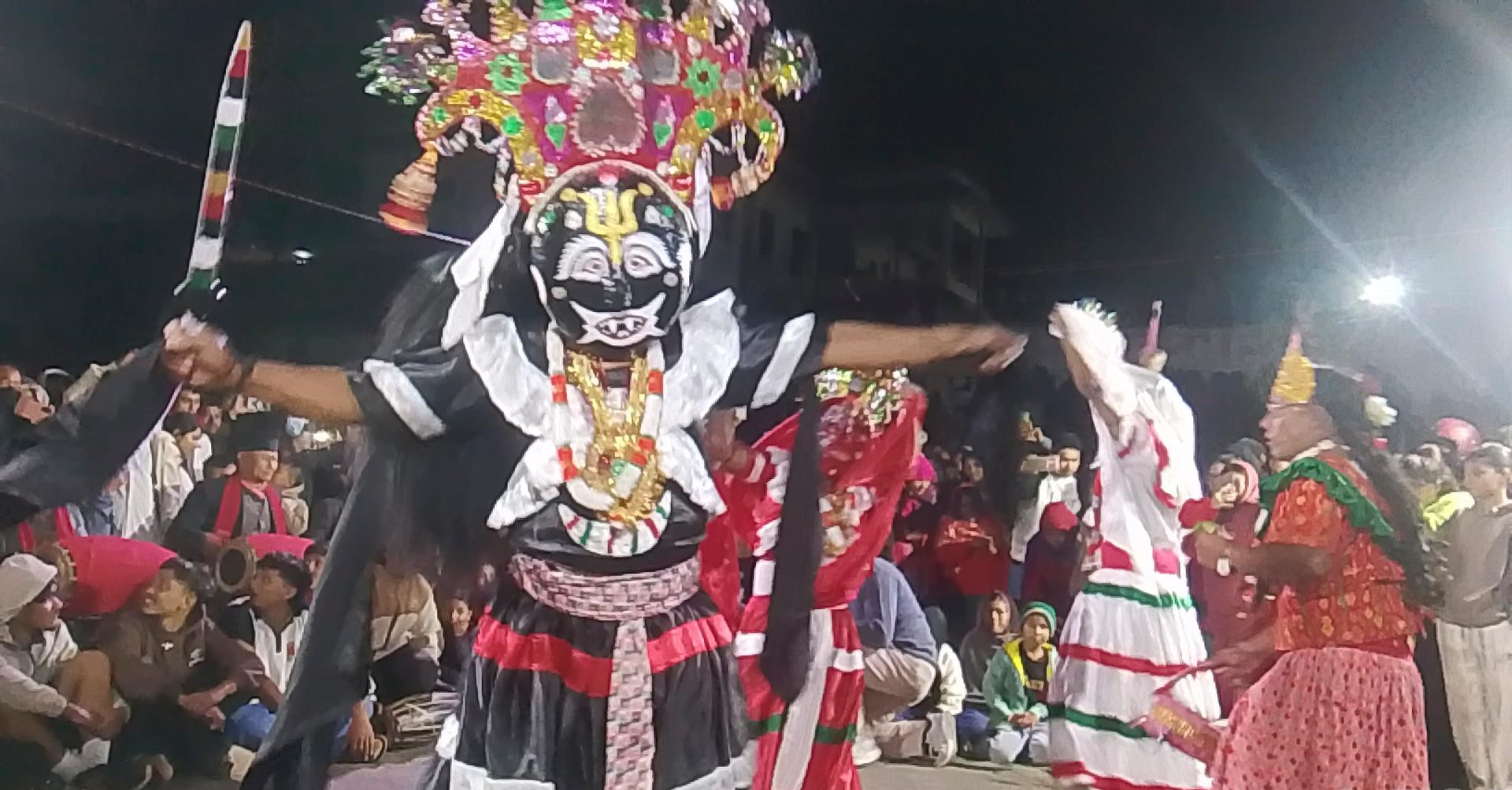
In Bhairava dance, Kaal Bhairava is presented as the main character while Shweta Bhairava and Rakta Bhairava remain as supporting characters. Along with them, the role of dankini ie dancer is also important.
Different colors, makeup and clothes are used according to the character. According to tradition, the artist who assumes the form of Bhairava is decorated with khwapa, i.e. skull, special clothes, garlands and leather. There is also a tradition of using the tail of a chawri cow as leather.
These costumes and ornaments make the dance visually attractive and also reflect the religious significance of the character. Although there are some changes in the makeup materials and the use of new materials over time, the community is aware that its original form and religious beliefs should be preserved.
Coordinator Shrestha says that there is a tradition of worshiping artists dressed in the form of Bhairava as symbols of God. Before starting the dance, worship is performed according to Tantric method and then the performance proceeds according to the prescribed rhythm and tradition.
Another distinctive aspect of this dance is the rhythm of seven beats. Bhairav Naach, which is usually danced to seven talas, has a different tempo and presentation of each taala. According to Kazi Shrestha, Vice President of Arghakhanchi Industry and Commerce Association, a lake lasts for about 10 minutes. Then another tal is started after a short rest. As all the seven rhythms have their own characteristics, the harmony between the dancer and the instrumentalist makes the dance more attractive.
According to Krishna Prasad Shrestha, the town head of Sandhikhark municipality, kheen baza i.e. Mirdung is used as the main instrument in Bhairav dance. Apart from this, instruments such as jhurma i.e. cymbal, sahanai and dhankuri are played. The originality of the dance is reflected when the movement and rhythm of the dancer match with the specific tune of this instrument.
Although it is a tradition that the main instrument player belongs to the Newar community, people from other communities also participate as assistant instrumentalists. This also expresses the cultural cooperation between the communities, according to the mayor Shrestha.
Religious and Tantric methods are given special importance in Bhairava dance. According to local folk belief, Bhairav descends on the fifth and sixth lake to a person who is perfect in Tantric knowledge. Locals believe that in such a situation, not only the dancers but also the audience work.
Since there is a belief that mistakes in rituals and worship can lead to damage, special precautions are taken from the preparation of the dance to immersion. This faith and discipline has given this dance a distinct identity from other entertainment performances.
The Bhairav Naach program includes religious performances as well as entertainment programs. Performances like Lathi Naach i.e. Takundoli, Ghoda Naach, Chara Naach and Lahure-Lahureni Naach make the program more interesting. With this, local artists get the opportunity to showcase their art and also help in the preservation of various traditional dances and skills.
According to Madhav Shrestha of Sandhikhark municipality-1, although Bhairav dance is a historical and popular dance of the Newar community, its popularity has spread beyond the boundaries of the community.
Thousands of spectators are present to watch the Bhairav dance organized at Tundikhel in Sandhikhark. In addition to the Newar community, there is a significant participation of people from other communities to watch the dance.
Bhairava dance is popular in various districts of western Nepal. Apart from Arghakhanchi, traditional dances related to this are also performed in areas like Palpa, Baglung and Dailekh. There is a difference in its style and presentation depending on the place.
Such traditions, also known as Kalika Naach or Lache Naach in some places, reflect the cultural diversity of western Nepal. According to Shrestha, coordinator of Bhairav Dance Protection Committee, Bhairav Dance of Arghakhanchi is also popular in Gulmi, Pyuthan, Palpa, Kapilvastu and Rupandehi.
Efforts made by communities who have moved away from their birthplace for employment, business and studies to preserve their original culture are also noteworthy.
An example of this is the Bhairav dance performance performed by the Newa society Arghakhanchi-Rupandehi in Butwal this year. Such programs help the new generation to familiarize themselves with their cultural history as well as to maintain relationships and affinity between communities in different locations.
However, due to changing lifestyles, modern means of entertainment and interest of the new generation, the continuity of traditional culture is becoming more and more challenging. It is not enough to perform the Bhairava dance once a year to keep it alive.
He argues that it is necessary to teach the new generation about the related religious practices, knowledge of the seven rhythms, skills in playing instruments, the art of making costumes and the historical background.
By documenting the knowledge of senior citizens and experienced artists in the community through written, audio-visual and digital means, it will be easier to transfer the tradition to future generations.
By increasing cooperation between the local level, cultural institutions, leaders of the Newar community and the youth, opportunities can be created to provide information about local culture at the school level and to create opportunities for regular practice and performance.
Arghakhanchi is an important district in terms of natural beauty, historical heritage and religious places as well as original culture. Systematic promotion and conservation of Bhairava dance can also contribute to the promotion of cultural tourism in the district. But it is said that it is necessary to respect it not only as a means of attracting tourists but also as a heritage of religious faith and historical importance.
The characteristic forms of Kaal Bhairava, Shweta Bhairava and Rakta Bhairava, the rhythm of seven talas, the sound of traditional instruments and the tantric rituals of Bhairava Nach are the hallmarks of Bhairava dance. This tradition, which has been preserved by the Newar community for generations, is progressing today with the participation and support of other communities. Its preservation will not only contribute to the continuation of a dance, but also to the preservation of Arghakhanchi’s historical identity, social harmony and cultural diversity.