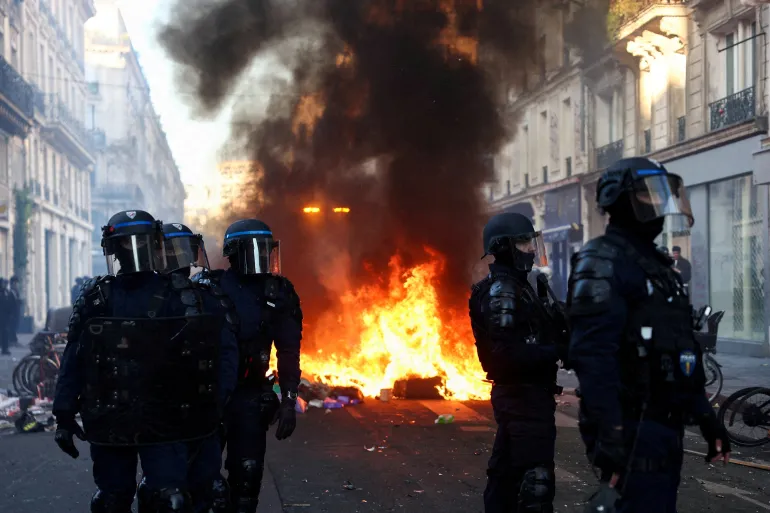
Paris. Nearly two months after secondary school students first began protesting against dilapidated classrooms, protests in France show no sign of abating. Since mid-September, more than 1,700 demonstrations have been held in 31 European countries under the leadership of France against rising prices and the cost of living.
According to the French Ministry of Interior, 146,000 people protested across the country, including 46,000 in Paris on Saturday. However, the trade unions claimed that 250,000 people participated in the country and 75,000 people in Paris.
Police fired tear gas and batons at protesters in Paris, although the number of participants was down from previous weeks. Also, police fired tear gas canisters at hundreds of people blocking the streets in the center of Lyon, France’s third largest city. About 70,000 security personnel were deployed on Saturday, days after an estimated 575,000 people attended a rally organized by the union.
The range of protests has widened to cover issues ranging from high fuel prices to wages and social housing. Looting and violence have also broken out during the demonstrations in some places. The police, who used barricades, tear gas and batons against the protesters, have been accused of using excessive force. Al Jazeera has mapped where violent protests have taken place across Europe.
The demonstration began in France
According to a statistical analysis of Armed Conflict Location and Event data, more than 1,200 demonstrations and riots involving 100 or more people took place across France between September 15 and October 30 over education, public services and the cost of living.
The protest began in mid-September in high schools, where students complained of overcrowded classrooms, teacher shortages and dilapidated buildings.
It soon turned into a protest against rising prices and was joined by trade unions and the yellow vest movement. During this time, there were riots and looting in some places. According to government estimates, more than 500,000 people demonstrated across the country on October 17 alone.
ACLED CEO Cleona Raleigh said on October 19 that the organization had recorded an average of 20.5 demonstrations per day in France over the past five years. “In the current performance cycle, this number has increased to about 66 per day, which is more than three times the normal rate,” she said.
According to Raleigh, typically demonstration cycles last about 20 days or larger movements 36 days. However, according to ACLED’s calculations, this movement has reached 45 days and is still going on.
“But the most notable difference is the level of encounters,” she said. A higher ratio was recorded only in the unrest that erupted after the death of Nahel Merzouk in 2023.
The response of the police has also been criticized. On October 28, four experts appointed by the United Nations Human Rights Council expressed serious concern over the excessive use of force by the French authorities to disperse student demonstrations.
“The ratio of arrests and detentions, affecting thousands of people, mainly minors, is disproportionate and discourages protesters from exercising their right to freedom of expression and peaceful assembly,” they said in a statement. A teenager lost his arm when a grenade exploded during clashes between school protesters and police in the northern city of Lille.
A wave of demonstrations across Europe
France is not the only country demonstrating. Since mid-September, protests against rising costs, low wages and a lack of public services have also erupted in 30 other European countries, from Portugal to Poland.
According to a statistical analysis by ACLED, between September 15 and October 30, more than 1,700 demonstrations and riots involving 100 or more people took place across Europe.
Alberto Alemanno, a professor of EU law and policy at the HEC Paris Business School, told Al Jazeera last month that while the protests in other countries have not reached the scale of France’s, it may be a sign that discontent is beginning to spill over. “France is the epicenter of this movement and now there are signs that it is spreading beyond France,” Alemanno said.
Which country has the most performances?
Although France led the protests, protests broke out across Europe at the same time over common problems such as low education budgets, rising costs and unaffordable housing.
According to ACLED statistics, between September 15 and October 30, there were more than 1,200 demonstrations and riots in France, followed by 173 in Spain, 160 in Italy, 70 in Germany and 33 in Portugal.
Tens of thousands of people demonstrated in Spain in early October after parliament rejected two emergency housing decrees on October 2. The parliament’s decision shocked the minority government of Prime Minister Pedro Sanchez.
There have been clashes with the police during demonstrations against the inflation crisis and expensive housing in Italy. Likewise, tens of thousands of demonstrators have marched in Portugal to protest against the crisis of inflation, low wages and the unaffordability of housing in major cities. Hannah Duggal/Al Jazeera