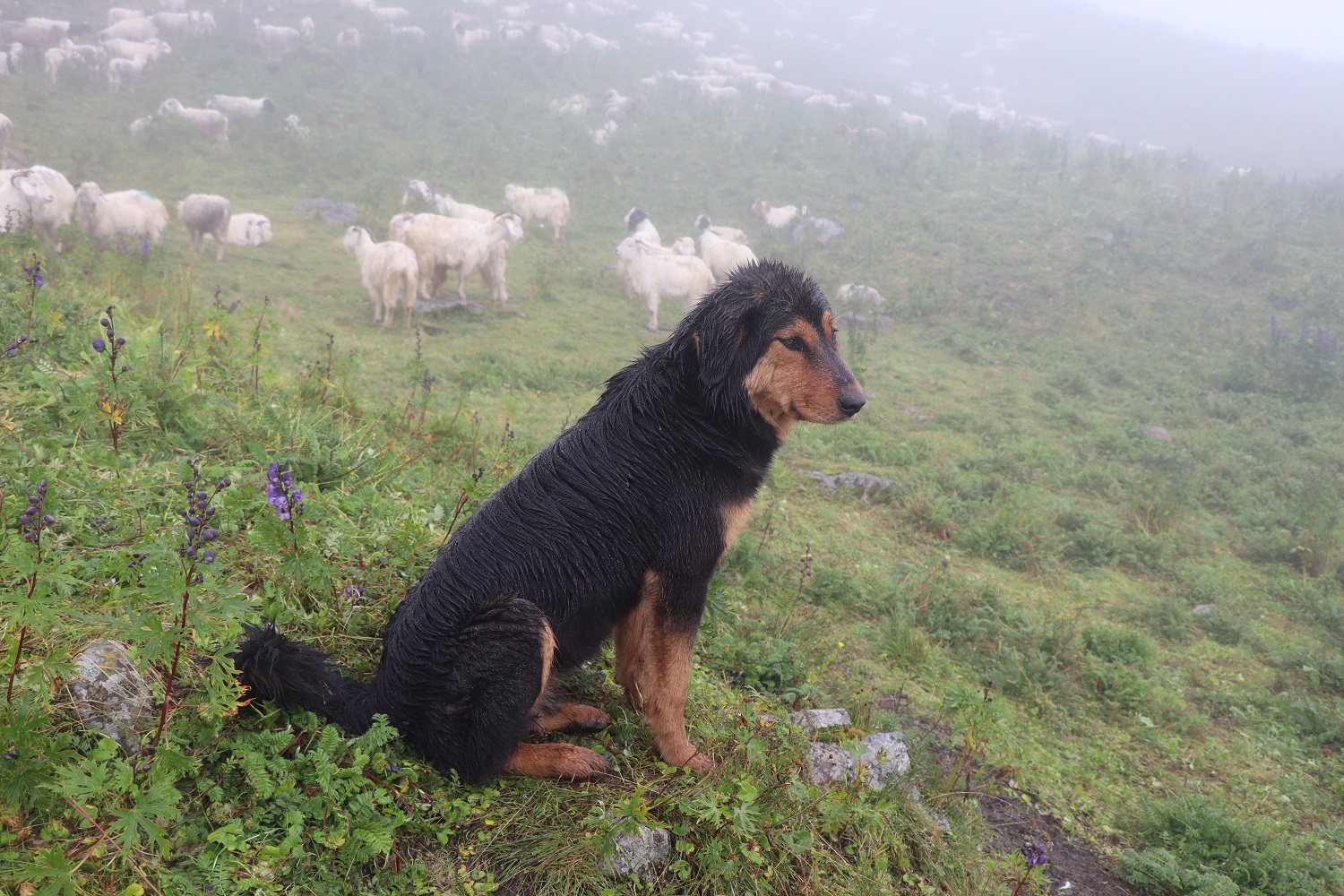
Myagdi. Him Bahadur Chantyal of Dhawalagiri rural municipality-5 Malkwang of Myagdi has five dogs in his shed. 50-year-old Chantyal, who returned from working in the United Arab Emirates (UAE) for 20 years, has adopted a ‘vote dog’ to protect the 600 sheep and goats on his farm.
“Dogs are not only pets for farmers who keep sheep and goats in dense forests, high mountains and harsh terrain for months, they are also reliable companions and security guards,” Chantyal said, “Dogs have been helping shepherds from taking care of hundreds of livestock to protecting them from wild animal attacks.”
Dogs have become indispensable helpers for the farmers who raise cattle in mobile sheds in Myagdi, Mustang and Dhorpatan areas. Asman Purja, a sheep breeder of Dhawalagiri rural municipality-4 Simkosh, said that although it is customary to keep dogs for fun and safety in city markets, it is both a necessity and a necessity for farmers to keep dogs to protect livestock in difficult hilly and mountainous areas.
According to him, shepherds here keep at least two hungry dogs with a tall body, weight of more than 30 kg and strong physical structure. “These dogs have the ability to quickly recognize the movements of wild animals, detect them by smell, and signal danger when they are frightened by sight. The pelts of such dogs are sold for more than 10,000 rupees each,” he said.
81-year-old Lalveer Tilija of Annapurna Rural Municipality-5 Paudwar has been rearing sheep for seven decades. In his experience, it is very difficult for shepherds to take care of hundreds of livestock without a dog. “Dogs with the characteristic of quickly hearing and detecting the movements of wild animals have made the shepherd’s daily life easy and safe”, he said, “If there are no dogs, the farmer will have to bear a lot of loss and suffering.”
Because there is a danger of leopards, wolves, bears and jackals in the forest, dogs act as guards of barns and livestock. In the evening, at night and in the morning, the dogs that stay around the shed and howl when they see a strange person or a wild animal, alert the shepherd by barking loudly. When necessary, it helps to protect the herdsmen by chasing and retaliating against the animals.
According to Tekjit Tilija, a farmer of Paudwar, dogs help to bring back sheep and goats that have gone far and also help to find lost animals. “Dogs help to find out where the animals have gone and keep the herd together”, he said.
Maniram Paija also opined that shepherd life is unimaginable without dogs. “When the animals are taken to graze, the dogs follow the herd. They do not allow them to go into trouble, they chase the animals back to the barn after dusk and they bark when they see wild animals. When they see animals like leopards, wolves and jackals, dogs bark to inform them and if they come to attack, they drive them away”, he said.
In the morning and in the evening, the dogs raised in the shed are fed with flour, sheep’s milk and meat. It is a tradition to keep a shed in one place for 10 to 15 days for animal grazing and then move it to another pasture. The dog that works with the shepherd is also accustomed to this lifestyle.
During the dry season, cattle herds that reached the foothills of Dhawalagiri and Annapurna Himals and Buki in Dhorpatan region have started moving down towards Bensi as the cold has increased. The Himalayan grazing area is called Khark, where the Buki and cattle sheds are kept. After eating nutritious grass in the lake, the herdsmen take their fattened animals and descend gradually with their household goods. In Myagdi, the tradition of increasing the fertility of the land with the manure obtained from animals by placing a mobile shed in the rice field is still alive.
The farmers of Gurja, Lulang, Lamsung, Khoria, Muna, Dar, Mudi, Khiwang, Faliagaon and Malkwang of Dhawalagiri Rural Municipality and Kuinekhani, Patlekhark, Mangalekhani, Chimkhola, Dagnam and Thadakhani of Raghuganga have been rearing cattle in the traditional mobile shed system. Similarly, the farmers of Dowa, Dana, Narchang, Paudwar, Sikh and Ramche of Annapurna Rural Municipality are also involved in this profession.
While the traditional mobile herd system is being challenged by modern lifestyles and job opportunities, the dog still remains an integral part of the herdsmen. These faithful animals that accompany shepherds on their difficult journeys through deserted forests and uphill and downhill have been playing an important role in the preservation and continuation of animal husbandry culture for generations. -Rasus