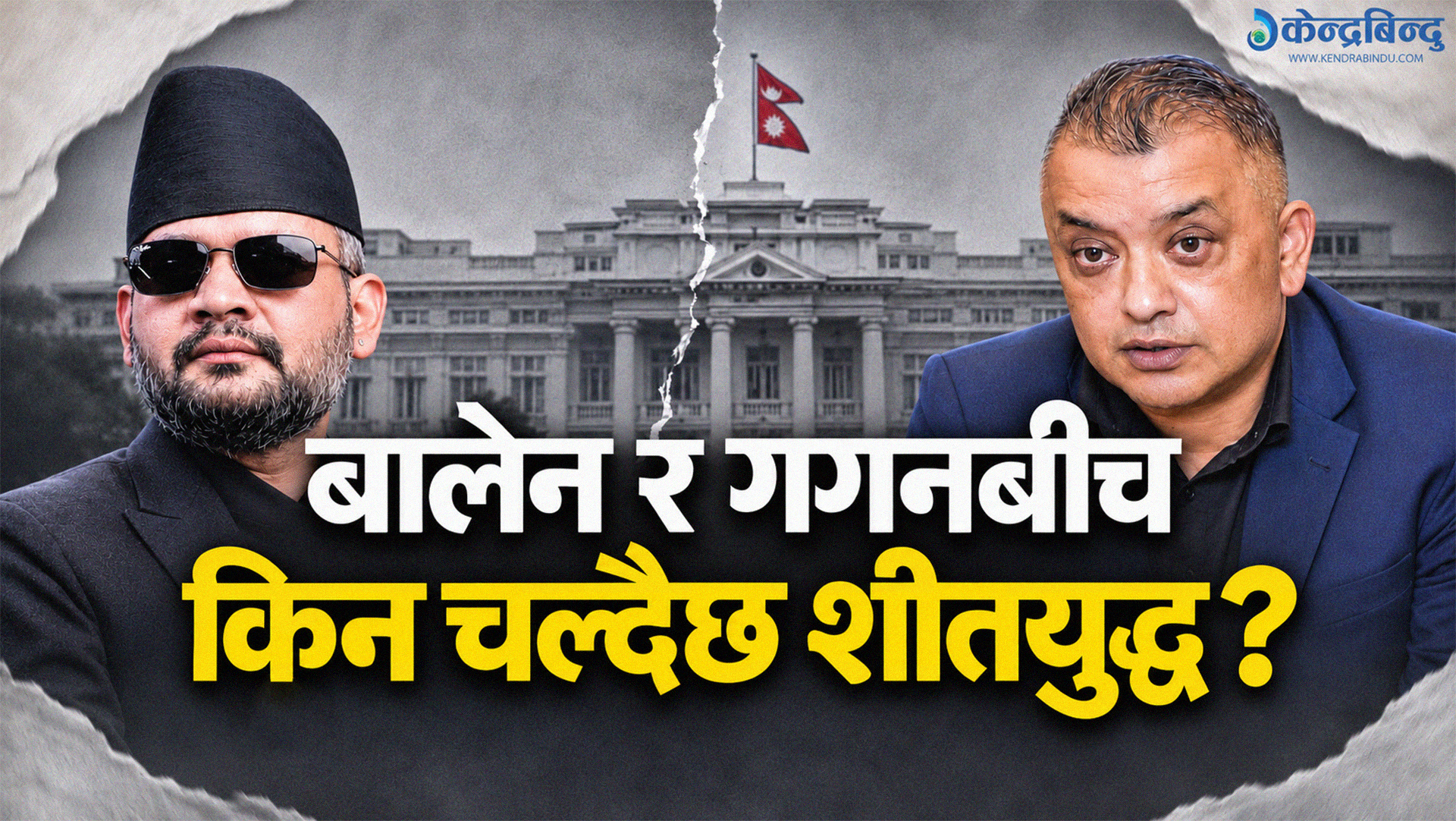
Kathmandu. A kind of political cold war seems to have started between Prime Minister Balendra Shah and Nepali Congress President Gagan Kumar Thapa in recent days. Looking at some recent events, public expressions, statuses on social media and controversial news that are being published one after the other, it can be analyzed that the relationship between these two leaders is not limited to general political disagreements. Behind this, the issue of power, organization, political future and who will lead the new generation seems to be connected.
After Thapa was elected as the President of the 15th Congress of Nepali Congress, a new debate has started in national politics. The demand for change of leadership and generational transfer has been rising in the Congress for a long time. By institutionalizing the same demand, new expectations have been created about the political direction and future of the Congress after Thapa became the leader. It can be analyzed that it has created a new wave not only within the Congress, but also in the political circles of the government and the National Independent Party.
The main reason for this is the possibility that the Nepali Congress under the leadership of Thapa will reorganize itself and make it the center of political attraction of the new generation. If the youth who are dissatisfied with the traditional political parties can be re-attracted to the Congress, it can have a direct impact on the political base of the RSVP. Because one of the main basis for the rise and expansion of RSVP was the popular dissatisfaction with the old political parties and the search for new leadership. But after the establishment of the leadership of the new generation within the Congress, the political dividing line between the old parties and the new parties has become a situation that can be changed to some extent.
Looking at the latest developments in order, it seems that the political environment has become more tense after the arrest of journalists related to the media. Thapa gave a special address from the central office of Nepali Congress the day after the arrest of journalists associated with various media houses related to the removal of IGP. In that address, he criticized the government’s working style and questioned the activities of the National Independent Party and the government. It has also been confirmed that the news was based on facts after the government dismissed IGP Dan Bahadur Shahi and appointed AIG Manoj KC as IGP.
This incident of Thapa’s criticism of the government should be considered important from a political point of view. Because after the establishment of the new leadership of the Congress, there were various speculations about how he would proceed with the relationship with the government. But his public criticism of the government after the journalist’s arrest has sent a message that the Congress is now trying to be active in the role of direct political monitoring and countermeasures against the government’s activities.
A few hours after this incident, a status of Prime Minister Balendra on social media created more buzz in the political circles. In the status written by the Prime Minister, there was an expression of intention that when the time is right, one or two people will not think that they will get exemption.
The Prime Minister did not mention anyone’s name in the statement. But because of the time, Gagan Thapa’s speech before that and the background of criticism of the government, there were those who interpreted it by linking it to Thapa. The political analysis that considered it to be a targeted speech was also published. The important question here is whether the Prime Minister’s speech was a message of general legal action or a reaction connected to the political events of the time? Although there is no official confirmation of this, the timeline of political events has given rise to various suspicions and interpretations.
Criticizing the government is the natural responsibility of the opposition in a democratic system. Likewise, it is the government’s responsibility to investigate and prosecute anyone involved in corruption or illegal activities. But it is the special responsibility of the government not to connect these two issues with political revenge.
A few hours after the announcement of the Prime Minister’s status, the news about Thapa’s statement that he had played a role in the process of obtaining the official status of the Nepali Congress was published in the Supreme Court. After that, the issue related to the internal dispute and leadership change of the Congress again came to the discussion of national politics.
About twenty-four hours after the incident, Thapa released another statement through social media, which was interpreted in political circles as a response aimed at the prime minister. The next day, the controversy took a new turn when the audio related to Inam Sapkota was released.
In this way, statements, news, statements and audios that have been published one after the other in a few days have brought the Balen-Gagan relationship to the center of political discussion. Behind it are important issues such as the political attraction of the new generation, the reorganization of the Congress, the political future of the RSVP, the functioning of the government and the balance of power in the upcoming elections.
For Balen, it is necessary to prove the claims of the new politics through the work of the government. For Gagan Thapa, it is a challenge to free the Congress from the old political culture and transform it according to the expectations of the new generation. Similarly, it is necessary for RSVP to establish itself not only as an alternative to traditional parties, but as an institutional political force that can deliver results.
Yesterday, youths who were disillusioned with the old political parties looked for new options. But today, after the new generation of leadership is established within the Congress, there is a possibility that the form of political competition may change. If the Congress under Thapa’s leadership can regain the trust of the youth, the RSVP should also pay more attention to its political strategy and performance.
Therefore, it is not enough to look at the relationship between Balen and Gagan in the current political developments. It has also raised the question of which direction the competition between the new and old powers in Nepal’s politics will go.
Ultimately, this competition is not just a matter of Balen and Gagan’s personal reputation. This is a topic related to the question of who will lead the new politics, who will win the trust of the youth and which power will be established at the center of Nepal’s politics in the future.