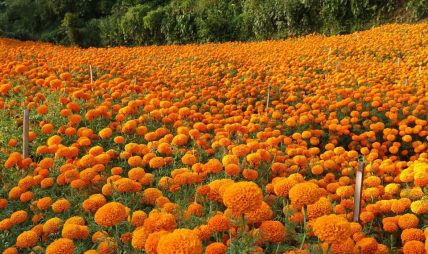
Damauli. The fields of Chimlishwara, Myagde rural municipality-4 of Tanahun, have now become pahenalpur with hundred-petal flowers. Even though the blooming flowers have enhanced the beauty of the field, the farmers are worried about the market. Confusion has increased whether the flowers will be sold after blooming before Tihar.
Due to the high demand of sayapatri during Tihar, farmers targeted the festival. However, this year, due to the delay of Tihar, the flowers started blooming soon after Dasain.
“Last year, Tihar fell early. The flowers also sold well. We could not deliver as per the demand”, said Jitmaya Rana, president of Chandeswari Fruit and Vegetable Farmers Group. “This time, Tihar is late. The flowers have started blooming after Dasain. I am worried whether the flowers will be sold until Tihar after a week before.”
Jitmaya’s concern is a common problem of 23 farmers belonging to the group. Buoyed by last year’s good income and market demand, farmers have almost tripled the area under flower cultivation this year. However, with the increase in production, the uncertainty of sales has also increased.
Farmers of Chimlishwara used to grow maize, mas and bodi in rotation. They have started collective farming since last year as they have to do a lot of work but the income is less.
Maize, leaving mass and flower cultivation
After seeing that flowers were being imported from abroad, their aim was to meet the demand of the local market by producing them in their own place and increase the income of the farmers. President Rana said that this year the cultivation was expanded after getting a good market in the first year itself.
Last year, the farmers planted hundred leaves in six plantations, this year they have cultivated in 16 plantations. Last year, the group earned Rs 450,000 by selling flowers at the rate of Rs 300 per kg. As the flowers could not be delivered as per the demand, this time the target has been set to sell flowers worth 1.5 million rupees.
“Last year the demand was high, we could not deliver the flowers. That’s why we have increased the cultivation this time”, Rana said, “But this year, due to the delay of Tihar, there is confusion about the flower market.”
Farmers’ access to market prices is poor
Apart from increasing the production, another challenge for the farmers is getting a fair price. Farmers who sold flowers to traders at Rs 300 per kg last year have shared their experience that the price increases when they reach consumers.
“We didn’t know how much to set the price of flowers. We sold them at 300 rupees per kg. The traders who bought flowers from us sold them to consumers at a higher price”, President Rana said, “If there was direct buying and selling between farmers and consumers, farmers would get better prices and consumers could also get flowers easily.”
Farmers have requested the local level to arrange organized haat bazaar or sales center. They expect that it will reduce dependence on middlemen and benefit both farmers and consumers.
According to Sansari Rana, treasurer of the group, floriculture was chosen due to low income from traditional farming. He says that even though he was excited by last year’s income and expanded the farm, this time the flowers bloomed faster, but he said that he was worried about the market and price.
Visera Rana, a member of the group, is also worried about the premature flowering and the possibility of rain. If it rains, the quality and sales of flowers may be affected, he said.
Floriculture, started collectively by 23 women of Chimlishwara, has become an example of local production and women entrepreneurship. However, the income of the farmers is not guaranteed only by increasing the production. Timely delivery of produced flowers to the market, proper pricing and direct contact between farmers and consumers are essential.
Now the hundred-leafed Dhakmak has blossomed. Farmers’ investment and hard work has blossomed. Whether it will take the form of income or wither due to lack of market will be decided by the Tihar market.