

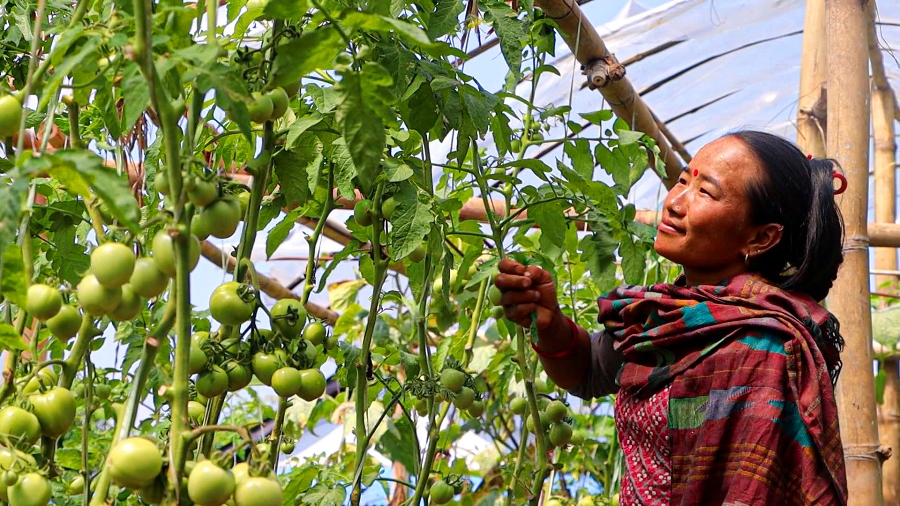
Dhorpatan (Baglung). Until three years ago, the women of Badigad were limited to working in the kitchen and in the fields. The rice, wheat, corn and millet cultivated throughout the year was not enough to eat for six months.
They had to rely on their husbands and family to buy bangles, bangles and general jewelry. But now they are not only cultivating food crops. In the fields that grow corn, millet and wheat, nowadays, Golbenda and Akbare grow a lot. Cattle tying sheds have been developed as modern cages.
Goats and goats seem to be happy when they are hungry in the cage. Women involved in commercial agriculture and animal husbandry do not have to depend on others to meet their general expenses. Although he had been doing traditional farming for twelve months, it was a problem to support the family. However, now there is no problem to support the family by growing seasonal and non-seasonal vegetables. Through the ‘Green Income’ program run with the support of Badigad Rural Municipality and other partner organizations, the women here are on the way to becoming self-reliant.
The green income program has been implemented in all 10 wards of Badigad since December 2080. The program has united the women of the villages and attracted them towards commercial agriculture and animal husbandry both collectively and individually. Gandaki Thapa Adhikari, chairperson of Badigad rural municipality, informed that 1,56 women from households joined the program and became entrepreneurs.
“The green income program has changed the lifestyle of the women here. In the past, we had to depend on others to meet common expenses, but now we earn our income with our own efforts,” said the president, “This program has started to alleviate poverty and make women independent.”
Entrepreneur Durga Thapa of Badigad rural municipality-1 said that the program has developed leadership and positive thinking along with income generation of rural women. He says that until last year, even vegetables were bought from the market and now the whole farm is producing Golbenda and Akbare. Thapa said that after training on vegetable farming, goat rearing and leadership development through the Green Income Program, his daily life has changed.
He said, “Earlier, our daily life was spent doing Chulochauko and other fairs, but now that situation has changed. Working in our own fields is very rewarding. Earlier, we did not have enough to eat for the whole year by growing corn, kado and papar. Now, the vegetables grown in that field are enough to eat for the whole year. We also get money to educate our children and run our household expenses.”
Through the program, advanced breed goats, goats, mini tiller plows, plastic tunnels were provided to the women. The women of Tunibot of Badigad-7 are wearing professional Akbare. The production and cultivation of Akbare Khusarni, which started last year, has now become widespread.
Kumari Roka Gurung, a local entrepreneur, said that after the women of the village were attracted to Akbarekhati, vacant land was also being used. He says that earlier, in the fields where one or two ears of corn and wheat were grown, they used to grow Akbare worth lakhs of rupees. Gurung said that local women sell Akbare from Rs 20,000 to Rs 1 lakh.
“The place is here, the field is here, we used to do farming in a traditional way, we had problems in earning a living while farming like that, but now we have learned the skills”, Gurung said, “Now we don’t have to go abroad for ordinary earnings, money is growing in our own fields. We can earn good money even by selling khusarni.”