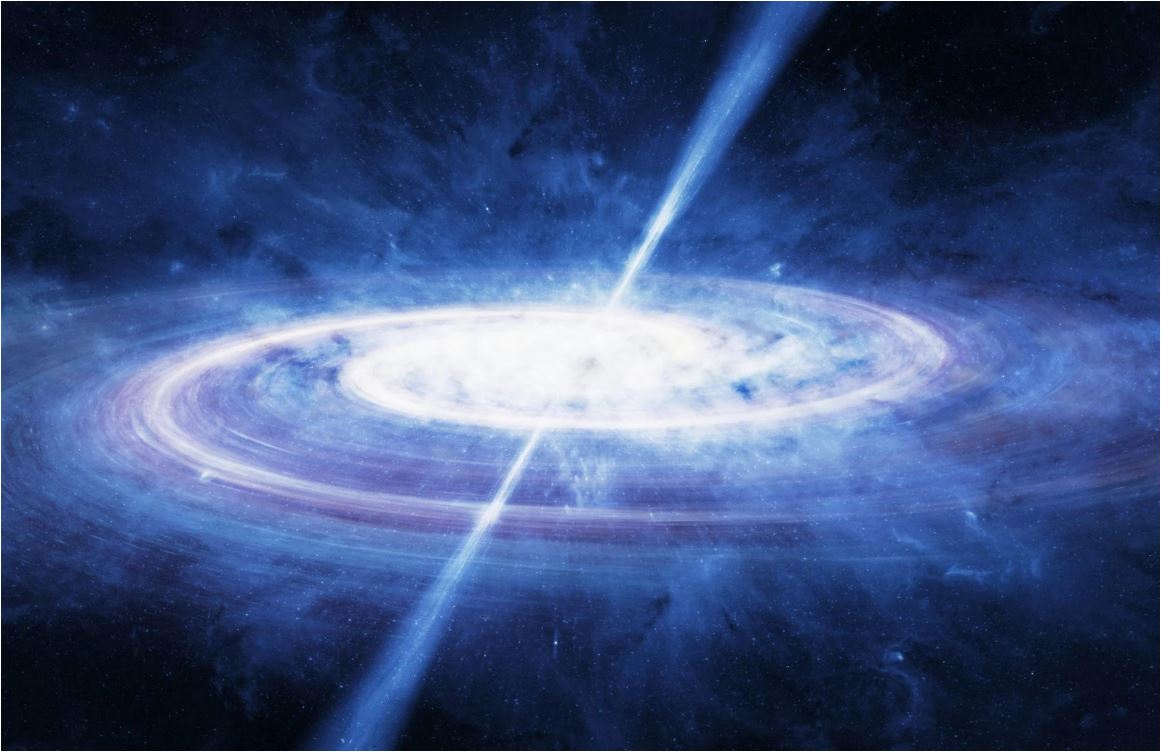
Florida. Scientists have discovered the most distant quasar ever, formed about 630 million years after the Big Bang, the origin of the universe. The giant black hole at its center has provided new information about the evolution of galaxies in the early universe.
According to the information released on Tuesday by the German-led research team, the quasar was formed at the beginning of the universe’s 13.8 billion year long history. This discovery broke previous distance and time records.
According to Julian Wolff, a researcher at the European Southern Observatory and head of the study, the previous two records pushed back the formation of the quasar by only about one and a half million years. But the new discovery has pushed that time back by about 40 million years. He called it the biggest progress in almost a decade.
The research team found the quasar while analyzing millions of observations collected by the European Space Agency’s Euclid Telescope. The Euclid Telescope, launched in 2023, is surveying galaxies to obtain information about dark matter and dark energy that play a role in the expansion of the universe.
According to researcher Wolff, finding a quasar in the early stage of the universe is a rare event. In addition, the exceptionally large size of its black hole and the fact that it is absorbing the matter around it at a relatively slow speed has become a matter of more interest. Scientists have seen it about 13.1 billion years ago. At that time, the age of the universe was less than five percent of what it is now.
Wolf named the quasar after Dun Onghasa, a prehistoric stone fort on the Isle of Aran in Ireland. His wife and daughter, Iris, were impressed by it when they visited the fort with their family. According to him, the fort, like the quasar, indicates a vast horizon yet to be explored.
The team’s findings have been confirmed by other observatories on Earth and in space, including Hubble and the James Webb Space Telescope. According to the information obtained from the web telescope, the mass of the black hole that provides energy to the quasar is about 360 million times more than that of the Sun. It has become a matter of surprise for the scientists that the size of the black hole is so large at such an early stage of the universe.
The final findings of the study have been published in the journal ‘Astronomy and Astrophysics’. Wolf said that the question of how a black hole grew to 360 million times the mass of the Sun in about 630 million years after the Big Bang calls for further research into the early universe.
According to him, the new discovery has set a new deadline for the study of the early universe. But he also expressed the possibility that this record could be broken by another discovery in a few months or it could remain for years. -ap